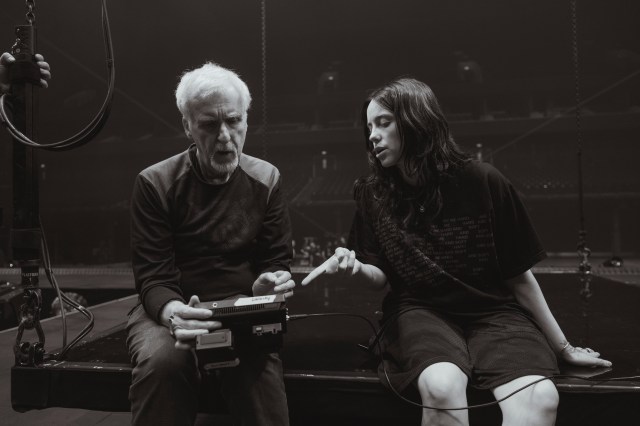
Pop’s most shape-shifting auteur is headed for the big screen, and she’s bringing James Cameron and RealD 3D tech. Billie Eilish has revealed the second trailer for HIT ME HARD AND SOFT: THE TOUR (LIVE IN 3D), a concert film captured during her sold-out global run and co-directed by none other than the aforementioned James Cameron (Avatar, Titanic).
Set to hit theaters May 8, 2026, via Paramount Pictures, the film promises a fully immersive experience, landing in Dolby Cinema, RealD 3D, and other premium large formats. If Cameron’s track record with spectacle is any indication, this won’t be your standard concert doc, with the tagline itself promising to “Reinvent the Concert Experience.” While concerts heading to theater are nothing new (Taylor Swift, Beyoncé, Metallica, BTS, etc…), the 3D formatting of the release and the household name Director seems to be (but let’s not forget Martin Scorsese directing The Last Waltz).
The project pulls from Eilish’s latest era, Hit Me Hard and Soft, a record that doubled down on her instinct for emotional whiplash. Translating the dynamic of that record into a 3D theatrical environment suggests a sensory-forward approach, blurring the line between live performance and cinematic world-building.
Tickets go on sale Thursday, April 16, with a newly released trailer teasing the scale and intimacy of the production. For an artist who’s consistently redefined the boundaries of pop staging and visual identity, HIT ME HARD AND SOFT: THE TOUR (LIVE IN 3D) looks poised to extend that vision into theaters. Check out the new trailer below.
March arrives with a noticeable throughline this month: hard hitting rock n’ roll — between long standing acts like Corrosion of Conformity, Foo Fighters, Modest Mouse and more recent buzz-worthy acts like Blood Command, Don Broco, and Drug Church, this list has it all. Whether it’s the arena-sized hooks of Des Rocs new heater or basement-born chaos of The Black Keys fresh cut, these ten tracks don’t sit still — they linger. Just the way we like them. Dig in below.
01:
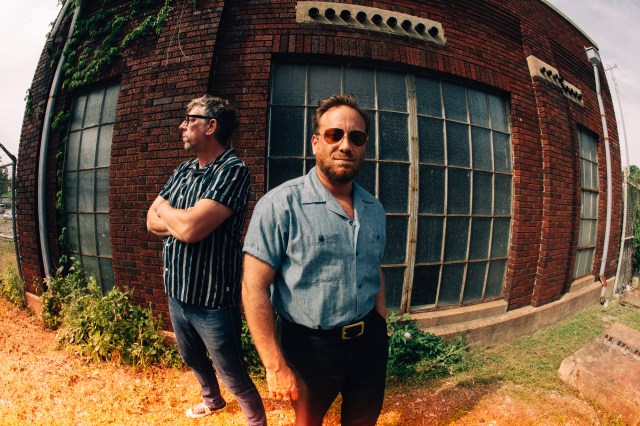
The Black Keys – Where There’s Smoke, There’s Fire
A slow-burn blues rocker that leans into the duo’s rawest instincts, this track trades polish for grit. Fuzzy guitar tones crawl under a simmering groove before erupting into a chorus that feels equal parts menace and release. It’s vintage Black Keys, but meaner. Their new record, Peaches, the fourteenth from the Nashville based duo is due out May 1st.
02:
Des Rocs – When the Love is Gone
A cinematic rock track that thrives on tension and an incredible hook. Minimalist verses explode into a towering chorus, with Des Rocs channeling heartbreak into something massive and theatrical without losing its edge. This is the new rock God at his very best… we can’t wait to hear what’s next.
03:
Foo Fighters – Caught in the Echo
Built on a driving, mid-tempo pulse, this song feels like a reflection piece without losing the band’s stadium DNA. Layers of guitar swell and recede as Dave Grohl delivers a hook that’s both anthemic and introspective. The Foo’s new album, their twelfth, Your Favorite Toy is out April 24th.
04:
Modest Mouse – Look How Far
Quirky, off-kilter, and quietly profound, Modest Mouse return with a slithery track that sways between jittery verses and an oddly uplifting refrain. Isaac Brock’s signature existential spiral is intact, but there’s a sense of hard-earned perspective baked into the chaos. Not just the bands first new song in five years, it’s also Janet Weiss, formerly of Sleater-Kinney’s first song on the drums for the Mouse.
05:
Dogstar – All In Now
After being inactive for more than two decades, Keanu Reeves spoked with NME about returning to the studio for their new record, also titled All In Now, saying “We couldn’t f***ing wait. Personally, I loved it all. For me, the attitude was like, ‘let’s work hard and let’s GO.'” The first single back itself is a healthy mix of Muse and Queens of the Stone Age. But no imitation here. These guys are in their own lane.
06:
Blood Command – Wet Death
Chaotic in the best way, this track jumps between punk energy and glossy, almost hyperpop-adjacent hooks. It’s abrasive, theatrical, and unpredictable… Blood Command’s signature style. Vocalist Nikki Brumen has been such a fitting replacement for Karina Ljone, now on her fourth release in just four years with Blood Command since joining up with Yngve’s never ending bag of riffs. Wet Death, their newest EP is out now.
07:
Don Broco – True Believers ft. Sam Carter
Hot off their last single featuring… Nickelback? Don Broco returns with another single from the recently released Nightmare Tripping. A high-energy track of the heaviest variety for the Don, it’s elevated by Architects vocalist Sam Carter’s unmistakable bite. The track thrives on dynamic shifts — melodic one moment, explosive the next — building into a chorus designed for crowd-sized catharsis.
08:
Drug Church – Pynch
Blunt, punchy, and packed with attitude, “Pynch” delivers its message with zero excess. Crunchy power chords and deadpan vocals create a track that feels both confrontational and melodic. Not that you’d expect anything less from Drug Church.
09:
Portrayal of Guilt – Human Terror
A heavy assault that doesn’t waste a second, “Human Terror” is pure sonic violence. Thick and filthy bass highlight a Korn-esque instrumental while harsh vocals hover over the track, bringing the feeling that it’s all collapsing in on itself. It’s oppressive and impossible to ignore. Did we mention Portrayal is a three-piece? POG’s new record, …Beginning of the End is out April 24th.
10:
Corrosion of Conformity – Gimme Some More
Southern sludge meets hard rock swagger here, with thick riffs and a groove that feels almost defiant. It’s a no-frills, high-volume track that leans on attitude over intricacy, and lands because of it. Hard to believe these punk-metal fusion guys have been going for over forty years but here we are… still going strong at that. Their new record, a killer one, Good God // Baad Man is out now.
Nearly 40 years into her career (38, to be precise, since her brilliant self-titled debut album), Melissa Etheridge is not only having more fun than ever, she is enjoying one of her biggest years yet.
She has a superb new record, Rise, including a duet with superstar Chris Stapleton, and a highly anticipated co-headlining tour with country icon Wynonna Judd. And the icing on the cake is she is nominated for the first time for The Rock and Roll Hall of Fame. Yes, 2026 is proving to be a very good year for Etheridge.
Most importantly though for Etheridge, she has found her sweet spot as both an artist and person. A wife and mother, Etheridge, who tells us, “I never thought I’d have a family,” is reveling in the balance of both worlds. The result is more fun making music as she explained during our hour-long chat.
Hit Parader: Congratulations on the Rock Hall nomination. Melissa Etheridge: Oh, that’s fun. Thank you.
HP: Who would be the dream person to induct you? And who would be your dream collaboration? Etheridge: You know what? Anybody who’s interested, really. But collaborations? It depends on who’s there. If Bruce is there, I would certainly always love to do something with Bruce. I’m hoping I can get Taylor Swift to come, and maybe rock with her. I’m hoping Sheryl Crow will be there. We could do something together and just whoever really wants to.
Photo: Candice Lawler
HP: I did interviews not long ago with both Chris Robinson from Black Crowes and Billy Corgan, who both now are around their late 50s, early 60s. We talked about the fact that when you’re in your 20s, there’s so much competition. But as you get older, they’re having so much fun with the sense of community that now exists because there’s nothing more to prove. And we had spoken in the past about the fact that when you were coming up, there was definitely that issue of pitting women against each other for radio for example. Etheridge: The truth back then was when I first went to radio with my first album, they would tell us, “Oh, I’m sorry, we’re already playing a woman.” And you’re like, “Oh, Jesus. So, there is really only one of us.” But it is so good not to be in that state anymore, to just be playing the music and not worrying that if I get it, somebody else won’t, or if they get it, I won’t, and there’s not enough. It’s really nice to just go, “Yeah, we’re just going to have some fun, and we’re all singing and playing, and we’ve all been blessed, and we’re great.”
HP: For all of you, this is just the natural state of life as you get older. Other things matter more. I love the fact that on your Instagram, you have it listed as “Mother, rockstar, activist.” as you get older, you realize it matters, but it doesn’t matter the way you thought it did when you were 23. Etheridge: Exactly, life is completely different from when I was 23. And that Instagram profile was actually written by my son years ago. I love that he put mother first. And I was like, “Oh, that means that he knows that I put that first.”
HP: It’s also nice to have that, for lack of a better term, separation of church and state, But I remember talking to Patti Smith, who’s as badass a woman as there is. And she was telling me that when she’s home, she’s doing laundry. That when she’s home, she’s mom. Etheridge: Yes, I make dinner. I’m not so good at cleaning. My wife does that a little better than I do. But life is number one, and your life is your family and your home. I never thought I would have a family. I didn’t think that was in the cards for me. And I had four children, and it’s surprising and very rewarding because I can walk off the stage when there’s always the end of the show. I can always go to my wife, I can always go to my children, I could always go home and that’s really good to know that I have all of that. It’s a lovely balance
HP: I’m sure it also makes music a lot more fun for you. Etheridge: Much more fun absolutely and now that my children are older, I don’t have as much separation fear like, “Oh. I’m not there for them.” None of my children have ever said that I’m not around enough, ever.
HP: So, when you’re making Rise, which is a wonderful album, is it so much less pressure internally? Etheridge: Definitely making this record was so much less stressful. There’s not that [pressure], “Oh, it’s got to have a hit. Where’s the hit? Where’s the rock radio thing?” I don’t think about that anymore. I just think, “Is this the best way to express this emotion that I’m thinking and feeling? Is this the best way to bring that about? Oh, how can I make this even more delicious?” And it was just amazing. Because I recorded here in L.A., I was home for dinner every night, and that was really fun, too.
HP: I’ve talked about this with so many people over the years. Cooking is so much like music in that once you get comfortable with it, there’s a creative freedom to it. You play with it and you’re improvising. Of course, when you start off, you’re following the recipes and then you get more comfortable and you go from following the recipe to feeling like John Coltrane. Etheridge: Exactly, that’s what I’ve done with my chicken recipes. I looked at them and I followed them and then I put a little bit more of this, a little bit more of that. Now I’m just improvising. I’m throwing all kinds of stuff in. That’s what life’s about – creating. I create in the garden, on the road, in the kitchen. I create wherever I go. That’s what it’s about – creating, building and moving forward.
HP: Then, as you get more successful, you get to create with different people and learn from them as well, like Chris Stapleton. I remember seeing a few years ago at a concert, blew me away. Even though he is considered “country,” I said, it’s exactly like seeing Neil Young in the 70s. Etheridge: Yeah, I think the genre labels are all messed up. I think we need to shuffle them up and start over again because you can’t pigeonhole people anymore. I was always very hard to put into a genre and so I just said rock and roll. But many people have said folk rock, country rock, midwestern rock, singer/songwriter. Nowadays there’s americana, country and outlaw country and they all sound like rock and roll to me, but okay.
Photo: Candice Lawler
HP: Talk about working with different people this time around. I’ve followed your career since the beginning and it’s very rare for you to do a duet? And I use the term duet because it makes me think back to like Marvin [Gaye] and Tammi [Terrell]. Etheridge: Yeah, that’s what I wanted. I didn’t want to throw some guy on my song and he’s singing harmony, and you can’t hear it. We went in and I wanted to write a song with him. I wanted him to feel like he was part of the song so that we could sing it together. And that’s the way it was written. We wrote it that way with the verses and the chorus and I love it. I love his voice and my voice together. There are times I can’t even tell whose is whose. I’m not a duet-y kind of artist. I haven’t done many. The ones that I have done, I’ve enjoyed with Bruce, with the few people that I’ve been able to collaborate with like that. But I have not done many at all. So, this was a big step for me, and I just love it. I’m really happy with it.
HP: You can know someone’s really cool, but it doesn’t necessarily mean that you’re going to have chemistry with them. So how did you know Chris was the right person? Etheridge: I just would listen. I didn’t know him, so I would listen to his music, and his writing spoke to me. But his voice, his understanding of blues, of gospel, of all that. We came from that same well. And I’d heard enough nice things about him that I felt confident that we could probably do something. I at least wanted to try.
HP: As you say, you haven’t done many. But the older you get, the more you loosen up. You want to try different things. One of my favorite quotes from Bruce is talking about the biopic. They asked him why he did the movie now. He goes, because I’m old. I don’t give a fuck anymore. Etheridge: I can understand. I’m very close to there. We’re so fortunate now we have audiences that will come see and people that are interested in our new music. But we don’t kill ourselves over it anymore and for that I’m very glad.
Photo: Candice Lawler
HP:As you continue to expand these new horizons, who else would you love to do duets with? Etheridge: Maybe because I was talking about him, I think of Don Henley. I feel like that would be like a really good one. I wonder how he’s doing. I haven’t talked to him forever, but Don Henley would be great. Steven Tyler was always someone that I would always say when people asked me, and I still haven’t been able to do anything, but there’s a possibility I will. I always wanted to work with Neil Diamond. He lost his voice, and I seem to be calling these artists up right as they’re unable to sing anymore. Glenn Campbell, I reached out to him right before he died actually. I would love to sing with Adele. What a great voice. Pretty much anybody who really wants to jump in and do a good song, I would be into it.
HP:I love the opening to “If You Ever Leave Me” because it feels so autobiographical and who knows if it actually was or not. Is it just fun to look back at this point? Etheridge: Oh, it’s fun. I loved everything I did. And I wouldn’t want to go back and do it because that’s just crazy, but, yeah, it was fun. I actually wrote that song as a joke to my wife. I was laughing and I said, “Honey, I wrote you a song.” And I couldn’t stop laughing. She’s like, “I’m not sure I want to hear this.” Then I sang the first line, “Rips in my shirt, spritz in my mullet.” And we just howled for a while. Then I ended up finishing it going, “I’m going to put this on the record because it’s just fun to play.”
HP:You look at the contrast of that with a song like “More Love,” which is such a beautiful song. They both come from the same place though of nostalgia and learning. Etheridge: Yeah, I like the album to be well-rounded like that. It did make it hard to do the sequence of the album, what was going to come before and after some songs, because you couldn’t go from a really sad to a funny song. So, I had to really work on that.
HP:We haven’t talked about the tour with Wynonna, who’s amazing. How much fun is it, going back to the idea of camaraderie, to be out on the road with someone who’s in a similar place, who’s a great artist, and someone you respect? Etheridge: I love that in the last handful of years people are finally going, “Oh, it might be good to have two women tour together. Maybe they could sell tickets.” I would have the hardest time before. Sheryl and I used to try to do it, and it was just hard to have people think that two women together on a bill would work. This is the first time I’ve toured with Y, and I’m really looking forward to it because there’s a crossover in that country rock area, and yet our fans are deep on both sides.
Rora Wilde feels like the lead character in a Netflix series. A “singer/songwriter/princess” according to her Instagram profile, Wilde was born and raised in a small town in Texas, a self-proclaimed “country bumpkin” who moved to L.A. to become a fierce, completely lovable and ferociously talented R&B singer. Hell, even the title writes itself – “From Country Bumpkin to Vixen.” I’d watch the hell out of that. Maybe Wilde, who released her empowering debut album, Vixen, late last year, feels like she is starring in the movie of her life because she has been preparing for this her whole life.
“I felt very much like somebody who always wanted to be on stage. I grew up acting, writing little skits, writing songs, making music videos that were not even being filmed, just pretending we were making a music video,” she says. “I was always in la-la land creating a world where I’m on the TV that I that throw on every morning at six a.m. and VH1 and MTV is showing all these music videos. In my mind I always was in those worlds and I just so badly wanted to be somebody who did that.”
When you are lucky enough to sit down with Wilde, as I did, you find that idealistic, adorable dreamer is still very much in there, even though as one would imagine, the transformation from awkward country bumpkin to gorgeous aspiring R&B diva has many bumps and bruises along the way.
“Maybe parts of myself I over sexualized. I started writing with people and producers that pushed me in a more sexual way and I was like, ‘Oh, okay, let me just play that part.’ I have a background in acting, I can do that, but it wasn’t authentic to me. I didn’t know what it meant. I didn’t know how to hold my own in that world because it’s something I never associated myself with. I associated myself with cello practice, rehearsal, playing the coffee shop and playing scales and singing,” she says. “And that’s what I knew. I didn’t know anything about dressing up, I didn’t put on makeup till I was like 24 years old.”
What type of series would Wilde’s story be, though if there wasn’t a triumphant comeback for our heroine? Of course there is the hero moment. That moment is Vixen.
“Vixen is my very pop R&B forward therapy session,” she says.
More importantly though, it’s where our fearless protagonist learns how to turn those youthful lessons into wisdom and experience.
“After crashing and facing a lot of consequences honestly from over sexualizing myself and letting certain collaborators do so I found my way from innocent baby to my own world and my own confidence and femininity, very much She-Wolf energy vibes,” she says. “I think every woman has a vixen inside of her and I wanted the album to be a playlist for confidence, accountability, sexy fun, girly pop and all that stuff. So, it was just really about finding my own confidence.”
Like any elite protagonist, Wilde is a richly drawn lead with complex and unexpected little eccentricities. My favorite of those is that mixed in with her deep admiration for acts like Erykah Badu, Kehlani and Lady Gaga is a mild obsession with the songs of Bob Dylan, who she even does a so-so but charming impression of.
“He is the storyteller of all storytellers. I’m obsessed, I just want to freak out and watch ‘Desolation Row and I even want to hear the JFK song [‘Murder Most Foul’], all of it, do it. He probably doesn’t even remember the whole thing. So, I’m going to give him a music stand with the lyrics. I love it. And whatever he’s going to do that night, the hit or the miss, I want to be front row. I will just be bawling,” she says excitedly at the prospect of seeing the Bard live this summer for the first time.
For Wilde, the idea of spinning a yarn, bringing people into the world she is crafting, is what unites the likes of Dylan and Badu, her dream artist to open for.
“I want to learn from her storytelling and her power on stage,” she says of Badu. “I don’t know how many times I watched or will continue to watch her live performance of ‘Tyrone.’ She was not only singing beautifully, it was stand-up comedy at the same time. She had everybody laughing and cheering, she had everybody right fucking there. I’d want to experience that live and just learn from it too.”
Because for Wilde, while she has that stunning and forceful R&B-tinged voice and her songs would feel right at home late at night in a dimly lit lounge or next to Sade, Barry White and Olivia Dean on your playlist, she is still, at heart, a storyteller herself.
“I think a lot of what I do live is storytelling. I want everybody to understand the songs that I’ve written in a way that they come to life in front of them and make them feel like I’m telling them the story in line for the bathroom. I want it to feel that way rather than it be this performance like a recital. I want it to feel like a story.”
Vixen is very much telling a story. Though not a traditional concept album like say The Who’s Tommy or Pink Floyd The Wall, Wilde programmed it to be an auto-biographical work, like a novel, or, well, movie/series.
“It’s very much chronological too, from beginning to end. So much of my confidence goes in a very specific direction. At the beginning I’m the very innocent baby girl who is over sexualized in ‘KISS,’ ‘After Party’ and all those very poppy records, ‘Girls Love the Beach.’ Then after ‘CTRL’ I get into this accountability and find my self-respect moment in ‘sober dead drunk or alive,’ ‘Say It’ and ‘Driveway.’ Then I end with ‘Sex, Drugs & Rock n Roll’ because that’s me owning all the parts of myself.”
Like any great movie or series there is that epiphany moment when the John Williams or Ennio Morricone score rises triumphantly and the audience, totally invested in the hero’s journey, shares that realization with them. For Wilde that epiphany is both a profound and moving one.
“I am still that awkward girl. I am still that nerdy kid, still first chair in cello, in orchestra and symphony,” she says. “I’m still there, but I’m also tapping into these new parts of myself. That’s why I feel like I’m not really changing. I’m just expanding my color palette because I feel like so often, we limit ourselves in our identities. That’s really another aspect of what Vixen is about, you don’t have to be one thing.”
If you were to stumble upon a rare copy of the Even Dozen Jug Band’s sole and self-titled album on CD, you’d find within the liner notes a revelation offensive to anyone familiar with Maria Muldaur’s work: that producer Paul Rothchild (The Doors, Janis Joplin) insisted she remain a backing vocalist, believing her voice “didn’t record well.”
I wonder now if Rothchild has eaten his helping of crow – because if Maria Muldaur’s voice doesn’t record well, whose would? Like many, I first heard Maria’s voice by way of her 1974 superhit, “Midnight at the Oasis”, and my first reaction was one of great envy. I trained as a singer myself, and I know that what Maria Muldaur brings to the table can’t be taught. I don’t mean to suggest that her talent was uncultivated, quite the opposite – listening to a Maria Muldaur record is a bit like watching an Olympic gymnastics performance: so many magnificent flips, glides, and twirls it could make you sick just witnessing it. But what her voice is, what lies beneath those years of practice and performance, is something superhuman entirely – that twangy, full-bodied tone is something you simply can’t learn, it’s something you’re born with. Maria was born with it.
In the sixty-odd years since the making of that record, her backing credits alone are noteworthy: you can find her on tracks with the Jerry Garcia Band, the Doobie Brothers, and Linda Ronstadt (she’s that voice which makes the haunting harmony possible on “Heart Like a Wheel”). Bob Dylan and Carly Simon were fans and friends during her ascent; Joe Boyd and Amos Garrett were frequent collaborators of hers. As for her own ventures, she’s released nearly fifty albums since 1969, including a two-album run with her onetime husband Geoff Muldaur.
Reading interviews new and old with Muldaur, I get the sense that she – and her voice – were critically underestimated all too often, usually because whomever was writing was distracted by her face. Find any account of Maria as a young woman, and it’s usually qualified by the phrase “I had a massive crush on her”; read any report of her live shows by a male journalist, and you’ll likely read more about her legs than her pipes. One NME writer dubbed it the “Muldaur effect”: Maria’s music was always second to her sex appeal.
Maria is, indeed, arrestingly beautiful. (If Julia Louis-Dreyfus’ heyday had coincided with today’s biopic craze, she could have easily depicted her.) She stands out in photographs, especially the one blessing the cover of Joe Boyd’s memoir White Bicycles (if you haven’t a copy, look it up – your eye will draw itself to the young girl lost in concentration). Promotional material for her early work has all the marks of a label eager to transform a singer into a sex symbol: one such photo features her full-haired and half-dressed in a field, a dark-haired homegrown beauty with a sultry expression. One gets the sense, looking at her 1974 Rolling Stone cover, that her it factor oozed from her pores, too.
But it’s always a shame when a talented woman is reduced to a pretty face, and doubly so when that woman’s oeuvre holds the key to the genesis of a genre. Maria Muldaur was Americana before Americana had a name; she combined the blossoming traditions of early R&B and blues music with a roaring country-queen sensibility. Her early track lists prove a dexterity across the then-stiffer dividing lines of genre – particularly her first record, which reels you in with a rollicking version of “Any Old Time” and sends you home with “Mad Mad Me”, a gentle, dark ballad fit with a string arrangement. Her second record, Waitress in a Donut Shop, achieves a similar effect as it attempts to balance its even-tempered, hymnal tunes among the funky and full-throated ones. Experimentation became a trademark of her style – later, her 1979 record Open Your Eyes featured a few bona-fide rock’n’roll tracks, which she performs as masterfully as she does any bluegrass tune. Jazz and gospel were no strangers to her, either, particularly after the turn of the century.
By her own account, Muldaur’s mélange of music styles is the natural product of her environment. She grew up in Greenwich Village in the fifties, where she was fed a steady diet of country and bluegrass music; she supplemented her musical knowledge by tuning into R&B stations, where she came to revere pioneers of popular music like Muddy Waters and Ruth Brown. Her jug band tenure – first with the Even Dozen, later with Jim Kweskin’s band – came by accident: she was plucked from a crowd of wannabe chanteurs in Washington Square Park by blues legend Victoria Spivey, who happened to be advising a group of young male musicians across the park – Spivey suggested that they needed a woman’s touch and laid her eyes upon Maria. (Last year, Muldaur released an album of Spivey’s songs entitled One Hour Mama.)
In 2021, Muldaur told Jazz Weekly that it was Spivey who first encouraged her to exercise her sex appeal on stage: “‘It ain’t enough to go up there and sound good; you’ve got to look good, too’’’. Those were two things that came naturally to Maria and defined the spirit of her early performances. But as Muldaur grew into her solo career, she eventually took her sex appeal off center stage. In 1978, she told a Rolling Stone reporter asking about her depiction as a sex object that she “didn’t mean for this to happen” – and her track lists throughout the years reflected that sentiment, swapping balmy ballads for theatrical, gospel-inspired tracks.
That was quite a drastic change from Maria’s foundational identity, particularly in a market where mainstream sex appeal can make all the difference for a solo female artist. Perhaps it was really this shift – coupled with a move away from the Hollywood bustle to a secluded life on the shore of the Bay Area, where she raised her daughter, Jenni – which allowed Maria Muldaur to fall out of the limelight. But Maria never lost her magic: as she aged, so too did her voice mature, and later recordings of her evidence years of dedication to her craft.
I’ve been searching for a word to describe that magic since I first heard Maria’s voice, something other than it; it turns out that Linda Ronstadt did the work for me. In the 1974 book Rock’n Roll Woman, she tells Katherine Orloff that Maria Muldaur was her favorite woman in music:
She’s the only girl I can think of, who doesn’t sacrifice an ounce of femininity for what she does…Maria does in fact succeed in a man’s world on a man’s terms without… becoming masculine in any way. She’s always feminine, and it doesn’t mean that she has to be receptive and passive and do what she’s told, and always come on like a sexpot or anything like that…I think that’s the ideal of being an equal in this world.
Ronstadt has it exactly right. Maria’s magic wasn’t in her sex appeal, not quite – it was in her femininity. It was that ultra-feminine quality of hers that had her ushered into the Even Dozen by Victoria Spivey, and it’s carried her to the top of the charts and beyond. A little bit of YouTube digging will turn up performances of Maria’s over the years: her and Dr. John promoting “Three Dollar Bill” on the Midnight Special in 1974 are particularly fun to watch. You can find recent performances, too – she still performs in the Bay Area today. There’s one such video from 2012, where she sings her version of “I’m a Woman”. When you watch her command the stage the same way she did forty years prior, you can still see it. I realize, watching her dance, that Maria Muldaur’s magic really can be that simple: that voice is all woman.
Ask one hundred artists their current favorite song or album they created and at least 95, and maybe more, will answer either the last one or the next one. Artists, by nature, detest looking back. That is a universal rule among musicians, which makes the latest record by iconic British band Squeeze, the beloved duo of Glenn Tilbrook and Chris Difford, such an anomaly.
When every other artist is focused squarely on the future, the pair went back to their roots for the superb new album Trixies. A concept album about a fictional club, the songs date back to 1974. The whole album was written then, but not recorded until more than 50 years later.
We spoke, in separate interviews, with both partners of one of the most acclaimed songwriting duos in British music, about revisiting the music half a century later, about their summer tour, future plans and more.
Photo: Dean Chalkley
Hit Parader: Were there songs on this record that surprised you at how true and relevant they still are 50 years later? Glenn Tillbrook: Going back and examining the songs, the thing is, we always thought they were good. But I think the other thing about them is that they really sound like the time that they were written. They are so much a product of what our songwriting was at that time, which was just absorbing everything we were listening to and instantly regurgitating it back out again. It’s that process where it just happens by osmosis. You listen to all this great music. And what we did was to turn up versions of music that we liked.
HP: But, what’s so interesting about it is, for example, a song like “Don’t Go Out in the Dark” feels like it was written for these times. It’s amazing that a song written for a fictional club 50 years ago, because literally it’s a song that you would give to your kids today. Tilbrook: Yeah, I can’t explain that. It works so well now, and it sounds contemporary, and yet it sounds like 1974 to me.
HP: When you look at these songs so many years later, can you see how these songs written at the beginning of your career influenced later songs you wrote? Tilbrook: Can I just return to “Don’t Go Out in the Dark”? Because honestly, that’s the only song on Trixies that I sort of rewrote. And here’s why. Because the song, the vocal tune, we recorded it. I’ve got a guitar here. I’m just going to play it to you how it was. It was a little bit cliche, it’s like that’s all it is for the verse. So, we recorded it, and then the chorus. That’s all it was. I had the vocal tune, and I just thought, “I’m going to put different chords behind the vocals, just fool around with it,” and it sounded much nicer to make it. And then with the chorus opening out, the basic structure still was there, but I feel like on that song, we had a good producer who said, “Why don’t you try just a few different chords and it’ll really bring the song out?” all the other songs, we didn’t have to do that too. But it was such a pivotal moment to recognize, “OK, we can’t be absolute, this is exactly how it was. Because with that song, the tune is the same, but the chords are different.”
HP: I talk about this with people all the time. You write a song when you’re 20, and, of course, 50 years later, it’s a different song because you’ve had a whole life, and you bring associations to it. So, you were willing to put that new experience into it? Tilbrook: Yes, totally. But really, it’s amazing that out of the 13 songs, that was the only one that really needed help. The thing about all of Trixies, we had Owen Biddle working on production, and I did some of that too. But we had all that experience to bring to the songs that we wrote, but we didn’t change the songs. Knowing how to arrange the instrumentation is where all the experience comes in.
HP:You guys just announced a killer show at the Hollywood Bowl here in LA. Are you guys excited to finally get to do Trixies live 50 years later? Tilbrook: It’s so exciting to do that because we’re going to start rehearsing next week and trying to work out doing it all as one thing. We’ve never thought about doing that with any record before, but if any record deserves it, I think it’s this one. I’m a little nervous about what people will think, but I think we’ve got to, we’re going to at least try it out and see if it works and take it from there.
HP:Are there songs on this album you’re particularly excited to see how the audience responds to them live? Tilbrook: Yeah, totally. We’ve been doing “You Get the Feeling” live and we’ve also done “Hell on Earth.” I’m really interested to do “Why Don’t You?” Because that’s a song that there’s not very much to it, but it’s very compelling for some reason. I think it’s an earworm in the best possible way and I think that’s the most 60s influenced pop plus a little bit of Sparks and I was obsessed with tangos at the time. The last tango song I wrote before abandoning that was “Take Me I’m Yours,” so that was hanging around for a few years.
HP:Are there songs you’ve written over the years that you’ve been surprised by how the audience responds to them? Like I spoke Graham Nash about “Our House” and Daryl Hall about “Sara Smile” for a book I wrote, and we discussed how they were such simple personal songs written about one person each that became anthems because everyone craved the feeling you get from those songs. So, have you felt that? Tilbrook: That’s very complimentary. “Sara Smile,” for instance, is magic to me. The most charming, beguiling person you’ll ever meet is contained in that song. And what a mood to create. Graham Nash has been one of my biggest influences, the harmonies that I do. Half the time I imagine I’m Graham Nash and what would he do? All right, obvious question.
HP:What one Graham Nash song do you wish you had written and why? Tilbrook: “Sleep Song,” from Songs for Beginners. Just such a beautiful, simple song. And he plays with melody over essentially a very simple chord structure. I’m sure you’ve heard from people over the years that you have the same effect on people who have been such fans of your songwriting.
HP:Are there artists you have heard from who you were surprised were fans? Tilbrook: That’s a really easy question. I met Questlove, and he was obsessed with a song that we did for Argy Bargy called “What the Butler Saw.” And Questlove was obsessed with that song when he was a kid. And he said, “I’ve never heard a song like that.” I was so pleased that he liked it because I love that song. Not many people heard it because it was pushed off of Argy Bargy.
Photo: Dean Chalkley
HP:Are you still enjoying it as much as you ever did? Chris Difford: It’s a different kind of experience. When you’re young and you don’t have any fear and you’re in the back of a van touring around, you experience it from that angle. But when you’re older, I’m 72 this year, I’m taking it a little bit slower because I have to. And I have to respect that. My time here is limited in a way because my youth, if you like, has been and it isn’t here. When you’re young, you never think you’re going to reach 30. Then when you’re 30, you think you’re never going to reach 40. Then when you’re 72, you don’t know if you’re going to reach 80 or even 73. So, you’re aware of time a little more than you used to be.
HP:What’s the fruit down at the bottom that tastes good? Difford: The new album and having people like Owen Biddle produce it. That’s the fruit that I feel very grateful for.
HP:There’s always been an audience for you and here in LA you’re playing the Hollywood Bowl, a venue The Beatles and The Doors played in. Difford: Yeah, we played it before. I’m really looking forward to playing it, and I think it’s time that we play places like that. I think it’s about time that we came on to a bigger stage and performed Trixies and whatever else we’re going to do.
HP:Were you surprised by how well the record holds up? Difford: Yeah, of course I am. And I’m very grateful for it. I think it sounds amazing. Everybody that was involved in the record has done a great job, all the musicians. I think it’s exactly how I dreamt it might be.
HP:Is it how you dreamt it might be when you started revisiting it? Or is it how you dreamt it would be in 1974 when you started it? Difford: When we started rerecording it last year, really. In 1974 I had no idea what it would sound like and I’m extremely pleased that it sounds this good. But that’s because it’s been in very good hands. It’s a real steppingstone from the past into what might or might not be the future.
HP:Were there songs in particular that you were surprised that they felt, for lack of a better word, prophetic? Difford: I had no expectations of any of the songs and what they would end up being like. But when I sat in the room where they were being recorded with the band and every beat and every time we got to a new song, I was thrilled. It just felt fresh and new, even though it was 50 years old.
HP:When you guys started rerecording it, did it feel like this was the right time? Difford: It just did. We could put another album out full of songs, but there would just be another album full of songs. Everybody does that. Nobody does this. This is the first time I know of that a band has gone back to the beginning and created something as ambitious as this.
HP:When you do new material, it can put older songs into a new context. So, on this upcoming tour, are there songs that you’re really looking forward to revisiting? Difford: That’s all to be discovered. I don’t really know what it’s going to be like. If I go and see a band and they perform 43 minutes of a record I’ve never heard before, I’m going to have to really think about it. But I remember going to see Elton John perform Captain Fantastic. That was a whole album that he played from beginning to end. It was such a brilliant, brilliant album. We’ll go on stage, we’ll perform it, it will sound good. And I’m hoping that the audience will be able to embrace the risk that we are taking.
HP:You say it’s a theatre piece. Since it is a whole concept, is it something you would ever want to see made into a theatrical piece or something else? Difford: Yeah, completely. That would be a passion of mine, without a doubt, to see it, to hear it on stage as a play. I could retire just seeing that.
Squeeze’s new record Trixies is available everywhere through BMG and Love Records here.
The GRAMMY-nominated electropop duo took their DJ set to higher ground during an exclusive outdoor concert at L.A.’s Franklin Canyon Park, in partnership with activewear brand Beyond Yoga.
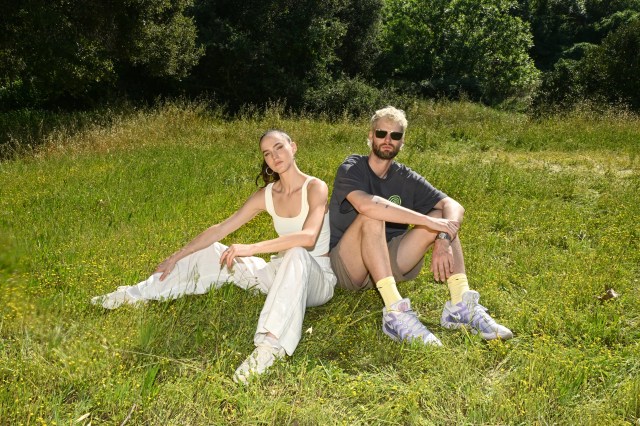
BEVERLY HILLS, CALIFORNIA – MARCH 21: (L-R) Tucker Halpern and Sophie Hawley-Weld of SOFI TUKKER pose as Beyond Yoga celebrates the Spring Equinox with “Seek Beyond: Open Air” featuring SOFI TUKKER at Franklin Canyon Park on March 21, 2026 in Beverly Hills, California. (Photo by Vivien Killilea/Getty Images for Beyond Yoga)
Few things give such a rush as the hours before and at the concert: last minute outfit and makeup touches, having everything perfectly organized in your size-abiding bag and finally pulling up to the state-of-the-art venue where the lights flash, the sound is amplified and you’re surrounded by faces of fans who’ve waited months — even years — for this fleeting instant. But after experiencing an afternoon set drenched in the heat of the day from SOFI TUKKER at a woodsy, tree-shaded amphitheater in Franklin Canyon Park, perhaps the euphoric feeling can be experienced just as heavily from being fully immersed in nature, sublime sound and not fussing over the small things.
In an exclusive, yet very fitting partnership, the GRAMMY-nominated duo joined forces with active lifestyle clothing brand Beyond Yoga to spearhead the company’s multi-year initiative: Seek Beyond. Described as championing “growth, joy, and progress over perfection,” there was a fluidity and creativity to the event that allowed everyone to let their guard down and, by all means, go with the flow.
BEVERLY HILLS, CALIFORNIA – MARCH 21: (L-R) Sophie Hawley-Weld and Tucker Halpern of SOFI TUKKER pose as Beyond Yoga celebrates the Spring Equinox with “Seek Beyond: Open Air” featuring SOFI TUKKER at Franklin Canyon Park on March 21, 2026 in Beverly Hills, California. (Photo by Vivien Killilea/Getty Images for Beyond Yoga)
Prior to Sophie Hawley-Weld and Tucker Halpern tackling the bright yellow Beyond Yoga-branded stage with an entire hour-long set chock-full of the hits that put them on the map, guests were first prompted to meet at a specific point in the park. Brand reps then encouraged “hikers” to follow the music, weaving past the lake, a turtle pond, and an installation of gold-tinged disco balls hanging from the trees before ending up at the activation tucked off the main road, where everyone was treated to a much-needed break.
With hearts pumping before the New York City-based duo even began their set, it was the perfect intermission, where Joe & The Juice replaced electrolytes lost along the trail, and if you were feeling fanatic, you’d be able to purchase special edition Seek Beyond merch from the Beyond Yoga truck out front. Not long after, the crowd migrated toward the amphitheater, slanting Colosseum-style toward the stage with split-log seating and leaning unapologetically into the word “campy.”
The opening DJ set already had the sea of influencers in neon yoga wear and diehard fans of SOFI TUKKER, who were among the lucky few to clear the over 1,000-person waitlist, in high spirits — despite the unseasonable heat of a Los Angeles spring day. It wasn’t long until we caught a glimpse of the unmistakable blonde hair and brunette beard of Halpern and the slicked-back ponytail of Hawley-Weld bobbing off to the side, and a low roar rippled throughout the audience.
With SOFI TUKKER exploding onto the stage — Sophie herself donning a white, monochromatic linen set from Beyond Yoga’s Spring 2026 collection — the pair got the crowd pumping with their 2024 hit, “Throw Some Ass,” which was physically represented by two incredibly talented backup dancers who moved with an ease that felt instinctive.
There was no better time to be wearing breathable, flexible activewear, as all four choreographically maneuvered the platform, including the very pregnant Malia, who was actually dancing for a party of two. If you looked out into the crowd, there wasn’t a still body in sight as SOFI TUKKER ignited with “Drinkee” off The Austin 100: A SXSW 2016 Mix album and their bouncy hit single “Pick Up The Phone.”
BEVERLY HILLS, CALIFORNIA – MARCH 21: SOFI TUKKER perform onstage as Beyond Yoga celebrates the Spring Equinox with “Seek Beyond: Open Air” featuring SOFI TUKKER at Franklin Canyon Park on March 21, 2026 in Beverly Hills, California. (Photo by Vivien Killilea/Getty Images for Beyond Yoga)
It’s a rare thing to say that an event containing such different personalities actually made for a great crowd, but the fact made it even better. It was simply sun-soaked individuals, high off an 85-degree day and the fact that it was still only 3 p.m. on a Saturday, grooving alongside Halpern, who, more than once, jumped into the throng, while Hawley-Weld shredded on her blindingly white Flying V electric guitar — allowing for their set to be not just audibly intriguing, but visually compelling on top of it.
As the hour crept closer to its end, the vast majority stayed firmly put on the dirt path below the platform — awaiting the final arrival of the duo’s mass-performing 2019 single, “Purple Hat.” When the first verse erupted from the speakers, “Purple hat/Cheetah print/Dancing on the people,” the momentum picked up, with everyone collectively shouting the lyrics and yet another visit from Halpern into the crowd — a reminder that the day wasn’t just about electro-pop and yoga pants, but community and unabashed, unfiltered joy.
And in these uncertain times, that seems to have become rarer and rarer. Finding yourself outdoors, in the sunlight, under the tree tops, kicking up dirt as you dance with faces you may not even recognize reminds us that even a momentary escape can offer some much-needed reprieve to the woes that haunt us all. We have both Beyond Yoga and SOFI TUKKER to thank for taking us outside — when sometimes, it only seems right to stay in.
BEVERLY HILLS, CALIFORNIA – MARCH 21: (L-R) Katie Marylander, Katie Babineau, Sophie Hawley-Weld, Nancy Green, Tucker Halpern, and Lexi Clayburn pose as Beyond Yoga celebrates the Spring Equinox with “Seek Beyond: Open Air” featuring SOFI TUKKER at Franklin Canyon Park on March 21, 2026 in Beverly Hills, California. (Photo by Vivien Killilea/Getty Images for Beyond Yoga)
Guitar hero Zakk Wylde started playing with Ozzy Osbourne when Wylde was only nineteen. So, Osbourne became not just a best friend, but a mentor for Wylde during their decades of music together.
It turns out though Osbourne’s influence and guidance went well beyond music. Ozzy and Sharon Osbourne were famously married 43 years in what is considered a fairy tale marriage in the rock world. Together for 43 years and working together as well, they had a lot to offer Zakk his wife Barbaranne, who first met in sixth grade, has been together now over 40 years and just happen to be a couple in marriage and music like the Osbournes.
In an exclusive interview before Zakk’s Black Label Society release their powerful new album, Engines of Demolition, a superb collection that showcases the full range and power of the band’s musical range, the Wyldes sat down for their only joint conversation on marriage, the Osbournes, songwriting and more.
Hit Parader: Do you guys have a song as a couple? Zakk Wylde: Yes, “The End,” by The Doors [laughs].
Barbranne Wylde: No, “A Song For You,” Ray Charles version, was our wedding song and is our song.
Zakk: But I do use the Ultimate Warrior’s theme music when I enter the love dojo every night. And I come running into the bedroom just like the Warrior when he attacks.
HP:All right, well, even the Warriors’ music is better than “The End.” I love The Doors, but that’s a divorce song. Priscilla [Zakk’s publicist] is telling me you guys have been together 38 years? Zakk: This year we’re going to be together 78 years now, we’re going on. And that’s dating; we’ve actually been together for 102 between dating and getting married.
Barbaranne: Okay, so I’ll interpret after he answers the question, and give you the real answer. We have been dating since ’85. So, we’re going on 41 years. But we actually did date in eighth grade. Zakk and I have known each other since sixth grade. And in eighth grade, we went to see the Urban Cowboy movie. He tried to go up my shirt. I wouldn’t let him, and he broke up with me the following Monday. Then we started dating again in our senior year of high school.
Zakk: I have gotten to second base, though, since then.
Barbaranne: Now I have to beg him. But when we first got together back in our senior year of high school, we were best friends. Zakk was actually dating my sister. And I was dating the bassist in his band at the time. And then he basically broke up with the bassist for me and said, “I’m going to marry this girl.”
Zakk: Well, now I tell her every day to look and read the fine print in the wedding contract because I have to remind her at all times, it’s like the Willie Wonka contract. So, if there’s something that she’s like, “I don’t want to do, or go,” I say you should have read the fine print. Always read the fine print. As a major manager, you’ve got to know that.
Barbaranne: Yes. I’m pretty good at negotiating content.
HP:Are you guys fans of the artist Patti Smith by chance? I was listening to “Ozzy’s Song.” There’s a great Patti Smith song called “Farewell Reel” that was written for her late husband. It’s one of those little songs that no one pays attention to, but I have always loved. Recently she was doing an interview with Anderson Cooper, and he played the song for her and she started to cry. “Ozzy’s Song” reminds me very much of it, it’s that same vulnerability and openness.
Zakk: Yeah, without a doubt, man. I agree, it’s pretty special.
Barbaranne: I can’t speak for Zakk, although I do sometimes, but I think that it was cathartic writing those lyrics because Ozzy was everything to us and will remain that. So, I think it was cathartic for Zakk to be able to put his soul, heart, and feelings into writing those lyrics.
Zakk: I wrote the lyrics in our library looking at one of Ozzy’s books, the one where he’s pointing and says, I am Ozzy. I was listening to the tune, wrote the lyrics, and when I got done, the book fell off the bookshelf, and it hit me in the head. I looked down at the book, and I heard a voice that said, “Now go make me a ham sandwich and go light on the Coleman’s. And make sure you wash your hands before you make my sandwich.” I went and made a ham sandwich like I had since I first auditioned for the band. And always go light on the mustard, Zakk, it mustn’t overpower the flavor of the sandwich. You must taste the rye bread, or sometimes sourdough, because it’s healthy. Never overpower; with great power comes great responsibility. I heard that the first time Ozzy told me that with the power of Coleman’s mustard. Then I saw it again in Spider-Man when it said with great power comes great responsibility and I was like, “That’s what Ozzy told me when I was making sandwiches with Coleman’s mustard.”
Barbaranne: You’re not going to get a serious straight answer out of him.
Zakk: Surely you must think I’m kidding, I’m not kidding, and don’t call me Shirley.
HP:It does make sense because, Zakk, as you and I talked about, Ozzy was one of the funniest motherfuckers in the world.
Zakk: Exactly. I tell everybody, in 2018, when we did the “No More Tours 2” thing, we were in rehearsal, and these three guys came in. One guy has got a briefcase with them or whatever, and none of us know who these guys are. Are they monitor guys, lighting guys? So, none of us knew, and then Oz came up, and he’s like, “Sharon got me a vocal coach.” I go, “Well, Oz, Sharon just wants you to be great, she just wants you to be awesome.” He goes, “Yeah, I suppose. It’s a little late in the game for a vocal coach, though, isn’t it?” It was like that all the time. He was hysterical. He really was so funny.
HP:Barbaranne, talk about for you, how inspirational it has been to get to spend so much time with her. And for both of you guys to be around that, because, Zakk, as you and I talked about, as bat shit as Ozzy was in a fun way, he loved his family so much and was such a great family man. Barbaranne: We’re definitely family with the Osbournes. When Zakk got in the band in 1987, we were babies ourselves, and Zakk calls Sharon mom. She’s basically a second mom to him. His mom passed away when he first got in the band, and Sharon kind of assumed that role for him. And we couldn’t be closer. The kids — Jack, Kelly and Amy — were a brand-new baby, one and two when Zakk got in the band. So, we all grew up together, and they’re our family.
HP:From the music business side, talk about how much you’ve learned from Sharon because she is quite legendary for not taking any shit. Barbaranne: Nope, she takes no shit. Almost every really big decision that I’ve made, I run it by her. A lot of times, she’ll just text me back one sentence, and I know exactly what she’s trying to tell me to do or not to do. I’ve learned everything from her. As a matter of fact, when I first moved to California and decided I wanted to work in the music industry, Sharon gave me a list of names, numbers, and addresses of other people that she associated with in the industry. My entire career in this industry, she has been my role model and given me the greatest advice. And she even gave me amazing advice, woman to woman, when Zakk was in the throes of drinking. She’s had lots of experience with that, too, and she said you can love him from a distance, Barbaranne. That is the greatest advice she’s ever given me.
HP:Is there anything that really stands out about the early days? Barbaranne: When Zakk first left to join the band, there was like a series of tests that he had to go through because they had to see if this kid could write. And then after seeing if he could write, it was, could he do a live show and not be shit scared on stage? So, they didn’t announce that he was Ozzy’s guitarist for quite a bit. But when he first went to England to see if he could write with Ozzy, and they lived on this farm area together. Zakk didn’t drink at all as a kid before he left for Ozzy. Then he proceeded to get sick all over the plane. I did not like this. They decided to do a press conference in New York City to announce to the world that Zakk was the new guitar player for Ozzy. Sharon pulled me aside, and it was the first time I had met them. She said to me, “May I have a word with you?” I said, “Yeah, of course.” She’s like, “I need to ask you, does Zakk have a drinking problem?” And I said, “Oh, my, no, he never really drinks.” And she’s like, “Well, he does now.”
Zakk: I was the only one that would drink with him because Oz would name names. He would tell you where the bodies were buried and where we hid the money. It was bad; everybody was in fear of losing their gig.
Barbaranne: Actually, it was very funny, we all knew if you didn’t want something on the five o ‘clock news, don’t tell Zakk and don’t tell Ozzy. But one time, I was over at their house with them. And Ozzy said to me, “I’ll tell you one thing about Zakk, he doesn’t fuck around. And if he did, I would tell you.” And I said I know.
HP:Ozzy made people feel like family. So, now in the band leader role, do you strive for the same dynamic? Zakk: Yeah, ever since us being in high school with Tommy Carrick, John Kern, and my buddies and the like, we all enjoy each other’s company, and we all enjoy hanging out. I never understood when you hear about bands fighting. We always enjoyed being together, and with Ozzy, it was the same thing; we all enjoyed hanging out with each other. It’s the same thing with the Pantera celebration; everybody rolls together. It’s always a good hang.
HP:Let’s talk about the writing on this album a little bit. One of the songs that stood out to me was “Better Days & Wiser Times.” I’ve talked about this with so many artists. As you get older, you just get more comfortable. You’re happier in life, you’re more confident. So, for you, was that a song that came very easily? Zakk: Ozzy always said, “I don’t think you’re so much a writer, but you’re a receiver. You pick up on an antenna.” For lyrics, I always end up writing the lyrics last. I have to figure out what I want to sing about because it could be something that you went through that you told me about, and that inspired me to write a lyric.
HP:Were there songs on this record that surprised you? And Barbaranne, same for you. You’ve known him since sixth grade, but I’m sure there are still moments that blow you away. Barbaranne: I hear him when he writes on the piano, or he’ll be in the garage, and he’ll just be like writing riffs or whatever, and I’ll say to him, “What is that? Make sure you record that or save that.” Then when he starts to put lyrics on it, he’ll have me run up to the studio, and he’ll be like, “I want you to listen to what I’ve done tonight.” Sometimes it’ll just blow me away, and a lot of times I will say to him, “What did you write that about? Where was your head at?” Because I’m living with him, and we’ve known each other’s families, we grew up together in the same little town in New Jersey. And I think that I know what he’s written about. And a lot of times I’m totally blown away.
Zakk: I’m a mystery wrapped in a riddle. You don’t even know me.
Barbaranne: Yes, you’re an enigma.
Zakk: After 68 years of marriage, you still don’t know.
Red Hot Chili Peppers’ bassist Flea will release his first jazz album, Honora, March 27. The album, which features both giants of the jazz genre and friends of his like Nick Cave and Thom Yorke, is the culmination of a life-long love affair with jazz.
So, when he agreed to take me through a playlist of some of his all-time favorite jazz tunes, the list was deeper and more eclectic than I ever could have imagined.
In no particular order, here’s 12 tracks.
1
Pharoah Sanders – Black Unity
Impulse!, 1971
I chose that song because I don’t know how long that song is. It’s like 20 minutes long. And for 20 minutes, in a state of pure free improvisation over a very simple chord pattern that gets turned inside out and backwards and upside down, these guys wail their brains out. I think there’s like six or seven of them, including Stanley Clarke on bass; two bass players, Stanley Clarke on electric and Cecil McBee on upright. But it maintains dynamics. It’s entertaining, it’s so powerful and spiritual. It’s just an incredible feat. There’s been a lot of great free jazz. And this might be the pinnacle for me; just the sound of it, the ferocity, the poignant tenderness of it. It’s just fucking mind-blowing. I actually tried to kind of copy it on my record, and it just turned out being something totally different. It sounds nothing like “Black Unity,” but it’s a song called “A Plea.” It’s the first song I put out. It wasn’t like I tried to copy it, because I would never, but I liked the structure of it over this simple chord progression, this improvisation. And I ended up doing something totally different when I got in the studio. But when I heard it, that was the initial spark that made me go make “a Plea.”
2
Clifford Brown and Max Roach Quintet – Joy Spring
EmArcy, 1954
This is a song that I first got into when I was about 12 years old. Clifford Brown on trumpet, of course, Max Roach on drums, George Morrow on bass, Richie Powell on piano and Harold Land on tenor saxophone. It’s the most beautiful… just the clarity, warmth and the presence of Clifford Brown and Harold Land playing the solo. The melody and the composition by Clifford, it’s just so beautiful to me. When I was a kid and I heard it, it just made me feel like human beings were beautiful and that human beings could be great. It’s the kind of thing that always makes me have faith in humans. Really there’s something that as a young boy started my love affair with Black America, too. all my life, from when I was a little boy and I heard it, and it was just like, “Well, the world is really cruel and fucked up, but here’s this beautiful thing. And this is the best of what people can be and it’s right there for you. I just love Clifford Brown, he’s my favorite trumpet player of all time. I love him. He’s the greatest. And Max Roach, what he did, what he continued to do from Charlie Parker until the 80s. What a career, man. What an evolving, beautiful guy.
3
Babs Gonzales, 3 Bips & a Bop – Lop-Pow
Blue Note, 1947
There’s been a lot of happy music played, but you’d have to go into Louis Armstrong or the Earl Hines group, The Hot Sevens and Hot Fives, in order to reach this level of sheer unadulterated, whimsical joy. “Lop-Pow,” by Babs Gonzalez, and really all his recordings, but this one is the one I’m picking. It’s just so fun and lighthearted and this is the song that when I die, and if I hopefully die under circumstances where there are people in my life that love me and care about me at my funeral, this is the song that I want them to play and to listen to. It’s just so beautiful and as a celebration of life and of passing into whatever the next dimension is, I would like everybody to listen to “Lop-Pow” and dance. I always used to think that I wanted “Bold as Love,” by Jimi Hendrix, to be the song. Actually, I would like both of them to be played at my funeral, “Lop-Pow” and “Bold as Love,” Jimi’s is more heavy and melancholy and brave but Babs Gonzales let it all hang out. He was just such a character, he was a guy that was really on the scene there in the 40s and hanging out with everybody. He wrote a great book called Paid My Dues.” It might be the greatest music memoir of all time. He wasn’t a real serious musician, he was on the scene and he was just a real party guy who partied with everybody, Bird and everyone. He was beloved.
4
Hank Mobley – Old World New Imports
Blue Note, 1963
It’s really great. The album’s No Room for Squares. And yeah, it’s on this track, “Old World New Imports”, it’s Donald Byrd on trumpet as both he and Lee Morgan play on it. Herbie Hancock, Philly Joe Jones. For me, in the bebop time, it’s the most exciting one. That era is my favorite era. I guess it’s early 60s. And it has this incredible head. “Beep, bo, ba, da, ba, da, beep boop. Pa -par -da -pap -a -pap -da -pap -da -pap -da -pap -dap,” and it’s so exciting. When I was in high school, we had our friend Scood, who was the first guy we knew who had his own apartment. So, we’d all go over there and hang out. And he was a great music man with a great record collection. And he used to play this song, it’s straight bebopping. Me and my friends, man; me, Anthony, Patrick English, Tree, Scood, we would just dance around and listen to it and smoke weed. It was just incredible the sound of it. So, if you want to know what shaped me, and what me and my friends did right around the time we started the Chili Peppers, what we were listening to was Hank Mobley.
5
Don Cherry and John Coltrane – Bemsha Swing
Atlantic, 1960
This is something we listened to too, around the same time. It’s from the record the Avant-Garde by Don Cherry and John Coltrane. It’s just a great, funky, free jazz [tune], but I don’t even know what you call it. I guess free jazz is it. It’s Don Cherry and John Coltrane with Charlie Haden on bass and Ed Blackwell on drums. The way that Don Cherry plays his pocket trumpet on it, it’s so earthy and real and it’s not so virtuosic. He’s playing real free, and the way that he’s playing this shit, look, he could be out technically played by 10 million trumpet players, but none of them could ever sound like Don Cherry on this, the way he plays. Then Coltrane comes in and it’s that deep Coltrane, just fucking wild going for it. But it’s just the funkiness and the bass of the rhythm section and the way that Charlie Haden and Ed Blackwell laid down that rhythm, it’s just so funky and it just has this magical quality of space and melody and funkiness. It’s also something that we listen to constantly. Actually, it’s a song that we loved it so much that the Chili Peppers used to cover it all the time in this comedic, funny way. Because it goes, “Bop -b -b -b -b -da -b -da -b -da-da -da -da -da -da -da -da -da -da,” we called it “Fuck You.” And we’d always go, “Fuck you, fuck you and your mama and your grandma, too. Fuck you. Stick it, you know, whatever. It was this improvisational joke that we did all the time. Jesting aside, the thing that we were listening to was that version by John Coltrane and Don Cherry with Charlie Haden and Ed Blackwell.
6
Miles Davis – He Loved Him Madly
Sony, 1974
I’ve loved Miles Davis since I was a kid, and I heard Kind of Blue when I was 12 or something. But Get Up Into It is a record that I got into about 10 or 15 years ago. Actually, Warren Ellis, he of the Bad Seeds and the Dirty Three and some other great music, turned me onto this album. I really love Warren and respect him, so when he told me to, I went and listened to it. Somehow, it’s like all the Miles records I listened to, and I listened to it all, from Birth of the Cool and Kind of Blue to On the Corner. It’s just a big fun record that got away from me. I skipped it, and it’s such a distinctly great record. And “He Loved Him Madly” is like a 20-minute ambient, psychedelic trip the fuck out beauty. Just put on “He Loved Him Madly,” and listen to it. Put the phone away, put it on and let your mind go. Free your mind and your ass will follow. Listen to “He Loved Him Madly,” by Miles Davis from the Get Up With It record, because it’s deep. It’s everything that I want in music. You can just take a bath in it. It’s so warm and just great. The musicians are so sensitive and the way that they relate to one another it’s super loving and warm, but also you feel this fucking power and the violence that is always lurking. It’s just beautiful, it encompasses humanity.
7
Charles Mingus – Wednesday Night Prayer Meeting
Atlantic, 1960
One of the greatest recordings of all time and one of my favorites, it has such a funky bluesy mean headbanging, a feeling of community, togetherness, intensity, spirituality and intellectual love. It says, “Wednesday Night Prayer Meeting,” it has a real church feeling to it, a gospel feeling, foot-stomping, banging [feel]. It’s in six, eight and they’re like getting down and you hear Mingus and whoever yelling and these guys are playing these wicked hard solos. It breaks down to this cool clapping pattern where it just goes into rhythm and back and you really feel the depth of the pain, the joy, the hope of black America in it, and I love that. It’s beautiful.
8
Duke Ellington – Never No Lament
RCA, 1940
It’s from my favorite recording era of Duke Ellington. They put out this box set of this period of time for Duke Ellington called the Blanton-Webster Band. It’s with Jimmy Blanton on bass and Ben Webster on saxophone. I really could have picked any song off this because it’s all great. But the box set is called Never No Lament. All of the songs, every track on it, every note they could just do no wrong. That band is so smoking. The arrangements are so good. The songs, the playing, the feeling. And this was a band that worked constantly. They were always on the road. They were just recording, working, going for it at their peak. It’s hard to say at the peak because they were always at their peak. Duke Ellington is just a national treasure who evolved constantly and grew and changed and did all this music from a very minimal [place], just by himself on the piano to the Money Jungle sessions with Mingus and Max Roach to all this stuff. I really love this music. This record, the Never No Lament box set, the Blanton-Webster years of Duke Ellington, it’s incredible. This is a great tune from that album. But listen to the whole thing. It’s just like the best of us, once again. I get carried away into that time.
9
Arthur Blythe – Misty
Columbia, 1981
From his album, Strike Up the Band. It’s another one that we used to listen to early days before we started the Chili Peppers, during that period of time. We really love this album. I could have picked the song, “Strike Up the Band,” from the album, too. It’s really great. It’s this great tuba on it. It’s just really fucking righteous, man. I love Arthur Blythe. He’s an L.A. Alto saxophone player that really made a lot of great music. We really love this album. Actually, there’s a guitar player on it named Kelvyn Bell, who we really loved. And we really loved that first Defunkt album. He played in that band, too, on that album that Joe Bowie did. It’s just beautiful music, it’s so poignant. The song “Misty” itself being a real great song, and Arthur Blythe, what he does with it starts off real beautiful, then they just go real wild and out and super dynamic, incredible cuts right through the fucking air. Errol Garner, who wrote the song, “Misty,” couldn’t read or write music. And he’s up there for me with the greatest musicians of all time. I always feel like when I’m doing my jazz studies and I’m trying to fucking decipher all the way chords move and all this stuff and man Errol Garner just did it by sheer love and commitment and immersing himself in this language and world.
10
Chet Baker – I Get Along Without You Very Well (Except Sometimes)
Pacific Jazz, 1954
I couldn’t leave out Chet Baker because I just love him so much and I was fortunate enough to hang out with him a little bit towards the end of his life. His singing and trumpet playing is so lyrical and beautiful. The record is Chet Baker Sings. It’s just beautiful music. I love his voice, the way he plays. Put that record album on, it’s super romantic, sincere and beautiful. There’s always just this feeling with Chet, the underlying tragic feeling and vulnerability of the guy that was always strung out and suffering and trying to make it. But it’s just a beautiful album.
11
Booker Little – Man of Words
Candid, 1961
One of my favorite trumpet players of all time, Booker Little, who was an acolyte of Clifford Brown. Much like Clifford Brown, Booker died very young. Clifford died in a car crash. Booker Little died of uremia. I just love Booker Little. When I look at photos of him and listen to him, or hear anything about him, he just seems like such a beautiful cat. My son’s middle name is Booker after Booker Little. There’s so much that I could have chosen. He didn’t really record a lot because he died so young. But on his record, Out Front, the song, “Man of Words,” it’s a pretty simple harmonic context with him just blowing this beautiful trumpet playing. Man, it’s like a clarion call; it’s just this beacon of light, of beauty, and when I hang up, I’m gonna go cook my eggs before I got to fucking practice myself and I’m gonna go listen to it because it’s just so fucking awesome. It’s a cry of love.
12
Alice Coltrane – The Ankh of Amen-Ra
UMG, 1971
It’s the last song on her album, Universal Consciousness. It’s just beautiful, I feel like as a kid I didn’t really get Alice Coltrane well enough, didn’t pay close enough attention to what she was doing, and I wish I would have, because I kind of got it late. I didn’t really get into Alice deeply until 10 or 15 years ago. Man, these records are so incredible. Universal Consciousness is right around 1970, when she made her universal consciousness journey to Satchidanananda. I could have picked any song because it’s all beautiful. I chose “The Ankh of Amen-Ra,” just for the mode of “He Loved Him Madly.” It has this warm, ambient quality. You just put it on, and it just makes your house filled with love and beauty.
Flea’s solo jazz album, Honora, is out March 27. Enjoy the visualizer for “A Plea” below:
Following the release of her second studio album, My Lover, the fierce up-and-comer of bedroom pop, Claire Rosinkranz, returns to her childhood ballet theatre with the same discipline and dedication that went into the 13-song tracklist.
Photo: Press Provided
Claire Rosinkranz has been practicing ballet since she was three. So, when she waltzed into her alumna studio after a nearly five-year hiatus, no one batted an eye. Her ballet instructor explains to me that when Claire laces up her pointe shoes, it’s like not a day has passed; she can jump right in with the same poise, stamina and rhythm that makes her just as much a devoted and talented musician — and she wasn’t wrong.
Rosinkranz is a self-described perfectionist, “as are most artists,” she adds, and ballet’s heavily disciplined environment was her prominent reinforcer growing up. “The drive, the discipline, the persistence, just going over and over and over until it’s perfect,” says Rosinkranz, carried into the studio, where she works closely with her producers — one being her father, Icelandic composer Ragnar Rosinkranz — to make music that feels authentically to her, “like my journal.”
Her entire world was centered around music — both of her parents and her grandma are immersed in the industry — but there was a time that Rosinkranz went tête-à-tête with the idea of becoming a prima ballerina. Homeschooled and practically eating, sleeping and training at the studio, this wasn’t all that far-fetched for her, but instead of pursuing a life en pointe, the young dancer found herself drawn to the classical scores soundtracking each ballet session. “Hearing all of those melodies was part of the inspiration for making music,” she recalls.
At the youthful, yet wise-beyond-her-years age of 11, Claire was at a crossroads. The answer? Turning to a higher power. “I had a moment where I said, ‘Okay, I need to really focus my energy in one place because I want to be really good at it, and so I said, ‘God, am I gonna do music or dance?’” she admits. The Rosinkranz prodigy firmly heard “music” and made it her number one since.
“I would fill notebooks up—front and back — every single page,” she shares. “I was very OCD about this, front and back has to have a song: the verse, chorus, verse, bridge, chorus, but I didn’t put out my first thing until 15-years-old.” The teen songwriting awakening resulted in the release of “Best Friend” in 2019, followed by her game-changing single, “Backyard Boy,” in 2020, that chalked up a billion global streams and scored her an MTV Trending VMA for Best Breakthrough Song.
With the recent release of her second studio album, My Lover, it’s easy to admire how she’s kept up the momentum. “I don’t feel this way often, but recently I’ve thought, ‘Wow, my life is perfect,’” she laughs. “I feel very inspired, very excited, very motivated, and in a place where — it sounds a little cheesy — but I really just want to create and create and create and create; I’m hungry to create.”
Forward momentum for the bedroom-pop singer hasn’t come without its challenges, though. With detrimental health issues causing her to take a step down from the stage and tap into wellness and recovery in 2020. And lately, if she’s realized one thing from her whirlwind past tour dates, it’s to honor rest like it’s sacred. “The more internal side of what I’ve learned is you have to be very aware of taking care of yourself because it is a machine and it is a monster,” Rosinkranz shares of life on the road, which included touring alongside Maroon 5 on their “Love Is Like Tour.” “I know there are certain people who can just party, party, party and, totally be fine, but that’s not me.”
To pull good from the bad, overcoming her illness ended up being a driving force for a good half of her latest album. “Chronic” is a questioning, hard-hitting ballad that lyrically captures the confusion of illness. Lyrically speaking, she sings, “I wanna feel better, but something about being sick is easy twisted, comfortable/ Maybe I’m dying, so comfortable crying.”
Rosinkranz quite literally rooted the album in the metaphorical idea of a garden, where music serves as the soil for her creativity to blossom, and within that is nonlinear, theoretical “growth” and “death.” Upbeat moments like “My Lover” and “City” are the kind of euphoric, dance-in-the-kitchen or hands-out-the-car-window songs that Claire likens to the metaphorical blossoming and growing. Yet those high-highs can’t exist without valleys that allow for the process to keep cycling. “Both life and death can exist in the same place together and still be beautiful because of each other — you can’t have life without death and death without life,” as she puts it.
Leaning heavily into the metaphor of planting the album in time and place, Rosinkranz still imagines My Lover as an everlasting repertoire. “Being timeless is a really important thing for me going forward in my music,” she says, and not only when it comes to songs. Claire’s most cherished activities — horseback riding, surfing and par for the course, ballet — are her current pursuits that she feels she could do forever, but “what I think all of those have in common is they can be beautiful, feminine, delicate and sensitive, but you also have to have a lot of strength and a lot of discipline and a lot of drive.”
Much like her album — and her psyche, softness is met with an undercurrent of strength and authority. You’d hear it in the stirring, fast-paced “Crazy Bitch Song” in comparison to the brooding “Funeral” or in person, a 22-year-old singer-songwriter dressed in a dainty white tutu, leg warmers and ballet slippers hitting the barre with fierce, unwavering focus after deboarding a plane from the Big Apple just a day before.
“The dichotomy of woman?” I offer. “Exactly,” she echoes. “Dichotomy of Claire.”
My Lover is available everywhere now. Tickets to an upcoming show and more can be found here.