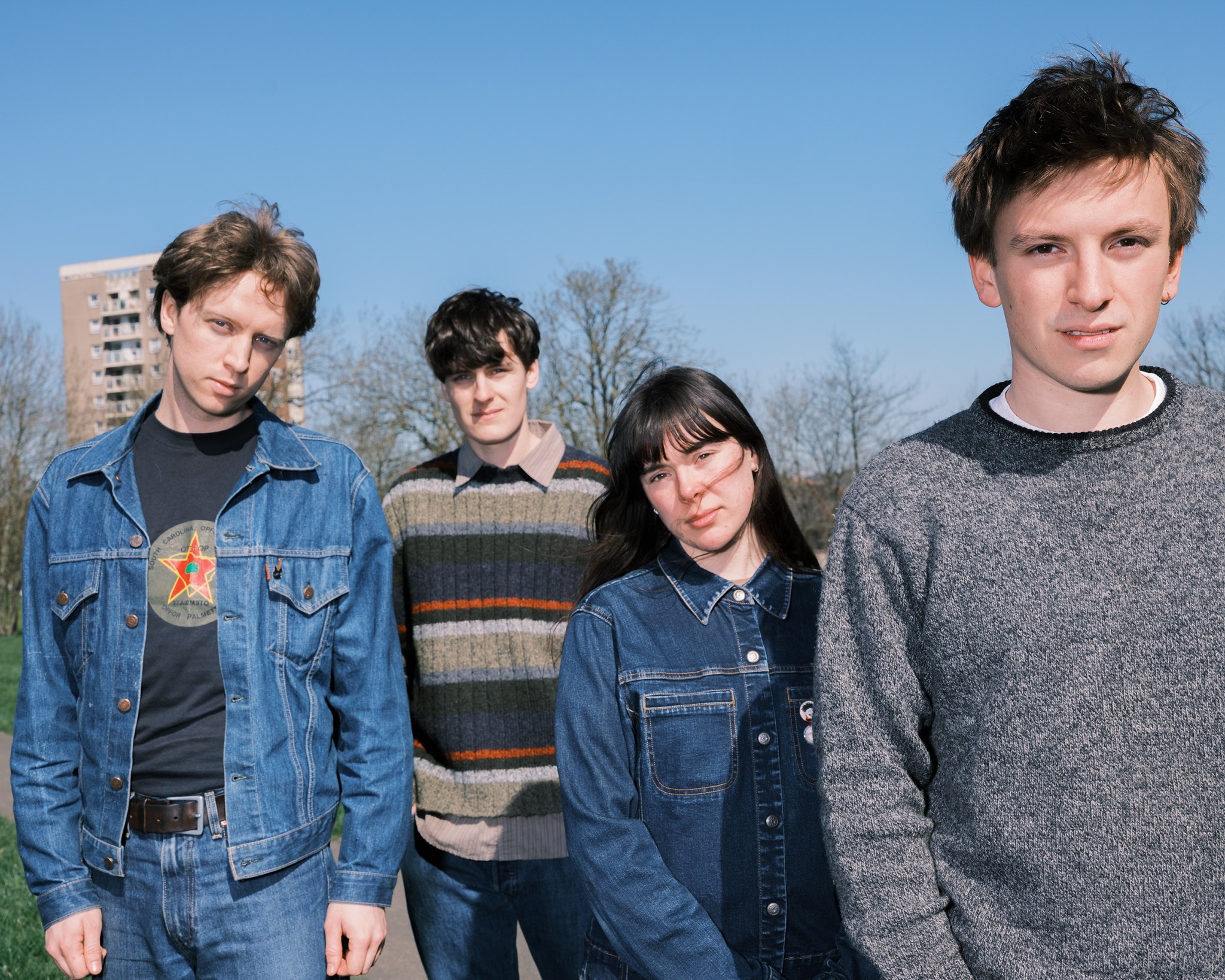
Westside Cowboy is your favorite indie band’s favorite indie band, and once you listen to the four-piece’s original mix of British indie and Americana, self-described conveniently as ‘Britainicana’, it will immediately click why. The group, consisting of Jimmy Bradbury (guitar/vocals), Reuben Haycocks (guitar/vocals), Aoife Anson-O’Connell (bass/vocals), and Paddy Murphy (drums), met while living in Manchester and was founded on a core ethos they still keep to this day: four friends having fun creating music that can be enjoyed by everyone. They’re self-admittedly not trying to overthink their art, just making what feels right to them.
That ethos has done nothing but skyrocket their career, with their earworm songwriting and signature electric live show landing them a slot at Glastonbury Festival after winning the Emerging Talent Competition in 2025. With two EPs released to critical acclaim and opening slots with established acts such as Geese and Black Country, New Road, a full-length LP was the next item on the band’s to-do list, and what came of it was more than any band could ask for from a debut: It Goes On.
Hit Parader got to sit down with Bradbury and Murphy to talk about everything that went into the record: the intention, the funny stories, and what makes this piece so Westside Cowboy. With their previous EP, So Much Country ‘Till We Get There, being my favorite project of the year, they’ve found a way to top what I thought couldn’t be topped. They’ve found their own sound: distinct yet accessible, and among the best indie rock of the decade. Paddy would disagree, saying they’re “not trying to make some era-defining rock opera or whatever [laughs]; just 11 songs that are quite good will do for us, I guess”.
Hit Parader: So, from January, what have been some of your favorite moments of being a part of Westside Cowboy?
Jimmy Bradbury: Oh man, we’ve done a lot since January.
Paddy Murphy: Finishing this album, I’d say
JB: That was a very freeing moment.
PM: Yeah, when it was all done. I remember listening to it all the way through, in the track listing we wanted it to be. I was like, I’m really proud of this, this feels pretty good.
JB: This is our first time we’ve ever put together a body of work this big. None of us have ever made a whole album before. So when you’re putting these songs in the pile, and you’re recording them, there’s some that you really, really like, and there’s some days where you’re not so sure how this is going to work or how they’re all going to fit together. But when you get that final mix back of all the things in order, and you have the listen-through, I think we were very pleasantly surprised. It felt like we made all the right decisions along the way, and it feels like a really concise body of work.
PM: I think we really loved making it as well. There were obstacles and challenges to it, but looking back, we did it in January, in the bleak midwinter, I guess, in a basement of a church in Leeds. It feels like it’s taken on a very nice time in my head, doing that, being stuck in this control room with something being wrong sometimes, being midway through tracking something and something’s not right. But it’s nostalgic for those moments, weirdly. I don’t know.
HP: With It Goes On being your debut full-length, what were some of the challenges of getting to that length of a project, and what did the longer format let you do that past projects, singles, EPs didn’t give you enough time to?
JB: I’d say it’s given us more breathing space and room to try some other tempos in songs. The first EP was very plug-and-play. We actually recorded it in the same place we recorded our album, that’s how we found out about Greenmount Studios in Leeds, with our lovely engineer Rob Slater. We did the first EP with Lewis Whiting from English Teacher, and Rob helped engineer it as well, along with a guy called Oscar. That was a case of, well, we have this set of songs, we’re just going to go in and play them how we do live and try to get it as best we can. Then we did the second EP with Loren Humphrey in New York, and that was more of a chance for us to maybe not be so brash with it, not so direct, but we can still be the live band that we want to be, but try to find some different avenues to project that on how we want on a record. With Loren, we really found that nice sweet spot that we got to try out in a few different ways on that second EP.
PM: It feels like it’s just the natural marriage of those two ways of thinking about things. To be honest, we like short albums, so whilst we can drill into things a little more, we can’t drill into them too much, which we don’t. I think we like that.
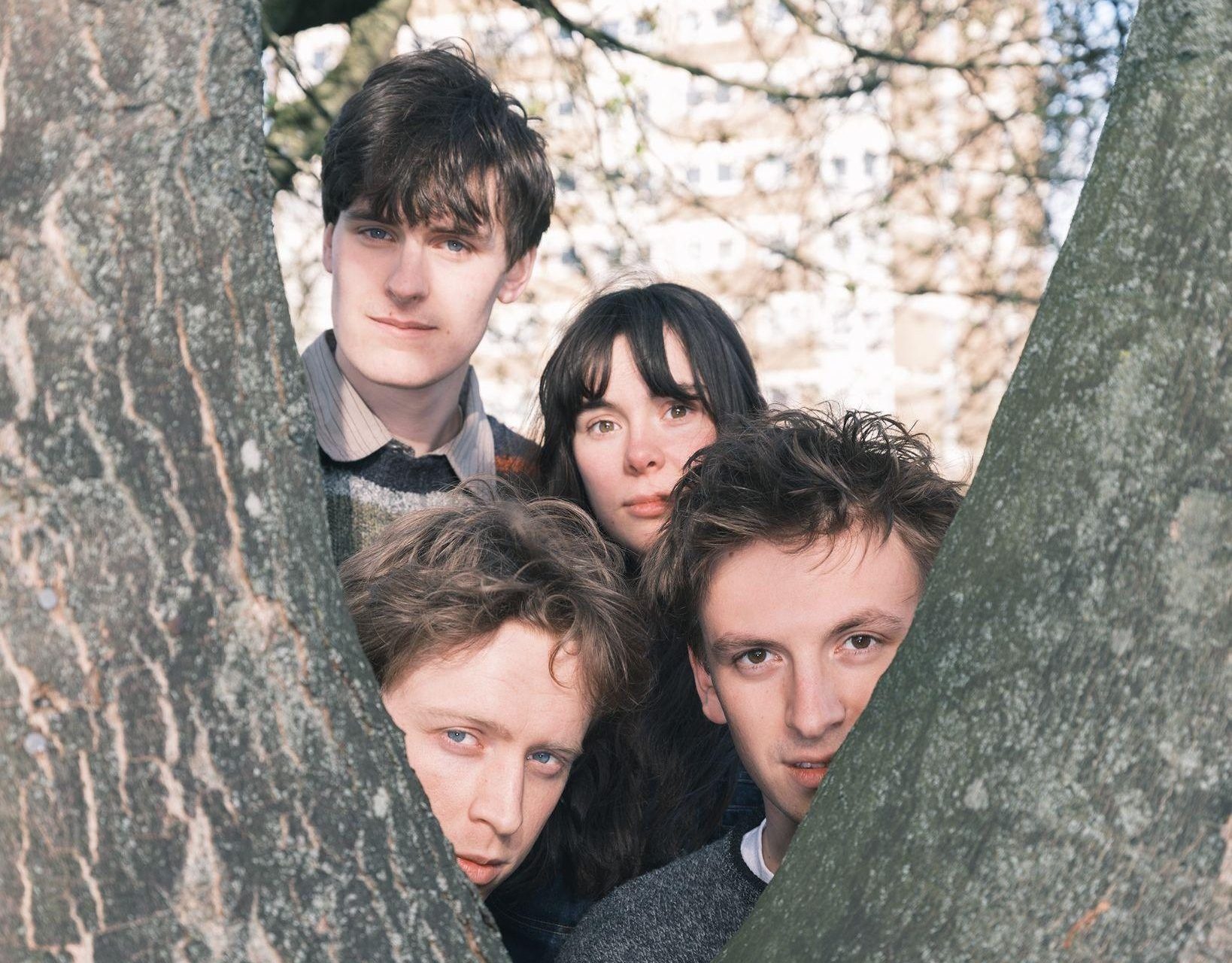
HP: Yeah, that’s fair. I remember reading that one of the things that you really harped on that I thought was really cool was how [Westside Cowboy] recorded the last EP live as a band, no click, no nothing, just four people in a room playing the song as it would translate to the live show. I’d love to know if that philosophy stayed as a throughline to this project.
PM: Yeah, the whole album is still tracked entirely live without click. We overdubbed a few things; we overdubbed some vocals, a couple of extra guitars, and a shaker, the classic. But the essence of it is all live, and I find it hard to foresee a future where we won’t at least primarily work that way. It’s just what a band’s supposed to be. Sometimes when people say things like that, it makes it sound too traditionalist, like you have to do these things, but honestly, in a lot of Cowboy ways, we find those limitations incredibly liberating.
JB: It never really occurred to us to do it another way either. It’s kind of just the way we’ve always done it. Even when we did our very early demos, we did it on a four-track cassette recorder; it’s just four mics with four instruments, plug in, and you’ve just got to play it. And I think it’s something we’ve never really tried to change because it works for us.
HP: If it’s not broken, don’t fix it.
JB: Pretty much.
HP: That’s great. One of the things that I love about your band as a whole is that it seems so fun in every aspect. Out of curiosity, what have been some of the most fun moments creating the record, and how did those specific moments or memories shape the way you want people to perceive the record when they listen to it?
JB: Oh, how about the drum pallets that we built?
PM: Oh yeah, doing albums and just recording musically anyway is just one big problem-solving task; it feels like sometimes. We just did loads of little things. We were having trouble getting the drum sound we wanted in the room at the time, so we went upstairs to a room that wasn’t being used, which was a lot bigger and more cavernous.
JB: For context, this is a church, and the actual studio is in the basement of the church, so it’s got a very low ceiling, but they have a main hall upstairs with a huge stained-glass window.
PM: So we ended up improvising this crazy shelter out of random bits of wood and background material, just making this weird little cave. I remember we were trying to track “Patchwork” at the time upstairs, and that song is obviously quite stop-start-y, and it was a nightmare because I couldn’t see anyone. We were trying to look at each other, trying to be like, “when do we come in?”, and literally looking through a slit and two planks of wood for when things came in [laughs]. That was funny. A lot of what albums also is, and recording in general, is just waiting around: a lot of hanging out. We’d track for a bit in the morning and the afternoon, and then we’d be like, “I’m hungry, when are we gonna eat?’ [laughs] and then inevitably falling down a YouTube hole.
JB: Loren is something [laughs]. Loren doesn’t really use much social media, but his version of it consists of his camera roll, which has probably 20,000 photos that he’ll love to show you at any moment and go, “This was a great time,” or pulling up continuous amounts of old live footage of Woodstock ’99, that was one funny one.
PM: He’s got a premium Dropbox subscription, so he has gigabytes and gigabytes of saved stuff randomly. And he used to play in bands back in the day, and he was like, “Man, back in the day we used to do some corny things, we used to do these stick tricks,” and he was like, “I used to do this one, oh man, there’s a video somewhere.” And he genuinely spent about 25 minutes surfing to find a singular set of music that his band did like 15 years ago [laughs], and he was like, “I FOUND IT!” and it was 45 minutes into an hour-long set in Switzerland and he was like, “No, look, I’m doing it, I’m doing my trick,” and it’s this weird glam-rock-esque stick trick. I remember those things in startling detail compared to others. I remember a lot of other things as well, but those are the moments that weirdly stick in my head more than they should, just sitting around and having fun with your friends and stuff. We feel really lucky. I worry it sounds like we weren’t really [serious], we really care about the album and making it to the best of its abilities, but with all things [Westside] Cowboy, you kind of just gotta be friends first, and then if something happens, that’s the bonus.
HP: So, with working with Loren on this project in Leeds, and this being your second project with him, is that correct?
JB: Our second project, yeah.
HP: Having a familiar face with production, how did that allow for more comfort or risks to be taken, or how did that preexisting relationship affect going into this project?
PM: It greatly helped things, definitely.
JB: I feel like Cowboy is very much built on, again, the if-it-ain’t-broke-don’t-fix-it, and we really liked working with Loren. It seems silly to go into this thing to try different ways of recording and to experiment, and build a relationship with this person, and then it’d be really silly of us to go out and record with someone else just for the sake of it. We all really like Loren, and I feel like the EP was a great way to test the waters to see if Loren liked us and we liked Loren, and thankfully he did, and we’ve learned a lot about each other, and about what he sometimes would want to do with our music, and he knows what we’re going to say about our music as well.
PM: It was both those things; we really trusted him, and he was very comforting, but we really trusted him, so if he was pushing harder on some things, we knew he was doing it for a reason a lot of the time. And we also knew him well enough by that point that sometimes we didn’t get swept along with stuff, because that can also happen when you’re in the studio, where someone will suggest something, and you’ll just go along with it. There were things he suggested and we were like, “nah, we don’t want that”, but a lot of the time he was pushing us in directions that we liked, even if we didn’t quite know it yet. We’re really happy that he did that, now, in hindsight.
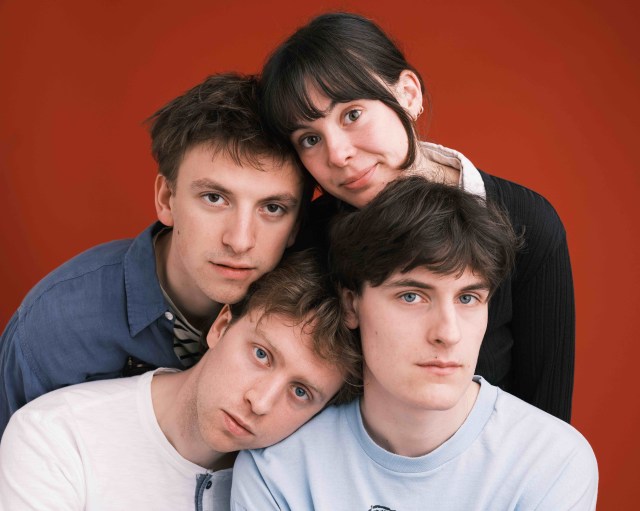
HP: Is there a specific example of a song that changed in a concrete way that wouldn’t have happened without Loren’s input?
PM: “Kick Stones (The Boys)”.
JB: I was gonna say “[You Could Have] Died There [On The Dancefloor],” but yeah, “The Boys” definitely.
PM: “Kick Stones” was a song we’d had for a while, but we demoed it a few times and never liked it on record. We demoed it with Loren at his house when we went and played some shows over there, and it was like, oh, this is kind of interesting; we were trying it in a different way. Then we went to track it in Leeds, and we were like, that’s cool, and then we revisited it a day or two later. We’ve told this to a few people, we were listening back, and he was hunched over the control board, and about two minutes in he was like, “I think I hate this song.” We were like, oh god. Another minute goes by, and he goes, “No, I definitely hate this song.” [laughs]
JB: “Yeah, I really hate it” [laughs].
PM: And it was one of those moments where it’s like, “oh god”. We already weren’t super confident in this idea, so to hear him say that was like, oh man, maybe we are just flogging a dead horse here. But in very Loren fashion, it was like, “No, let’s take it apart, let’s see what’s not working about it.” And we kept going with it for another couple of days, and we found the sweet spot. It was crazy because that was the first single, and that’s the first song in the track listing; it literally went from being a song that at one point was not going to be anywhere near the album, and now it introduces the whole thing.
HP: That’s crazy. After the success of So Much Country ‘Till We Get There and all the live work that you’ve been doing over the past six or so months, was there any form of pressure or freedom to create what you want going into this project that didn’t happen before, because of the success of the previous projects?
JB: I think we’ve all felt pressure in our own way, under our own circumstances. I don’t know if it’s necessarily anything like, “oh, we have to beat the last thing.” I don’t know if I really see it as that. But we spoke to a few people and got some good advice, where it’s like, “it doesn’t have to be perfect, go make a first album”. It’s kind of like you want it to have energy, you want it to feel youthful, and it doesn’t have to be perfect; there can be mistakes in there, which there definitely are. That’s the first step into it, and then who knows about the second one? Maybe we’ll be harder on ourselves on that [laughs].
PM: There’s a lot of, young bands put a lot of unnecessary pressure not only on making a good album, it seems like it’s not enough just to write a good album, you’ve got to write a defining statement of a thing, it’s got to capture everything you’re about, and it’s got to mean as much today as it means in 20 years or whatever. That’s just totally unrealistic. Just write and record what feels good to you now. We went in with that feeling of, we’re just thinking about now, we’re not trying to make some era-defining rock opera or whatever [laughs]; just 11 songs that are quite good will do for us, I guess.
JB: And they very much represent the thoughts and feelings that we’ve been having in the past couple of years, and it’s all come to this, I suppose.
HP: That’s completely fair. For the last question, very broad, whatever you want to answer: what are you most excited for the rest of the year?
JB: I’m excited to play the album. I’m excited for us to have a real good go at being a headline band, we’ve been a support band for so long, and I like to say that we’re better at being a support band than a headline band currently, and I’m excited for us to learn the ropes of being a headline band, being able to be on stage for more than 45 minutes [laughs].
PM: Gradually step into those shoes. Yeah, we’re really excited to play the songs live. We’ve only really dipped into it so far, we’ve done one show and played the entire thing all the way through in order, and it was amazing; we really loved it. So more of that will be really exciting for us.
Listen to It Goes On, out now.