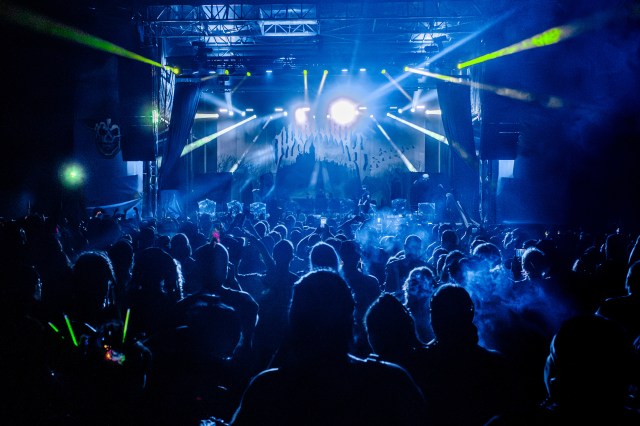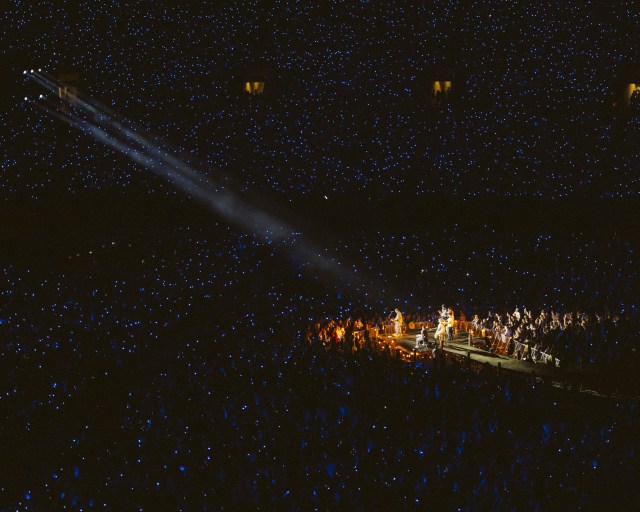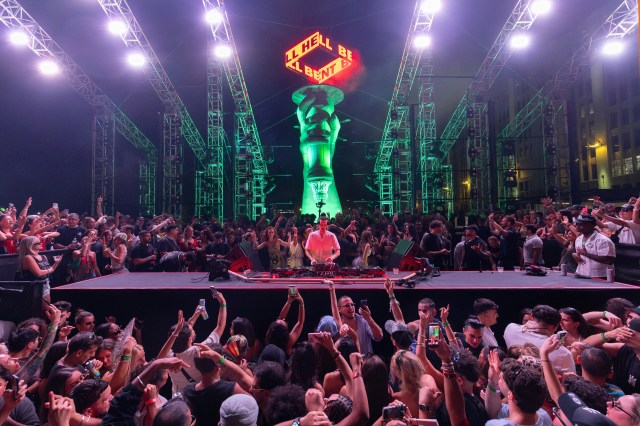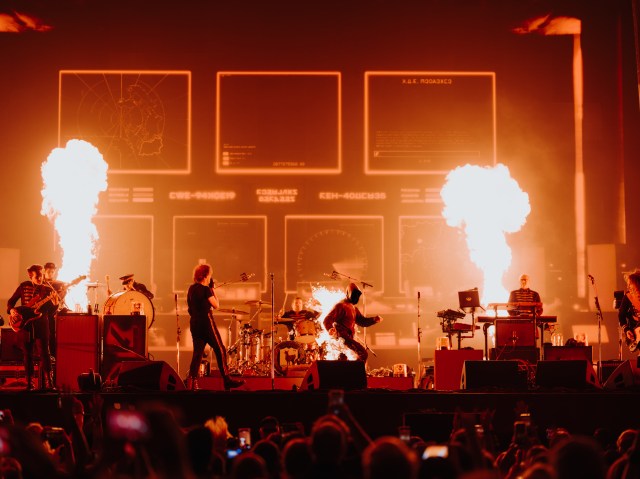
Seeing YUNGBLUD’s sold-out show Friday at the Greek Theater made me realize how important family, community, and human connection really are.
That feeling started when the opening band, The Warning, came out and instantly caught my attention. At first, they just seemed unbelievably in sync. Every drumbeat, every guitar riff, every pause felt perfectly timed down to the millisecond, yet somehow effortless at the same time. I couldn’t figure out why until Daniella Villarreal introduced herself along with the other members, Paulina and Alejandra, and I realized they were sisters.
Suddenly, everything clicked.
They’ve been performing together for over 13 years, starting as a small cover band from Monterrey, Mexico, after their cover of Metallica’s “Enter Sandman” went viral. Now they’re touring arenas around the world. Watching them felt like watching a sibling connection come to life. They were peaceful yet chaotic, intense yet completely connected. And honestly, that’s what siblings are. There’s arguing, forgiveness, chaos, and love all mixed together. Every loud drumbeat almost felt symbolic, like every past argument floating away into the air while they created something beautiful together.
It only felt fitting that my older brother was there with me.
As the loud rock music filled the arena, I started noticing something quieter underneath it all. As I looked around, I realized how many families were there together. Parents with kids, siblings, friends with their arms around each other. For a generation constantly glued to phones, this felt different. This was the only concert I’ve been to where I saw more people cheering together than on their phones recording. People crave real community now more than ever. Everyone was actually living in the moment instead of watching it through a screen. Music was bringing people together in real life.
Then it was finally time for YUNGBLUD to come out.
Cred. Tom Pallant
Before he even stepped on stage, the word “hello” appeared across the screens in multiple languages. It instantly made the entire arena feel welcoming, like no matter what your background, everyone belonged there that night. We were all there for the same reason: to let go for a few hours and just feel alive while jamming out to some rock n roll.
Then, suddenly, confetti exploded through the crowd.
It felt like all of our worries were being thrown into the air alongside it. For a second, nothing else mattered besides just being there in the moment.
And once he hit the stage, the energy completely exploded.
Besides making amazing music, he is one heck of a performer. At one point, he randomly jumped off the stage and started climbing the arena handrails while yelling, “ARE YOU MOTHERF***ERS READY?!” The crowd went insane, everyone cheering, some even holding their breaths… Hoping he didn’t fall. Eventually, he ended up standing on a chair in the middle of the crowd, continuing to scream. From that moment on, I knew this concert was going to be unlike anything else.
Cred. Tom Pallant
When he started performing “Lowlife,” the entire arena loosened up even more. Everyone screamed the “La-La-La” lyrics together, and for the first time, I fully looked around the crowd and realized there wasn’t a single empty seat in the place. I really tried to find one for a good minute, but I couldn’t. Thousands of people from all over Los Angeles had come together for this moment.
One of the most emotional moments of the night came when YUNGBLUD dedicated Black Sabbath’s “Changes” to his late mentor and friend, Ozzy Osbourne. Before starting the song, he told us we needed to sing loud enough for Ozzy to hear us from heaven, especially because Ozzy’s family was in the audience. As soon as the crowd heard this, they instantly understood the assignment. This is one of my favorite songs, so I was screaming at the top of my lungs. Everyone sang together like one giant family. You could hear the raw emotion in YUNGBLUD’s voice during that performance, and honestly, it gave me chills.
Of course, in true YUNGBLUD fashion, he made the crowd stick out their tongues. My brother and I doing that together reminded me of when we were little kids. YUNGBLUD even started calling out people who refused to do it, projecting them on the giant screen until they finally gave in. The entire arena was dying laughing. At one point, the cameraman showed this one kid absolutely rocking out with his tongue out, throwing devil horns, and headbanging so hard that it caught YUNGBLUD’s attention enough that he not only brought him on stage, but he put him on his shoulders. I’ve never seen an artist interact with fans so personally before.
But beyond the chaos and fun, what made this concert really special during Mental Health Awareness Month was how openly YUNGBLUD talked about mental health.
Cred. Tom Pallant
When he performed “The Funeral” and the crowd screamed, “I hate myself, but that’s alright,” it didn’t feel hopeless. It felt real. YUNGBLUD has always been open about his own struggles with intrusive thoughts and insecurity, and instead of pretending those feelings don’t exist, he talks about learning how to live alongside them without letting them completely take over his life. I think that honesty matters a lot right now because social media makes it seem like everyone else has everything figured out when they really don’t. He serves as a reminder that even successful artists struggle with their mental health.
He constantly reminds fans that they are not alone, and he backs those words up with action. He has worked with organizations like Mind, where he pledged to donate £1 (up to £25,000) split between Mind and Sound Mind Live for every use of the “Breakdown” CapCut/TikTok template. He continues encouraging open conversations about mental health instead of avoiding them.
One of my favorite moments of the entire night was when he told everyone to turn to the strangers next to them and say, “Hello motherf***er,” and then, “I love you.” It sounds ridiculous, but in that moment, it actually felt genuine. For a few seconds, thousands of strangers became one giant family.
The concert ended with “Zombie,” a song inspired by watching his grandmother struggle with alcoholism and slowly losing herself. The song captures something so many people are scared to admit: the fear of becoming a burden, the fear of appearing weak, and the universal feeling that you have to go through your darkest moments alone. But standing in that crowd, surrounded by thousands of other people screaming those lyrics together, I didn’t feel alone at all.
Cred. Tom Pallant
That’s what made this concert so powerful to me.
In a world where social media usually only shows people’s happiest moments, YUNGBLUD doesn’t run away from the darker emotions. He dives directly into them. He talks about grief, insecurity, loneliness, anxiety, and self-hatred openly instead of hiding them. And I think that’s exactly why so many people connect with him so deeply.
By the end of the night, there had been screaming, laughing, crying, and complete chaos. But more importantly, I walked away realizing something I think a lot of people need to hear during Mental Health Awareness Month:
No matter how alone you feel sometimes, you never truly are.
YUNGBLUD is bringing the rock star back to rock. At just 27, the British firebrand stunned 45,000 fans and the world at Ozzy Osbourne’s farewell show with a jaw-dropping, emotional cover of “Changes.” Critics and legends alike are calling it one of the greatest live performances of the past 25 years. In a genre starved…
Hit Parader: If you had to choose three songs, albums, artists, or even non-musical forms of media like books or shows or something that played some form of influence or some role in the creation of this record on your end, what do you think that would boil down to?
1. Everything Everywhere All at Once
Cred. Press Provided
Rob Damiani: I’d say one thing is that we’ve always had this mentality, or I have always had this mentality, of trying to create something fresh while still honoring the influences and the references that inspire you to do what you do. Like any artist, sometimes you lose faith in yourself, or you question, are you on the path you set for yourself? Are you happy? Are you approaching it in the right way? One of my favorite films of the last few years was ‘Everything Everywhere All at Once.’ That was one of those films that was very affirming for me. I love action movies, martial arts movies, philosophy, comedy, all these very disparate things that don’t always sit well with each other. Somehow, they created this super enjoyable, funny, but very emotionally led, thought-provoking film that brought all these crazy things that I love about film and media, and encapsulated them in a very original film. It was one of those things where I was like, ‘This is fucking awesome, I’ve never seen anything like this.’ I would love for people to hear a Don Broco song and get that response in any small way. If anyone could feel even a glimpse of what I felt watching that film, to have all these things in a movie, then I think I’m achieving what I want to do. A lot of the songs and records bring different ideas, themes, and feelings. For me, that is what the human experience is about. It is about experiencing all the crazy shit, all the different feelings that come with being a human on this planet, rather than boxing yourself into one thing. That film, for me, was like, ‘They can do it here, I’m going to give it a go and try and do it within our album.’ Whenever you have that worry and doubt, ‘Are we doing the right thing?’ I think back to how great that movie made me feel, and then I go for it even harder.
2. Toxicity by System of a Down
RD: More musically, I’d say going back to one of the first albums that really stuck with me and influenced a big part of who Don Broco are was System of a Down’s ‘Toxicity.’ It is still a phenomenal record. You still put it on, it still feels so urgent and so fresh. Again, similar to the movie, it is hella fun, it is crazy, the lyrics are nuts, there is some weird shit in there that probably doesn’t make any sense, and there are also a load of very important lyrics about politics and what it is to be a human, and very spiritual songs. Somehow, they are all in there, and it works. I knew all the words, and I’d sing along, but I wasn’t thinking as much then. I was a kid when it came out, really young. It was one of the first records I went down to buy as a CD with my friend. I remember we put it on in my room and just listened to it three times in a row, our minds being blown. Going back to it, it is still just as amazing as it was then, and a lot of the lyrical themes are still just as relevant now as they were then. They nailed it on so many levels. It is a super varied album, but still really identifiable as System of a Down. That was the album that really launched them and catapulted them. When you think of System of a Down and what their sound is, you can find all of that in different forms within that record. That is a big influence on me in general, but also on this album. As a band as well, seeing how thick it is after all these years, they seem now like the biggest they’ve ever been. Seeing some of the shows they were doing in South America, it is insane, hundreds of thousands of people moving like an organism. It is crazy. It is really cool to see something that you love so much reaching another fan base as well. A lot of people are discovering them now for the first time, which is so cool.
3. The First Law by Joe Abercrombie
Cred. Press Provided
RD: A third one; there is this author called Joe Abercrombie. I’ve just been reading his series, the first trilogy is called ‘The First Law.’ I was not reading as much as I could because I love reading, but I’m just pretty lazy. Unless I’m on holiday and have nothing to do, I’m so easily distracted. There is so much good TV around, so much doom scrolling to be done. You get to a point in the day, and you’re like, ‘Okay, I’m tired now, I’m going to read a book.’ Holidays, I’ve been really trying to, every time I go on a little holiday, kickstart the next book, and then that takes me through. I really recommend ‘The First Law’ trilogy as the starting point. Even if you’re not into fantasy novels, because it is set in this fantasy world, if you imagine a Game of Thrones-esque land, it is at the turn of the introduction of industry. You’re coming out of this fantastical pseudo-medieval world with magic and this and that flying around, and it is like, what happens when the industrial revolution begins, and how does that affect the world? That is the backdrop, but the character development is just so awesome. The duality between people, every character in it goes on such a journey. I wouldn’t say this is a blanket rule and this won’t ruin every character, but in the same way as in Game of Thrones and any sort of post–Breaking Bad TV show, if there is a main character that doesn’t go on a bit of a character development, whether he starts good and then does some questionable things, or starts the villain and redeems himself, it is really interesting how people and humans are capable of so much good and so much bad at the same time. The choices they make and the decisions they make, whether for right or wrong, can take them down certain paths.
This overall feeling is that life is so fragile and can so easily be taken away for a variety of reasons. In the books, people are getting killed left, right, and center through fights and wars and this and that, but in general, you take real life, it is a celebration, but at the same time, you’re living in this misery, but at the same time, all this great stuff is happening. It is basically about a world of contradictions. I was finding myself taking photos of lines and copying bits and writing them down, being like, ‘That’s a sick idea for a song,’ taking pages of notes of reference points to build into a song or various lyrics, various bits in the book of cool lines to steal. I wouldn’t say any of them really made it into the record, maybe one or two. I think the general themes of the duality of people and the world being a shitty, dark place, but still good things can happen, is reflected in quite a lot of the lyrics in these songs. I’m still reading a new one of his books and writing down bits in case they come in useful. It is hard when you’ve got a load of melody ideas and a song, and then you’ve got this really cool lyric you want to fit in, but it doesn’t, and it just derails the song.
Listen to Nightmare Tripping by Don Broco out now.
Read the full article in Issue 5 of Hit Parader Magazine.
The cover story of Hit Parader Issue #5 enters the temple of Sleep Token at the exact moment their mystery has become too massive to hide. One year after Even In Arcadia turned the masked British phenomenon into a global rock event, the album’s instrumental edition strips away Vessel’s voice and invites fans to hear the cathedral underneath —…
The Utah-based indie rock mainstays Krooked Kings are at a point in their careers when various pressures from the ever-judging internet say the band should be ‘content creators’, but members Oli Martin (Lead Vocals/Guitar), Matt Monosson (Bass), Paul Colgan (Guitar), David Macey (Keys), and Quinn Casper (Drums) would much rather just be a band again. On their new record, In Another Life, produced by Yves Rothman (Kali Uchis, Yves Tumor, FKA Twigs), the five-piece lean into the new mindset, pouring months on months into tracks that would make up the album while simultaneously stepping back from the industry’s focus on making that next viral social media post. The result of all this is the loudest, most intentional, and hungriest version of Krooked Kings yet; one that wants to stand the test of time and do what a band should do: put the music first. Hit Parader got the opportunity to sit down with all five to talk about the amazing new record and the effort behind it.
Hit Parader: You said on an Instagram post that the new chapter with this record is one where the ‘music comes first’. How has that mentality shifted the way that this record was created versus other records in the past?
Cred. Travis Frey
Matt Monosson: This record took way longer, I would say [laughs].
David Macey: Yeah, this record is a million times longer than any other.
MM: Previous times, it would be one day per song, pretty much, and the album would be done in two weeks, and then we’d mix and master it. But this one, yeah, as Quinn said, it was almost too much time, to be honest [laughs].
DM: I think in terms of the music coming first, maybe the phrasing of that could be interpreted in a few ways, but for me, I think we were kind of trying to make a statement about our content, and that we were trying to be more mindful with that and artistic with that, in terms of social media stuff, and really put the music at the forefront of the content and represent it in a way that feels artful to us. I feel like that’s what I imagined we were intending when we say, “Oh, we’re putting the music first.” Obviously, we’ve always taken care with our music, and we are proud of what we’ve done. But yeah, I think it’s more that we want to represent ourselves in a way where it’s like, ‘hey, this is an artistic endeavor’, and we want to portray it that way.
Oli Martin: Yeah, yeah. I think it’s easy to sell your soul to the algorithm. I think for this new chapter, we wanted the pressure to feel a little more old school, where it’s not so much pressure on… I don’t know, if our social media is performing incredibly, I think that’s awesome, obviously, and that’d be great. If it’s not, I think we’re all in a happier space as a band knowing that we really cared about the music, and at the end of the day, if we don’t have a TikTok or Instagram that’s going viral and everyone’s excited about us for a few seconds, we’re still going to be happy with what we’re creating, and we’re not creating music for those moments. We’re creating for us, and what we really enjoy listening to, and hopefully what people want to hear. But yeah, I think it’s just hard, because with being a musician nowadays, you’re now a content creator and in all these other roles. I don’t know if we’re trying to say, “Oh, don’t do that,” but I think for us, we’re tired of doing that and tired of trying to perform as that, and really want to just perform more as artists and less as social media content creators.
HP: And then with Yves [Rothman] producing the record in LA, I’d love to know more about how working with him sharpened the vision of what you already had coming into the studio, without taking away from the core identity of you guys as a band.
DM: I think the core identity of us is that we’re a committee of people. We all have similar tastes, but we’re not exactly the same. So I think having a producer that has his own taste and vision that can be a little bit of a leader or a tiebreaker for us was a helpful thing to have. Because when it’s a decision by a committee of five people, that can get pretty tough, but when there’s someone that you can almost look to as the authority figure, it’s like, oh, okay, this is a cool direction. I feel like he was super helpful with the writing and the production and everything.
Cred. Travis Frey
MM: He also really wanted to capture the essence of us live. Kind of going back to what I said, we were so plug and play before, but we always did great live, where he heard us play live and was like, there’s something there. And like Dave said, he was able to lead us in the right direction. I feel like I’m proud of this record. I feel like it really sounds like us live, when previous stuff has been a little bit more computer-ish.
Paul Colgan: I was gonna throw out there, I feel like Yves kind of pushed us to have an idea sonically of what the whole thing was gonna sound like before it was even pen to paper. I think he threw some names out there initially, like Cage the Elephant, Arctic Monkeys, those big rock bands of the early 2000s where it feels like you’re in a live room with that band. And I think that was nice to have that general idea of what it’s going to sound like before we had even recorded a single note.
HP: And then with the tracks on the record, there’s definitely a wide sonic range with “Damage Control” and “In Another Life” and “Fix This.” How did you approach choosing what tracks made the record, as well as the pacing of the record and making it flow the way it did?
PG: Yeah. I mean, I don’t know. I feel like it was really broad. We were all in the studio, and we had probably 20 songs that we were choosing from. And I think everyone has a little bit of a sense of what’s going to be a strong [song]… I think we had eight songs that we felt really strongly about, and then kind of had to whittle it down to a few others to fill in the blanks. I feel like every album needs a little bit of a slow moment to close it out and needs a big crescendo moment. And, yeah, I feel like it was just picking the right songs that painted that entire picture of a holistic-sounding album.
Quinn Casper: Yeah, I feel like, if I remember correctly, we were having some beers in the Airbnb after we had just finished recording everything, and our manager was like, “All right, we need the sequence. We need the track list.” And it is kind of a hodgepodge. There’s some different-sounding stuff, for sure, but I feel like we just listened to songs back to back and then just kind of trusted the gut and were like, that feels like a natural cool snare hit into a big song after a smaller intimate moment or whatever, and it all just came together and felt like a natural progression.
DM: Yeah, it’s funny that you say that there is a wide sonic range, because thinking about it, that is true. But I think in my mind it’s funny to think about that. It all feels very in the same world to me, but you are right.
PC: In that world, I always like it when there’s some range to it too. It also didn’t really occur to me how many different-sounding songs there are because they all just live in the same world for me, like Dave was saying. But I think there’s a fine line between having an album that lives in the same world and having all of your songs sound the same, and I think we kind of walked the line on this one, and I’m happy with how it turned out. A lot of variety.
Cred. Travis Frey
HP: And then, on the new record, what felt different, if any way, about the way that you approached the lyricism compared to past projects, from themes to the way you wrote or anything?
OM: I think we took a lot of time. Yves was a little bit of a stickler, I think, on lyrics. And, man, at the end of the day, it was definitely up to us as to what we were writing, but I think in previous records, not that we didn’t think about lyrics really deeply, but I think this album, Yves just really challenged us with everything. It’s also about saying what you want to convey, but then there’s the singability, stuff we never really thought about before. He’d be like, “Okay, that kind of sounds weird to sing,” and it was frustrating at times because I’d think, man, I cracked it. And then he’d go, “Yeah, it’s the right word, but it just doesn’t sing right.” There were random lyrics where we definitely fought back on, but I think a lot of time was spent on lyrics, whereas in the previous albums, they were written so fast. We used to put vocals down last, and it would kind of all happen in a week. So at the end of the day, you only had that week, and there wasn’t much time to edit the lyrics. With this one, though, there was a lot of editing.
PG: Yeah, a lot of revision.
DM: It’s kind of crazy, honestly, how little editing we’ve done in the past, and then to jump to this, where it’s months and months.
QC: Yeah, I feel like Yves, and I mean this in an endearing way, was such a bastard sometimes [laughs], because every day, no matter what, if the lyrics were done, even if Ollie just did scratch vocals, he’d be like, “All right, that’s cool, but let’s see if we can beat it.” Even if it ended up being the final lyric, he was always like, can we beat it, is there something better? Which is a really good trait to have in a producer, he’s constantly trying to have everything be as good as it could. But it just ended up being more work and really racking our brains and pushing ourselves, which ended up being good.
HP: Awesome. For everyone individually, what individual song or part that you played on the song are you most excited for, proud of, that is on the record?
MM: I can go first, yeah. I think “Sleep Tonight” I’m really stoked on. I feel like I was just fiddling around, and the band really resonated with it, and the song came together really quick. It’s a really cool line. Quinn said it also… I think every other part does a good job, and so I’m pretty stoked on that one. It was not too much of me twiddling my hair, it kind of just happened.
DM: “Ugly Love,” that one is awesome. It’s cool to have a song that was more keys-based first. Maybe that’s probably why I like it, but I think the key part is cool. I’m hyped about it. I’m just like, this is my moment [laughs].
Cred. Travis Frey
PC: That one was cool too, because in the original mix, it was not super prevalent, and then we kind of flipped it on its head, and it’s the main thing now.
QC: Yeah, that’s cool.
OM: You finally got a moment, Dave [laughs].
DM: Finally. It’s only been six years [laughs].
QC: For me, probably “Rancher’s Daughter,” because I don’t do anything so I can just hang out and catch my breath during the show [laughs]. Have a beer too. No, I’d say I feel like “Parking Lot” is just fun, just straightforward groove, rock song, loud open hi-hats. There’s this one drum fill that I don’t even remember doing. I don’t know if I did do it, honestly.
OM: Yeah, I don’t know. I mean, I think the vocals are a little different for this record. We have some doubles on some, but with Jackson on our old records, we had a lot of layered vocals and stuff. So I think the vocals sound pretty different. I’m excited to see what people think. I think it was definitely a little scary to switch it up so much, so I think I’m just happy we did and see how it goes.
PC: Honestly, I think “Ugly Love” is my favorite song on the album, and for that reason, that final little slide guitar at the end has got to be up there for me.
HP: And then, just for the last question, if the listener, after checking out the record, had to have one takeaway/message, what would you hope that to be after they listen to it?
DM: They would feel a strong urge to start an email chain that says, “Send this album to 10 other people, or you’ll die in the next month.” [laughs]
OM: I think that that’s pretty good [laughs].
PC: I like that.
DM: I don’t know. I can’t think of some grand takeaway. Maybe you guys have something more poetic than that.
OM: “I want to give Krooked Kings a million dollars.” [laughs]
In Another Life by Krooked Kings is out now.
Read the Article in print in Issue 5 of Hit Parader Magazine.
The cover story of Hit Parader Issue #5 enters the temple of Sleep Token at the exact moment their mystery has become too massive to hide. One year after Even In Arcadia turned the masked British phenomenon into a global rock event, the album’s instrumental edition strips away Vessel’s voice and invites fans to hear the cathedral underneath —…
Over the span of a few short years, Vacations frontman Campbell Burns has watched his band transform from small shows in Newcastle, Australia, to packed rooms around the world. Yet Burns still discusses Vacations as if the band were a small project that just ‘happened to take off’. While the beautiful indie rock tracks are easy on the ear, there is much more lyrical intentionality hidden if you listen to the fantastic lyricism crafted by Burns. With a new chapter on the horizon, including new music, many shows, and their very own festival, MATES Fest, it becomes clear that Burns is less interested in chasing the abstract concept of success and more focused on making sure that Vacations’ artistic vision lives on, and that Vacations has always and will always be a band that you can discover and claim as your own. Hit Parader sat down with Burns to discuss more.
Hit Parader: So just to start off, while in Vacations, you’ve lived in Newcastle [Australia], Los Angeles, and then you recently, last year, moved to New York City. I’d love to know how each of those individual cities and the creative worlds around them kind of reshape the way you write, think about the band, and approach the day-to-day process as an artist.
Campbell Burns: So when I was in Newcastle, I kind of felt like I was in my own creative bubble. I was a part of a really strong, unified community of musicians, artists, and creatives. And I was young at the time. I would have been 18 when I was coming into it. So 18 is the legal drinking age, going-out age in Australia. So I started going to shows, meeting more musicians, and meeting a lot of like-minded people. And so with that in mind, and starting Vacations and then all these other bands coming together, that was really special and formative, especially in my earlier years, because I was really influenced by what people were doing around me, because it was real and it was tangible. Sure, I was influenced by things overseas or on the internet, but in terms of my own music career, I never really thought about much outside of Newcastle, which is kind of funny to say, because we’re now an international band, but when I was releasing those first couple of EPs, I did not consider anyone, even as far as Sydney, which is only two hours away, that people would be listening to it. And then it started going somewhat viral on the internet through YouTube, people like David Dean Burkhart, a huge 2016 bedroom pop kind of guy, getting that music out there. So shout out to him and everybody.
Cred. Isaac Nuñez
But then, I guess, moving to LA was a different step. Moving to LA was honestly kind of a blur. I say that I lived there for a year and a half, but that was really a stepping stone into the US. The most amount of time I spent consecutively in LA was only two months. I was barely there. It was more of a home base because I knew that I had reached my ceiling or my limit in Australia with what I could do, especially in terms of Vacations, and opportunities as a songwriter and producer on the side if I’m in my off-season. So LA felt like the next logical step. And it was eye-opening. It was very overwhelming as well, because I was dealing with culture shock. And then as I settled, I kind of had reverse culture shock going back to Australia. It was this double life. It was a bit strange at first. I’ve gotten a lot more used to it as I’ve settled into somewhere like New York, simply because I enjoy New York as a city to live in. I like LA, don’t get me wrong. I feel like LA is very much a city where you go to work. I just love living in New York so much, and it kind of reminds me of being in Newcastle, in the way that there’s community, and it’s accessible, and it’s easy to meet people. Everyone’s very forward-thinking and hard-working. I really appreciate that, not that you can’t find that in LA, but I think you have to be a lot more intentional about it, and I at least found it a bit more difficult. But then again, also to my own point, I was only there for maybe two months at a time, so.
HP: With both Newcastle and New York specifically playing a pretty big role in your life, if you had to choose an artist, some experience, or some form of media from both of those places, that has impacted your or the band in any way, what would that be?
CB: At least with Newcastle, I was part of a collective when I was 18 through my early 20s called No-Fi, as a play on Hi-Fi, Lo-Fi, and that was myself and a bunch of other musicians and artists, and we would put on DIY shows, art gallery exhibitions, big parties, and really try to celebrate the local community. And that was, again, really formative in my early years as a musician. And I was like, This is what I’m a part of, nothing else matters. I am here, and whatever else is happening, it’s whatever, because I just want to be a part of this. This is my world. So that was incredibly influential.
New York’s just different. I think for New York, it’s the idea of potential, the idea that anything could happen, and there’s always something happening here every day. It’s a very attractive quality in a city, especially with where I’m at in my career right now, because if I go back to Newcastle, it’s different, and I’m further along now. It’s kind of that big fish in a small pond. People have moved on from their bands, they’ve settled down, or they’ve moved into other lives. And as that naturally happens, especially with a career path like music, it’s tricky. Although we’ve played a lot of really good shows in New York, I feel like I’m always exposed to new music in New York. There’s always shows, bands always come here, people, friends from all over are always passing through. I just love that aspect of it. I feel like just by simply existing in New York, you are inspired, which sounds cliché as fuck, but I really do get it.
Cred. Isaac Nuñez
HP: No, but that’s fair.
CB: Yeah, now, after being here for a year, it’s only a walk outside and then anything could happen, whereas in most places, I probably couldn’t say the same.
HP: With you growing up with No-Fi, and doing a lot of DIY and community-focused things back in Newcastle, what would be one aspect of that DIY community-forward ethos that you would want to keep ingrained in your career as Vacations keeps growing?
CB: Putting a spotlight on artists that are up and coming, that are developing their craft, and always trying to build a community. I never want to be a successful indie or alternative, or whatever genre tag the record label wants me to say, but you know what I mean. I never want to be at a point in my career where it’s just like, ‘Oh, we’re not thinking about the opener, or we don’t care about those around us.’ There is always some aspect of those DIY roots that carry on into everything that we do now, because I care a lot. I think there’s a lot of really fucking cool musicians out there. All my friends are sick. I love them all, lots of talented people. I just want to bolster everybody. Because I’m in a point in my career where things are good, things are stable, and there are people around me that are making their first single, or maybe they’re an album in, and I’m like, ‘This is sick. Let’s work together,’ or ‘Come open this show.’ Or people will come to me and be like, ‘Oh, how did you get a manager?’ And then we can sort of trade stories. I think that the exchange of information is really important and valuable.
HP: And with that aspect of trying to bolster other artists that were once in the same position that you were in, you’re hosting the third iteration of the MATES Festival in June, which is super exciting, and the first one that’s in New York, if that’s correct.
CB: Yeah, first one in New York.
HP: With the past two iterations of the festival featuring a mix of Aussie and US artists on the bill, I’d love for you to tell me a bit more about the ‘bridge between scenes’ concept of the festival, and how the vision has evolved since you brought it to New York.
Cred. Isaac Nuñez
CB: There are so many good artists in Australia that I think more Americans need to be aware of, because in my time since being here, a lot of Americans will associate Australian music with maybe Tame Impala or maybe AC/DC. But I’ve also heard before that people thought that they were British. So it’s just trying to put a spotlight on artists that I really admire, I really love, and bring them to the US in front of an audience that we have down pat, just to make it more accessible, but also mixing that in with American bands that I really love. And long-term goal, I would love to eventually bring American artists to Australia and have them mix in with other Australian artists, and have this almost traveling festival. Maybe we do it again in LA, and then maybe in Sydney, and then it’s this back and forth. I think that’d be really beautiful, because I know a lot of people who I’ve met here like Australian music. So I just want to put them onto more bands that I’m connected with, or that my friends back home are listening to and telling me about, whilst mixing that in with what’s happening here in the US.
HP: Yeah, I looked at the lineup, and it’s a lot of stuff that I’ve already been a fan of. I’ve been a huge fan of Horse Jumper of Love for a decent amount of time, so it’s really cool to see them play on such an awesome bill. Grent [Perez] is also awesome. It’s really cool.
CB: And they did a song with my friend Samira, who’s in Winter. So I’m like, this is just a natural pairing. If you know, you know kind of thing.
HP: And then you dropped a couple singles off of your upcoming record No Place Like Home (From the Motel), which is a rerecording of your 2024 record, No Place Like Home. And from what I saw online, you actually did track it in a motel.
CB: Yeah, I mean, I gotta be real, it’s a set that we built, or that one of my good friends built, in Newcastle. But it was framed in a way where you can’t tell, like it looks like it’s actually shot on location. Which is cool, but that’s just that whole movie magic thing.
HP: I’d love to know where the idea to retract the record in a live setting originally stemmed from.
CB: We did a live session in Newcastle a few years ago at Sawtooth, which is a studio that I worked out of for a number of years. We had a really positive reception to it. We just kind of did a set list of Greatest Hits. And I think it was around when Forever in Bloom came out. I think it was because of the pandemic, because a lot of people were doing that. We were like, ‘This is a way that we can stay active and play a show, but on our own terms’, and be active while the world is on fire. So we wanted to carry that idea, but make it more thematic and push the artistic boundary of it all. So being able to close the chapter on No Place Like Home and say, ‘Thank you for all your support. Here’s a live version of the album’, but it’s not just a live album, it’s filmed as well, it’s in a set piece. I think it’s a really beautiful thing to do. It’s something that we want to try and do for each record or each release moving forward, because it’s just really fun. I also get a kick out of it because I’m like, ‘Cool, we’re playing the album from start to finish’, but also fans that might not have ever seen us live can also experience that album with us.
HP: Definitely. And then I was listening to the record, and a lot of the songs take a different shape than originally on the record, which I think is really cool.
CB: You know what, that’s cool, because you get so used to playing it live that I kind of forget what the album sounds like. You start adopting these small changes melodically, or the way I sing it is probably a little bit different, because singing in a studio versus live is always different for me, small things like that. So that’s actually cool to hear. I appreciate that a lot.
HP: When you’re playing songs live versus hearing them in the studio, what songs have changed the most once you’ve brought them to the live stage?
CB: At least out of No Place Like Home, I think it’s pretty faithful to the record, probably “Close Quarters” only because I sing that very differently, because so much of my vocal technique is stacking vocals. So in a song like “Close Quarters,” where it’s incredibly dynamic, I have to pick a lane and be like, ‘Okay, am I singing like this, or am I going to sing like that?’ And I remember playing “Close Quarters” live for the first couple of times. I did the more soft-spoken, almost talking kind of delivery, but it never really landed. And then I was like, I’m just gonna try shouting, I’m just gonna try projecting my voice. And that paid off a lot. There are other songs; it’s funny doing a song like “Telephones,” because for years, I was like, ‘Nah, there’s no way we can pull it off.’ None of us can play keys [laughs] You know, it’s like, how’s that gonna work?
Cred. Isaac Nuñez
And then, I don’t know, the first US tour, we were like, Let’s just do it. This song is going off, let’s add it to the set list. I’m sure it’ll be a fun time. And it exceeded all expectations. But a lot of the guitar parts that I will play for that are usually improvised on the spot. I’ll just pick some jazzy chord progressions that can harmonize with the original chord progression and layer them. So that’s always fun. But I think we’re not like some other bands where it’s a completely different rendition live. We try to keep it, I think, for our own sakes, very consistent, so we can give a consistent show, rather than each night being something totally different. We’re not a jam band.
HP: I understand that. And you said in a past interview that one of the most important parts of your writing and your songs is that the emotional weight of the track connects with fans, too, in a sense, and I’d love to know if that enters your mind when you’re actually approaching songwriting, or how much that plays into your lyricism.
CB: It’s pretty funny, when I’m songwriting, I’m not really thinking about a whole lot. I’m just in the process of simply doing and trying to figure out what I’m trying to convey. I think as I’ve grown and matured as a songwriter, now I will actually ask myself questions and go, ‘Okay, what is this trying to say emotionally?’ Whereas when I first started out, I was like, ‘Oh, cool. I wrote a song. I have a sick riff or a good chorus, and I would just be stoked about that, but not necessarily, ‘What does this song actually mean?’ Whereas now I ask myself those questions, especially now coming up to our fourth record, because we’ve almost finished recording it. One of the things with that was there are some songs where I’m like, ‘Hold on, I’ve already said this before, or I’ve already used these exact same lyrics.’ What am I actually trying to say differently this time?
HP: That’s fair. And then, just to go back a little bit to the live record, for fans that have already listened to and like and love No Place Like Home, how do you want this project to feel different or convey a different kind of message or emotion, in a sense?
CB: I’m not sure, that’s up to the listener. For me, I get the satisfaction of playing these songs with my best friends and having a visual component to it. That’s really satisfying, and it feels fulfilling for me as an artist, but I would be curious if, as a listener, some people feel differently about the songs live, whether they like it more, or maybe they don’t like it as much live, or some parts they connect with more. I don’t know. That’s an interesting question to think about.
HP: And then, just to start to wrap up, tell me a little bit more about what your 2026 is shaping up to look like. Anything you want to plug?
CB: Gotta plug MATES. Big festival, really excited. New album. Lot of singles in the lead up—actually, no, there’s two or three singles in the lead-up to it. Also, a little bit of touring across the world. I can’t say where. I’m sure the locations are pretty easy to figure out, but it will be a lot more this year, whereas last year I had moved to New York and was settling into that, and everyone was kind of doing things in their own life, whilst also working away on this record. So we had kind of a break last year, which I think was really needed, and this year we’ll just be slowly ramping up everything on all fronts. So I’m really excited by the prospect of it.
MATES Fest is on June 20th, at Knockdown Center in New York City. You can buy tickets here.
Read the article in print in Issue 5 of Hit Parader Magazine.
The cover story of Hit Parader Issue #5 enters the temple of Sleep Token at the exact moment their mystery has become too massive to hide. One year after Even In Arcadia turned the masked British phenomenon into a global rock event, the album’s instrumental edition strips away Vessel’s voice and invites fans to hear the cathedral underneath —…
The Scranton Emo legends Tigers Jaw have always evolved and grown in parallel with their audience; quietly scaling and building what is Tigers Jaw while refusing to sand off the raw DIY edges that made their sound their own in the first place. On their seventh full-length album, Lost on You, Ben Walsh and Brianna Collins are most interested in proving how a small-town do-it-yourself ethos can take you when you let that mindset grow with you, and it shows clearly on the project. The record perfectly captures a fully dialed-in 5-piece band making art they want to create together, yet it remains grounded in that same hometown hunger that’s continuously carried them from MySpace show swaps to sold-out shows across the country. Hit Parader had the opportunity to sit down with Walsh and Collins to discuss the fantastic new record, the artistic vision behind it, and much more.
Hit Parader: To start, you guys have often been hailed as one of the best DIY bands from this third, fourth wave generation. What aspects of the origins, the DIY origins, are you most proud of and that you’ve kept as a core value of the band as you’ve grown, toured, and made seven records?
Ben Walsh: I think Bree, you should maybe start with the art piece here.
Brianna Collins: Sure, yeah. I think because the band started when everyone was so young, it also was sort of this tenacity of doing what you can with what you have, and with album art specifically, it’s sort of how I stepped into a larger role in the band where there was a need, and I was like, Oh, well, I make art. And from that point, whatever year that was, 2008 to now, it’s grown into this sort of art director role, where now I am able to have this outlet of Tiger’s Jaw as a call to make art and express myself in that way, along with the musical side of the band, and having to learn how to do all these different things, make ad mats, we still do so much ourselves.
BW: Yeah, I mean, just the whole scene that we came out of was just a small town, everybody’s just bored and trying to make something that feels like theirs. And it was really inspiring to see people from all different types of music, all different interests and backgrounds, having a place to perform and having an audience to perform to. There would be really cool DIY shows happening all over the place on any given weekend. And so it was really cool to build out our own little corner of that scene. We started off just by playing anywhere locally that we could play, by throwing shows at places if you could rent out a place for the night, or there was a friend’s house, or wherever we could play, we would try to play a show. Once we started utilizing MySpace and email and stuff, we were able to start networking with people from right outside of our area, and we started doing show trades. We’d book a show in Scranton for a band, and then they would book us in their hometown, and we would trade off. So it was little by little, we would just propel ourselves into new places.
And eventually it started feeling pretty real, we would play. We played in Brooklyn for the first time, and people knew our music. And I was like, wow, this is really fantastic. I never imagined anybody outside of Scranton would care about our band. So it was these little, little, little victories that kind of came really organically. And so with that spirit, we’ve sort of approached everything that way. I have been our band manager ever since we started, and still am to this day. We’ve always been self-managed. And as we kind of spoke on before, Bree basically handles 90% of any merch item, or album cover, or anything that you see. She has curated such a strong set of imagery for this band, which is a huge part of who we are as a band, in addition to the music itself. So I think when we did start working with labels or a booking agent, it just came very organically, and it was like, Oh, we meet these people that are very like-minded and maybe sort of have a similar background or similar ethics as us. And it feels good working with them when the time is right. Our first handful of tours, we kind of scraped together ourselves via MySpace and things like that. And then we played plenty of shows to nobody for quite a while, and then eventually you start seeing more people coming out to the shows. And then eventually we’re like, okay, cool, it might make sense to work with a booking agent. So it was this natural progression of when to outsource something, or if it’s something we can handle on our own, we handle it ourselves.
HP: That’s super cool. And then congrats on the new record, Lost on You. That’s super exciting.
BW: Thank you!
HP: You’ve talked about waiting until you can kind of feel confident in the material and letting the album progress naturally. How did that philosophy show up in your choices during the time before and during the new record started to take shape?
BC: Not putting pressure on a timeline per se, especially because the last record we put out, I Won’t Care How You Remember Me, came out during the pandemic, and we couldn’t support the release of that record in the way that we typically would. It’s been a longer period of time from that release to now than there has been between other releases, but I think just allowing ourselves to organically come up with the ideas for the songs and not trying to rush into the studio and giving ourselves the time to collaborate and work together, to build the foundation with demos and then do pre-production, and not just be like, ‘we got to get to the studio, we haven’t released a record in this many years’.
BW: Yeah, I think with the luxury of time, we were able to chase ideas that we might have given up on in other circumstances. It allowed us to really explore every possible idea that we had and spend a lot of time refining those ideas and making sure that it was something that felt good and felt like part of the same batch of music. But I think because we approached it this way, this record definitely covers a lot more ground sonically than in the past, but it still feels like us, but just there’s maybe a few more risks, maybe a few more ideas that earlier on as a band we might not have gone after.
HP: And with this being your seventh full-length, and while songs like “BREEZER” and your first single “Head is Like a Sinking Stone” kind of nod towards the earlier work, the record definitely also feels firmly rooted in where you guys are now as a band. How would you describe the version of Tiger’s Jaw’s sound that exists on this album compared to past releases?
BW: Well, this is the first release we’ve been able to do in a long time as a fully functioning five-piece band. The five people who perform the songs on stage are the five people who are in the studio. Last, when we did the last record, it was before Mark was officially a member. He had played a few shows with us, or played one full tour with us, but we were already writing the record at that point, so he wasn’t a part of that one. So this record, and by virtue of spending a lot of time all together, demoing ideas out, these songs really capture the spirit of us playing together in the room. And the way that we approached things in the studio was we first and foremost tracked each song, all the instrumentals for each song live, and we ended up keeping live drum and bass takes, and those are the foundation of all of these songs. So it started in a place of all five of us in a room together playing these songs. So there’s this energy and rawness to the songs, and then on the flip side of the coin, there’s studio polish where that is needed. So it’s a really nice juxtaposition of the two, and a really nice blend of the two, where you still kind of get the raw energy, and you also get the production value.
BC: I was just going to say every record is a sort of time capsule of the moment in time, the people involved, and we’re so locked in with how we are performing live, and on this record, it felt like we were really able to translate how locked in we are and how connected we are as musicians and friends with this record as a whole. It just feels well-rounded in that sense.
HP: That’s awesome. And speaking of polishing in the studio, you recorded the record with Will Yip at Studio 4 in Philly, which is really cool. What aspects of keeping the producer consistent through records have allowed for more creative freedom/risks to be taken, and what aspects of the new record wouldn’t have really materialized the same way without his input being in the room?
BW: I don’t think it was intentionally trying to do this, but I think fewer variables can kind of be more freeing when you have a trusted voice in the conversation as the producer. We know Will very well on a personal level. And he knows our band really well. He’s familiar with our whole catalog, and he has a really good intuition of how to assimilate himself into our group as essentially an extra band member when he is contributing as a producer. So I think there’s this organic comfort. He’s a like-minded person, he’s a friend outside of the studio. So it just creates this level of comfort that, you know, I don’t feel tense when I’m in the studio, I feel relaxed and able to enter a creative headspace. So I think just in the overall approach, it’s really great to work with someone who makes you feel at ease and able to create without being judged, and to chase every idea that you feel is worth chasing.
BC: Yeah, I think my favorite part, too, about working with Will specifically and over the course of all this time, is that he might not necessarily be a part of the base of the writing process. Whereas all of us have heard the demos, I don’t know if you’ve ever heard of someone called demo-itis, but it’s where you get maybe locked into the idea of the demo rather than challenging yourself to think of it in other ways. And he comes in as this best friend, additional bandmate ear that, like Ben said, knows our band so well and knows us, and just thinks of ways, also with his producer intuition, of how to challenge us and maybe emphasize or switch around, just maybe help you critically think about it in a way that maybe you wouldn’t have if someone didn’t spark the idea. I just feel like he always helps me, so that if I have a vision, it comes forward better than I even thought it would with the band in general.
HP: And now that the record is done, what part of this era are you most excited to experience from the stage rather than the studio?
BC: I can’t wait to play a show on the day that the record comes out and actually be able to see people and talk to people. I feel like I’m working on getting over just the way that the last release was, and then allowing myself to be excited about all of the things that we’re able to do, even just being on tour together again, all together when the record comes out, and, yeah, I’m very excited for that.
BW: Yeah, for me, it’s just being able to play the songs in front of people. And I know how it feels to play them in a room with just us; we did it a million times over, and the songs are still exciting to me, so I feel really excited to share that energy with a group of people in a room. And it’ll be just really great, on our last record, we weren’t able to tour right after it came out. So just having a more normal rollout for this one, it just feels exciting. I don’t want to overuse that word, but when you write and record and put out a record, it’s not really until you start performing it live in front of people that you close that creative loop on things. And so when you’re not really able to close that loop, it just is an unsettling feeling. You’re like, the record’s out, it’s just in the air somewhere, I hope people find it. But being able to literally play a show the day it comes out and be on a tour for the weeks after it, you get that immediate feedback of just connecting with people. So I’m really looking forward to that.
HP: And then, just to wrap up, when you think of Lost on You as a whole, what aspect are you most proud of capturing on the record?
BC: I mean, I feel very proud of it, and, like I kind of talked about earlier, just how locked in we are as a band feels really good right now. It feels great to play together. It feels great to write together. It felt great to record. It’s definitely like, I love this record. I love listening to it, and I feel like that’s something you should want to do if you’re making this art. I want to enjoy it, and I can’t wait to share it, especially because we all did it together.
BW: I think sonically there’s some familiar elements on this record, but there’s a lot of new elements, a lot of new guitar tones and keyboard tones and just approaches to songs that we really haven’t explored much in the past. So I’m just excited that we’ve really spent a lot of time working on these songs and refining them and making them as good as they can be. So just really proud to have it out in the world, because we’ve been on quite a journey already making this record.
Lost on You is out now, via Hopeless Records
Read the article in print in Issue 5 of Hit Parader Magazine.
The cover story of Hit Parader Issue #5 enters the temple of Sleep Token at the exact moment their mystery has become too massive to hide. One year after Even In Arcadia turned the masked British phenomenon into a global rock event, the album’s instrumental edition strips away Vessel’s voice and invites fans to hear the cathedral underneath —…
Four fantastic decades into laying down the low end for Skid Row, hard rock legend Rachel Bolan decided it was time to make a record that only had his name on it. Gargoyle of the Garden State, out June 12th, isn’t a pivot away from his day job; rather, it’s a raw, punchy punk dispatch from a longtime New Jerseian coming home after years away, compelled to tell his stories about his life, his way. Cut mainly with Bolan playing the majority of the instruments, alongside longtime friend and producer Nick Raskulinecz (Foo Fighters, Deftones, Rush), the debut solo record draws on all things in Bolan’s life: punk, hard rock, and years of hard-won experience. With three singles out, and more tracks to come, Gargoyle of the Garden State is the farthest thing from a side solo project, and more like a part of Bolan’s songwriting and creative brain that is only now seeing the light of day after 40 years. Rachel sat down with Hit Parader to discuss more.
Hit Parader: Just to start off, congrats on your debut solo record Gargoyle of the Garden State coming out on June 12th, that’s super exciting.
Rachel Bolan: Thanks!
HP: And this is your first solo record after decades with Skid Row. What do you think made now feel like the time to step out and release something under your own name?
RB: Man, I really don’t know. The time kind of found me. I had some songs written that I knew just weren’t right for Skid Row. And I was talking to my friend Nick [Raskulinecz], who produced the record, and he’s like, you should do a solo record. Let’s do it here. And I was like, that’d be great, but let me see if the label’s even interested. So they were, and then it all just kind of snowballed from there. I started writing more and more and more, and I’d send them to Nick. What do you think of this? What do you think of that? And then here we are now with the album coming out on June 12, and it was a really, really fun process. But why I waited 40 years, probably because of my day job with Skid Row [laughs]. It takes up a lot of my time. Skid Row is my life.
HP: That’s completely fair, and with it being produced with Nick [Raskulinecz], who’s worked on a crazy laundry list of records with Foo Fighters, Stone Sour, Deftones, but also worked on the latest Skid Row record as well. How did that existing relationship kind of approach the way you approached the record, and how was it different than The Gang’s All Here?
RB: Well, Nick is one of my closest friends, so working together was so fun. And it was really easy. And the second part of your question, the big difference was the decisions were made really instantly. It was just because most of the time, after the drums were done, after Rob [Affuso] finished drums, I just started playing all the guitars and the bass, and I just sat there across from Nick most of the time. It was just the two of us, unless one of my friends came in to do a solo or a vocal line or something. But when I do stuff with Skid Row, it was really odd at first, because I’d play something and I didn’t have my dudes to say, what do you think of that? I had to make the decision with Nick, or Nick is just like, just leave it as is. It’s you. So that was the biggest change for me, not having all my bros around to help make decisions with each other, whether it’s a drum line or a guitar part or bass part or vocal part. So just doing everything on my own. It came together really, really quickly.
HP: It made the entire project completely you, rather than having someone in the band to bounce ideas off of, so to speak.
RB: Correct. Yeah, yeah. Nick was the only guy I bounced ideas off of, and I trusted his opinion fully.
HP: That is super cool. And you said that you played a lot of the instruments yourself. What was your favorite and least favorite part of that whole process, and how did playing most of the instruments kind of shape the writing and recording process?
RB: I did it because it was raw. I would say a fairly good bass player. So that part wasn’t an issue. It was playing guitar. And I say issue, that’s probably the wrong term. But I can play guitar. Did I hit every note in all the bar chords? Probably not, but it’s my style. So the whole process was kind of my favorite part, not to cop out on an answer. And then once everything started coming together, there’s a song called “Bridges,” and I played sitar on it, a picking part. I played some acoustic on it. I played electric guitar and bass. And when we started putting the layers on, I was like, wow, this is pretty cool. And then I heard Nick on the phone. He’s like, yeah, Rachel’s over here killing it on guitar. And I was like, am I? That’s cool that my friend says that, and the producer that I really respect says that. So it was all kind of my favorite part, just building the songs from the ground up. And with it being my vision and my vision only, I was really on top of it to make sure that it all sounded the way I hear in my head.
HP: And then with that rawness that you talked about, you could definitely argue that a form of rawness is kind of quintessential to punk music as a whole. And if you want more polished, more quantized sort of stuff, punk isn’t really the realm to find that. And that’s really cool.
RB: I would agree with that 100%. I grew up listening to punk, and the reckless abandon of punk is what drew me to it, the energy, the angst, the honesty, and the subject matter. And a lot of punk songs, some is political. Some is just views of how they feel. And it wasn’t catering to anyone. It was just, this is what I’m saying, and this is what I want to say. And so I think that’s what drew me to punk rock, because they weren’t trying to write songs that would be on the radio by any means. At least that’s what I think. So yeah, and I drew on lots of my influences, punk and new wave and the whole Brit pop era and KISS and stuff. So everything kind of shows up in little bits, all my influences.
HP: That’s fair. And then it might be a bit redundant, and I apologize, but I’d love to just know a little bit more about the title of the record and what it means to you and how you kind of came to it initially.
RB: Well, I recently moved back to New Jersey, which is known as the Garden State, and I had been gone for almost 25 years. So to come back after that long and just feel at home again. But I wasn’t expecting to feel at home. I was expecting, well, I don’t know really what I was expecting. I knew the food was going to be really good, and I’d reconnect with some of my other friends. But it’s kind of a two-parter, because I wanted to call the album “Gargoyle” because, to me, gargoyles, I love gargoyles and the aesthetics of them, but a lot of people don’t know that each gargoyle has a different meaning and a different purpose for people that believe in mythical things. And so I always thought that was really cool. But they’re basically just there. To most people, it’s like they don’t really serve a purpose until they serve a purpose. So that’s how I kind of felt. And I wanted to call the album “Gargoyle,” and then move back here, and I was like, no, I’m back in the Garden State. Let’s call it “Gargoyle of the Garden State.” And it just sounded cool to me, and it made a lot of sense to me.
HP: And there’s a lot of fantastic features on the record. How did those partnerships kind of come to shape, and did you write any of the songs originally with collaboration in mind?
RB: No, I didn’t write anything with anyone in mind. It’s after I had demoed it and we got to the point of going in the studio and recording these songs. And I was like, man, who would sound really cool on this song? And these are all friends of mine. So I called Corey [Taylor], and I was like, hey, you want to sing this song? Think Sham 69. Just do it with some angst and stuff. So I sent him the song, and he’s like, let’s do it. And he flew out to Vegas. We recorded his vocals, and he’s so good in the studio. And same with Steve Conte, and same with everyone that’s on the record. I sent them the song or asked them if they wanted to be part of it, and they said yes. And I was lucky enough for everyone to say yes. And then I either did them in person, like Damon Johnson, for instance. He played five solos on the record. He came to the studio because he lives outside of Nashville, and that’s where we recorded. And he just sat there on a couch and played the most amazing pieces of music I’ve ever heard. And Scotty and Snake played on a song. They each played on a song, and they recorded remotely and then sent it. We dropped it in. And Steve Conte, the same thing, and Nuno Bettencourt, same thing. But I didn’t write songs around them. Once we got to the recording, I was like, who would sound really cool on this? And that’s how we did it.
HP: It must be a really cool feeling for you to write a song, have it fully demoed out, and then you hear someone else on the song, and then they agree with that thought that you had, where they also hear themselves and think it would be a good addition to the record.
RB: It was a great feeling. It’s a monumental moment in my career for me, because I’ve been doing this a long time, and to do my first solo this deep into my career is monumental. And to have friends along with me to do it, I can’t even describe the way it makes me feel from a friendship standpoint alone. It’s like, this is why I’m friends with these guys. They have my back, and they want to be involved, and they understand how important it is to me. So that’s one aspect. And then the fact that they’re also damn talented to be a part of it and make the songs better, it’s just an incredible feeling.
HP: And Scotty, Snake, and Rob also worked on parts of the record as well. I’m curious, you mentioned, were all of them remote recording as well?
RB: No, Rob played drums on the whole record. He drove to Nashville, and he crushed it. He did 11 songs in like two and a half days. It’s a lot. And I knew he would, but he had them all. I sent them to him. And I know Rob and his work ethic, and he doesn’t want anything sounding less than 100%. And he’s such a great drummer. And he came in and just crushed it. And then Scotty is out in LA, so he did it remotely. And Snake is out in New York, on Long Island, so he did it remotely, just because it’s a lot easier than flying down for a couple hours.
HP: That’s fair. I’m kind of curious, how did working with Rob on your own material versus Skid Row project kind of change the workflow or studio dynamic, if in any way?
RB: It was the same, because we play together all the time. We know each other’s next moves, and it just wasn’t really any different. And the fact that he and I have similar tastes in music, we grew up listening to the same kind of stuff, a lot of the punk stuff and a lot of pop stuff. And so it was just really natural, and we play together so much. He’s been in Skid Row for 15 years, I believe. So we are so locked in like a rhythm section that he was my only choice to play drums. If he hadn’t played it, I’d have been like, oh man. Because we just understand each other really well. We know each other’s next move. So it was pretty incredible watching him.
HP: That’s so awesome! You said in a previous interview that “this isn’t a project, it’s a part of your soul”. I’m kind of curious, in your opinion, what parts of your life and/or soul show up most clearly on this record?
RB: Man, from teenage years right till now. There’s stuff. It might not be a whole song about it. It could just be a line. That’s the way I write, though. I write lyrics and then try to make sense of them after they’re all together. But I’m thinking of times just hanging out as a stupid teenager somewhere and getting into trouble or whatever. And that was a long time ago, but I think all facets of my life are somewhere on this record.
HP: That’s fair. And then, just to wrap up for the last question, as you get ready to drop Gargoyle of the Garden State, what do you think you’re most excited for people to hear or experience about the record or anything forthcoming?
RB: Well, when it comes out, I’ve been seeing a lot of comments just from the first single, and it makes me feel really good, because people say I can’t wait to hear the whole album. So I’m really looking forward to seeing what they think, see if it lives up to their expectations, which I hope it does. I put everything into this record, lots of time and lots of energy, and that’s how I do things. So I’m really hoping that it resonates with people.
Gargoyle of the Garden State by BOLAN is out on June 12th via earMUSIC
Read the article in print in Issue 5 of Hit Parader Magazine.
The cover story of Hit Parader Issue #5 enters the temple of Sleep Token at the exact moment their mystery has become too massive to hide. One year after Even In Arcadia turned the masked British phenomenon into a global rock event, the album’s instrumental edition strips away Vessel’s voice and invites fans to hear the cathedral underneath —…
Sweet Pill is one of those bands whose songs and shows still carry the intensity and passion of the basement shows they came up in, even as their world, fanbase, and venues grow larger. Formed in Philadelphia’s strong DIY orbit, the emo/math-rock five-piece built their careers the traditional way: cutting their teeth in smaller rooms, relying on word of mouth, and crafting songs and messages that carry weight and travel much farther than the spaces where they were written and played. On their sophomore LP, Still There’s A Glow, band members Zayna Youssef (vocals), Jayce Williams (guitar), Sean McCall (guitar/vocals), Ryan Cullen (bass/vocals), and Chris Kearney (drums/vocals) channeled that raw collaborative energy into a bigger frame while keeping the scene in which they grew up in sight. Hit Parader sat down with all five band members to talk about the tour, the new record, and how, despite life’s struggles, there’s still a glow.
Hit Parader: With [Sweet Pill] being such a huge part of the Philly/Rowan DIY scene for so long, you’ve played some pretty quintessential rooms to the scene like Ukie Club, Underground Arts, and The [First Unitarian] Church. I’d love for you to tell me a little bit more about your first headline set at Union Transfer and what that meant to you guys personally after coming through the scene.
Ryan Cullen: For Union Transfer, for me, it was such a special experience. That was the first venue where I was going to real shows and seeing bands play. I think the first band that I actually saw at Union Transfer was La Dispute, actually, and then they were the first big band to take us out on tour. So that was a really cool full-circle moment, to be able to go and play in the room where I had seen La Dispute play, and then also having the experience of touring with them was incredibly special. That was really cool, to be able to be on stage. That’s one of my favorite venues to see a band, and it’s now one of my favorite venues to play.
Cred. Mitchell Wojcik
HP: And then with 4333 [Collective] being such a big aspect of the scene in Philly, how important has it been for the band to stay connected with that grassroots aspect of the community? What would one thing be that you would want to preserve from the scene in Sweet Pill as y’all continue to grow?
Jayce Williams: I think that we come from the world of DIY, and we’re still in it in our own ways. I book shows with 4333, and we all have other different tie-ins. We play in other bands. We’re involved in other parts of the scene. I think that because we have the perspective of being a world-touring band now, and we play all these rooms like Union Transfer, and we’re at the next level above DIY, it’s really important to not forget where you come from in that sense.
We don’t take this shit for granted. There are a million bands trying to do the same thing, and we’re so grateful that we even have the opportunity to take that next step. This is our passion, and we actually get to do it. It’s become our job. Sometimes it feels like a job, but most of the time I’m holding onto that feeling from the DIY world. I want to tie it into Zayna’s message about the last song on the record – how you’re letting go of your childhood – but this is something that I don’t want to let go of. This is what got me here, just setting up a show in a basement. That’s literally how we started.
HP: On another note, your sophomore record, Still There’s A Glow, came out on March 13th! One thing I really love about the record is the emotional honesty and transparency while also tackling difficult themes. When writing these songs, how did you approach the heavier emotions in a way that was still healthy toward yourself?
Zayna Youssef: I think, at least for me, a lot of emo music is self-deprecating [laughs]. That’s an outlet for sure, a way to get those words out of you. But for me, a lot of my favorite music always has hopefulness to it. I think that’s something I’d rather promote, I think we all would rather promote. There are a lot of people who look up to Sweet Pill, and specifically, a lot of people who look up to me, just being a woman, or being an Arab woman, and being in emo. I think having hopefulness is important to keep the flame going.
It’s ironic, I say that because many of the album’s themes center around fire and burning, flames, smoke, extinguishing things like that ‘Still, there’s a glow’, there’s a notion that no matter how heavy it is, there’s a light at the end of the tunnel. I think, in general, it’s hard for me not to be honest when I write. Some people can write differently; for me, this outlet is the most honest I can be.
Cred. Mitchell Wojcik
HP: With the theming of fire being pretty cohesive throughout the record, was that something that was initially planned when you wrote the first half of the record, or did it find its way in as you kept writing more of [the record]?
ZY: From my perspective, the way that I think Sweet Pill successfully writes music is that we start with the music first. We hear what we’re working with, and I can hear the emotion through the sounds that the guys are playing. Personally, I have been starting an angry journey, discovering this emotion of anger in its full force. I wrote somewhere in my notes app, “Next album is gonna have themes of fire, anger.” It’s deep in my notes app, but I did write that down.
And then we started writing, and “No Control” was the first song written, and it didn’t really have anything to do with fire [laughs], but musically it has this drive, this burn to it, and that’s kind of where it kicked off. It was a little premeditated, but also, I thought, “Am I putting myself in a box? I need to think outside of it a bit.”
JW: I have one thing to add to that. In our writing process for this record, we took a trip up to the Poconos to rent a cabin to write some music, and we wrote this song that’s actually going to be the third single coming out, called “Slow Burn.” It’s way different than our other two singles. It’s pretty fast-paced, and I remember when we were writing it, we called it a ripper. Then someone said, “A burner.”
ZY: ‘Slow Burn’ was the first word I wrote in that song.
JW: You probably said that immediately, yeah.
ZY: When we were demoing it, I heard the “I’m in a slow burn,” that’s the first part I wrote, and then the rest of the song followed. That’s also the third song we had written for the album. It went in sequential order: “No Control,” “Glow,” “Slow Burn.” That one, that was the first word. So it was very early on where this fire theme was developing, and then the rest of the song and album, I tried to fill in the gaps.
HP: And then, this was also the first release that was written fully by the band at the same time. How did that writing process affect the end outcome compared to Where the Heart Is or the Starchild EP?
Cred. Mitchell Wojcik
JW:We wrote Starchild as a group, but that’s not a full record, so we don’t really count it. Where the Heart Is, some of the songs were written [individually], but they all came together as a group. But Still There’s a Glow is from the start, all of us wearing our chef hats, and we all put in input.
ZY: Starchild was an EP, and we kind of had Starchild written, and then the rest was, “Oh, we, what do we do with it? Is that a single?” So we pieced it together that way. Still There’s a Glow was, we’re looking at a blank page, and we’re like, “Okay, we need to create an album.” And that was the first time we ever did that, because Where the Heart Is was just jams that we had had under our belts, and introducing it to each member. Members had switched and changed until we finally established Sweet Pill, then we made Where the Heart Is. And so this is very different, and I think that it puts a lot of pressure on us.
Chris Kearney: Yeah, we actually had a lot of music written, and really wanted to narrow it down and fine-tune it to be the 13 songs. We probably had close to 30-ish ideas, and we just really wanted to come together and trim the fat and just make it as good as it could possibly be.
Sean McCall: As for our process for that, though, we went up and rented a cabin to come up with ideas from scratch two different times. And the rest of it is, it’s generally all five of us in a room with our instruments, waiting until somebody hears something that someone else is doing and being, “Oh, that’s really cool. Let’s build on that.” And then Zayna, your writing for the lyrics is a different process than that. But as far as for the music, it’s all five of us trying to structure it, and then Zayna thinking, “Oh, if I was going to write over this, we should cut this part in half. We should change this part to be twice as long.” Or, you know, Zayna has got all kinds of cool musical input on the actual structure of the song that way, too, which is super helpful for us.
JW: The way I describe it is, you know, when a painter paints a painting, it’s one person on one canvas, but writing a song collaboratively, the way we do, is five people painting on one canvas, and so you bump elbows, you have your own agenda, and you have your own style. And I think we work really well under that kind of pressure. And we do bump elbows, and we can argue the hell out of a part that we want to keep. But I think, from the beginning of this interview, we mentioned how Ryan mentioned how, you know, we are an emo band, but we all have these different influences, and we really sit outside of that box, too, and that’s really prevalent, because we all have input in the songwriting. Zayna doesn’t play an actual instrument. Her voice is an instrument, but she is just as involved in the songwriting as anyone else. And you know, it used to be just guitar boys, Sean and I would come up with an idea, and then we’d present it, and it would just be one riff, and then our song would come around it. But Ryan, one of our favorite songs on the album, the last song, “Letting Go,” started because Ryan plays something on the bass, and Chris has just as much input on melody, even though he’s playing an instrument that is not melodic, but he plays it melodically. I don’t know how to describe it.
Cred. Mitchell Wojcik
SM: I like what you’re saying, Jace. Before I was even in Sweet Pill, watching all of these individuals, Ryan, Zayna, Chris, Jayce, separately or together, do their own things. They are all capable of doing something else completely, and doing awesome at it, but Sweet Pill works because there’s five of us who are kind of able to do that and, like you’re saying, Jayce, usually when you have that with other bands, I’ve seen it or heard it as, this part of the record sounds different because that person wrote this, and then another person wrote this half of the record, and it sounds like two different things. And I think we accomplish not doing that together, because it’s so collaborative, it doesn’t feel like two different records, but it definitely feels like you’re pulling a lot of influences into one place and kind of getting Sweet Pill, you know.
JW: I mean, and there’s no shade on this, but look at Modern Baseball. You have Jake songs, and you have Bren songs, right?
SM: And that works for them.
JW: Absolutely. They’re both, you know, great in their own ways. We just have Sweet Pill songs.
SM: Yeah, it’s a little different.
HP: That’s awesome. And Zayna, you were quoted as saying that ‘the process of the record came from a lot of trial and error, until the album shaped itself’. What aspect, song, lyric, anything of the album, are you most proud of that spawned from that specific cycle of trial and error that otherwise would not have been in the record?
ZY: Well, I will say the first time we went to the Poconos, we birthed “No Control” and “Slow Burn.” And then the second time we birthed “Glow.” And then we kind of birthed the rest of it in our practice space, and I birthed my end of it in the studio.
SM: I was just gonna say “Smoke Screen” was one that we forget about, that was kind of going in between yes and no. It almost didn’t even make the record. And now here we are.
Cred. Mitchell Wojcik
ZY: Yeah, that’s a good example. That’s gonna be our fourth single, and that’s, the song is called “Smoke Screen.” And basically, the guys had one of the jams, and I was trying to write to it, and I was having a really, I was very blocked, writer’s block, whatever. I couldn’t figure out what to say. And, I mean, I knew what to say, but I didn’t know the best way to say it. But it kind of sat dormant for a while, and then, months later, in the studio, I just tried again after writing different songs, and it helped me figure out how to write this one that was sitting for a while. But yeah, there’s a lot of lyrics. A lot of lyrics came last minute, and a lot of lyrics came in the moment. A lot of lyrics were thought out for months.
JW: I want to just add to that a little bit, too, like what Chris said earlier, we had 30 songs written, and what I was mentioning before, how when we’re writing together with that metaphor, we do bump elbows. And I think it took Zayna saying to us, “Hey, I have this writer’s block on this stuff we’re working on,” which I think some of us were kind of, “What? This stuff rocks.” And then I’m so happy she said that, because then we wrote 12 more songs, which almost all of them made it on the record. And I think without that emphasis to kind of start from scratch again, we wouldn’t be where we’re at right now.
HP: With you guys scrapping almost an entire record, how did that feel in the moment, starting from scratch and just backburner a lot of material?
ZY: I think everybody has a different answer for that, because I felt good, but I think it was probably a little defeating for everyone. I mean, even after we restarted, I had to restart a million times myself, just lyrically.
RC: I’ll say that it was really hard to move past some of the songs that we were working on, I thought that they were really cool. But the way that Sweet Pill writes music is, we will take a part of a song, and then we’ll get to the end of that part, and we’re like, “Okay, so what should come next?” And we start pulling from our catalog of different riffs and jams that we’ve made. And I wouldn’t be surprised if there are aspects of those songs that we scrapped that will make their way to new Sweet Pill songs in the future, after they maybe find a better home. So it’s still material that we have to play with. It’s good to have in our pocket for now.
JW: Yeah, going off of that, it is, in the moment, it was hard to start from scratch, but now in hindsight, I’m really grateful for it, because we do have that arsenal of stuff to pull from when we want to write again. And we had practice yesterday, and we have four ideas that we’re jamming on. [While] we’re rolling out our second album, we’re already working on the next thing, and there’s no stress involved. It’s just fun, and that’s how it should be. Writing this record was stressful for all of us individually, but we pushed it out, and I’m really proud of it.
Cred. Mitchell Wojcik
HP: Just to start to wrap up, this might be a little cliché, but if the audience could have one takeaway or central message after listening to the new record, what would you most want it to be?
CK: That shit rocks [laughs]. Sorry, you can give a real answer.
ZY: That’s a real answer [laughs]. I was gonna say, ‘still, there’s a glow’ [laughs]. I guess, if you want a real answer after that is that life keeps going, and you have a choice more than you think you do.
HP: And then just a fun one to wrap up. What are you most looking forward to in 2026 from all y’all?
ZY: I’m excited to tour. We did a lot of touring, obviously, these last few years, but this last year, we were doing a lot of outside of America, which was awesome, but I’m very excited to play Sweet Pill shows to our home turf, just to feel that familiarity again. So I think that’s what I’m excited for.
RC: I’m excited to play rock music with my friends around the world.
SM: I’m excited for this damn record to come out [laughs].
JW: GTA 6, fingers crossed.
CK: I’m excited to exist with my friends and play some cool shows and have a good time.
ZY: I’m also excited to see some change happen, hopefully in this bleak, dark world.
In this issue of Hit Parader, Brent Faiyaz steps into the cover spotlight for a rare, unfiltered conversation about artistry, independence, and the cost of doing things your own way. At a time when most artists race against algorithms and deadlines, Brent moves on instinct —scrapping albums, disappearing to finish ideas on his own terms,…
Fresh off the touring cycle that saw the Australian indie-folk trio Sons Of The East play over 100 shows around the world, they found themselves writing more and more music on the road: between shows, behind the stage curtains, and mainly away from home, a fact that shows through clearly on their fantastic independently released album SONS. Even as they build on their folk roots with their newest full-length release, the group of Jack Rollins (Vocals, guitar), Nic Johnston (Vocals, keys), and Dan Wallage (Guitar, banjo) explore new sounds and styles they haven’t before on SONS, widening their sonic palette without losing what makes their sound theirs. Hit Parader sat down with Rollins to discuss more: how relentless touring, ever-changing influences, and independent autonomy shaped SONS, and how, at the end of the day, it will always come down to playing music they love with their friends for as many people as they can reach.
Hit Parader: So, just with the new record and the making of SONS, much of the songwriting happened while touring. How did being constantly on the move shape the emotional tone of the music?
Jack Rollins: Good question. I guess I don’t know, it does get a little lonely on tour, if I can be completely transparent. So I guess there is a bit of yearning and longing in some of the themes in the music, but also I think we just kind of felt crazy pressure, knowing that we did 110 shows last year, and then as each show came to a finish, we were like, “Fuck, we’re getting closer to coming home and then having to finish this album.” We already had a few songs ready, but basically, we had to come home and literally only had like two or three months to finish the album. We were kind of just, like, anything that was coming up we were putting down, and we’re happy with anything, or whatever, really. But yeah, there is a sense, you can kind of sense this travel, definitely some kind of yearning and longing for connection in a lot of the songs.
Cred. Pat O’Hara
HP: And then what are a couple of places that you or others drew inspiration from that your fans wouldn’t expect? Maybe a book, a non-folk artist, or a movie, or something?
JR: Good question! Yeah, I don’t know, we get it everywhere. I don’t really listen to folk music. A lot of us don’t really listen to folk music. I listen to a lot of really crazy, different stuff compared to folk. I listen to a lot of hip hop and Afro beats, stuff that’s so far removed from folk music. I still love folk music, but a lot of times, if I’m driving in the car, I wouldn’t put that on, unless it’s a nice sunset drive or something like that. We listen to a lot of War on Drugs, J.J. Cale; you can definitely hear little bits of that seeping into the new record. We’re just trying to make the pool of inspiration a bit bigger and wider in terms of its range, so it keeps things interesting for us.
HP: I love that. My personal favorite off the new record is “10 Days,” which is a really pretty ballad/ interlude. Tell me a little bit about the imagery and the storyline behind the lyrics, and the lyric in specific, “They say bad luck comes in threes”.
JR: Nick had probably a 95 percent hand in writing that song. Speaking of longing, that one came whilst we were on the road last year. He’s got a partner that he’s been with for a long time, and she’s wonderful. I think in those lyrics, you can hear Nick really kind of almost calling out to her as we’re on the road, and you know, it’s right there in the title, “10 Days.” It’s all about him coming home soon and how that’s going to feel, because it is always a bit awkward coming home to your loved ones, because you haven’t seen them for, we’d been four months last year. So yeah, coming home is kind of a weird thing, you’re like, “Is it the same? Is it going to be different?” So yeah, I agree, it’s a beautiful song that Nick championed there.
HP: What song off the record took the longest to finish, and what song seemed to flow out the fastest?
JR: The song took the longest… There are a couple that took us a while. I’m trying to think. “It’s Alright” took a while; we mucked around with that for months. But then, on the opposite end, “Sweet Thing” and “Time Will Tell” were done in a day each, which is really cool. “Pour the Wine” took like a few weeks. I’m trying to think. I can’t really remember now, I think we kind of repressed it because it was so fucking stressful.
HP: I understand. Sometimes I’ve noticed an interesting thing between some people I’ve talked to. If they work on a song for months on end, it always ends up being like, “Hey, I just like the original song,” and you kind of revert back to the first demo.
JR: Yeah, definitely. There’s this guy, an Australian comedian who’s also a musician, Tim Minchin, who talks about how it’s like a painting. You never really know; you’ve got to know when to stop adding paint to the art because you can overcook it. Sometimes it’s just like, when do you get to the point where it’s done? Having deadlines is always good because you can just go, “Alright, it’s time to stop, because we need to deliver this thing.”
Cred. Pat O’Hara
HP: If a fan only had the ability to check out one song off the record, what would you show them? What’s the “opus” in your opinion?
JR: Oh…
HP: I know that’s like a favorite child situation, but,
JR: Yeah, a little bit. I don’t know. I think because the record has heaps of different genres on it, it’s hard to pick. Can do a top three?
HP: Please!
JR: My favorite three are probably “Recognize,” “It’s Alright,” and “Sweet Thing.” When we were going through the album, those are the three that I’d listen to the most when we’d just finished with them, and be like, “Hey, this is cool,” you know what I mean? So I think probably those three, for me, I would pass on to a fan. But as I said, those three, “Recognize” is like a War on Drugs-type thing, “It’s Alright” is like JJ Cale, and then “Sweet Thing” is like a full ’50s, ’60s-type beat.
HP: I was reading online earlier today, someone on the War on Drugs Reddit page said, “’ Recognize’ reminds me of [The] War on Drugs and this song rips.”
JR: That’s sick.
HP: “Now I’m checking out these guys as well.”
JR: Fuck yeah, that’s great.
HP: So, just with this record, it adds to a long tradition of self-releasing records, accomplished entirely without major label backing.What has been the most meaningful reward and unexpected challenge of steering your music independently, and in what ways has the autonomy shaped your vision?
JR: Man, you ask great questions. Well, I think because we’ve always been independent, we’ve always had to learn on the go. We’ve been our own marketing team, our own publicity, our own design studio; we literally do everything ourselves. Especially Dan and Nick, those guys are so hands-on. Dan does so much with social media, designing merch, and making marketing schedules. We’ve really had to knuckle down and learn. We started this thing just to be musicians and not have real jobs, but now the admin’s crazy. We’re literally running a business and having to learn all that has been really important and amazing as well.
I think being independent for us is all about control and owning our own stuff. Our manager always said to us from the start, “Just own the product,” and we’ve enjoyed being able to do that. Sometimes it’s taken us a long time to release stuff, so not having overlords breathing down our necks has been nice for us to do things at our own speed. It took us ten years to release our first album, so maybe it took too long, but we’re happy where we are, enjoying playing and writing music, so life’s good.
Cred. Glynn Parkinson
HP: And you could argue it’s a lot more authentic without as many hands in the pot, so to speak.
JR: Exactly, exactly. You don’t want to have too many cooks in the kitchen.
HP: Just tell me a little bit more about the rest of the year and anything else you want to add for the fans.
JR: Yeah, so we just did an Aussie tour. I just did a month in Europe, and we’re halfway through a month here in North America. Then we’ll probably come home and chill out for a bit, just do some surfing and get some sun in, it’s an Aussie summer when we get back. Then we got Christmas and stuff. Then we’re just going to do some writing and hang out, and we’ve got a few things back over in the States in May, and a few gigs around Australia early next year. Working towards that and just getting to some new music, I think. Now, not having any crazy deadlines will be nice to get in the studio with no pressure and see what we can cook up. We’re having fun touring and looking forward to getting back in the studio and having fun making music again.
HP: And that’s what it’s all about.
JR: Exactly.
Listen to SONS by Sons Of The East wherever you stream your music.
Read the article in print in Issue 4 of Hit Parader Magazine.
In this issue of Hit Parader, Brent Faiyaz steps into the cover spotlight for a rare, unfiltered conversation about artistry, independence, and the cost of doing things your own way. At a time when most artists race against algorithms and deadlines, Brent moves on instinct —scrapping albums, disappearing to finish ideas on his own terms,…
RAYE is the exact voice you’d want to represent single women. She’s lived through it all before: sleepless nights, painful yearning, years spent getting over an ex, who could be reduced to a few body parts: just skin and bones and two eyes and no brain. But the South Londoner Rachel Keen, a.k.a RAYE, isn’t writing off dating despite the ailments of the single scene; she’s turning it into a grand, dramatic, symphonic narrative — packaged grandiosely in her sophomore album, This Music May Contain Hope.
Cred. Ariel Goldberg
Closing out her tour of the same name, RAYE radiated at Los Angeles’ The Greek Theatre in an unsurprisingly sold-out first-night appearance. Preceded by opening acts from her sisters, Amma and Absolutely, the family affair was a lively lesson in 21st-century womanhood. No holds barred, the haute hitmaker waltzed onto the stage in a long trench coat and an umbrella — standing under a cardboard rain cloud — establishing the scene around the album’s opener, “Intro: Girl Under the Grey Cloud,” as a dreary London day, but only briefly.
We’re then transported back to a 60s-style soundstage, RAYE’s pin-up style on pointe, where the soulful singer stood before us in a red satin dress and signature bob, sided by two back-up singers in the same garb. The drum sequence welcomed in the next song, her hit single, “WHERE IS MY HUSBAND,” the ol’ razzle-dazzle to match. No one could stay seated—especially when the old Hollywood-style background lit up with bold lettering, reading “Beware…The South London Lover Boy.”
“Girls, stay safe out there/ Best you stay prepared/He’s a South London lover boy,” she forewarns — backed by the energy of the big band. Silencing the crowd was her prolonged, quizzical stare over the lyrics, “He’s not looking for a heart, just your pillow to rest his head.” Perhaps we all stood in solidarity, having found ourselves in similar situations far more times than we care to admit.
From the start, RAYE set the record straight that she does not recommend reading reviews online — vocalizing that she talks too much during her shows. She was right. After hearing her third or fourth fourth-wall-breaking narratives that carried the show forward in story format, one could argue she didn’t talk quite enough.
Cred. Ariel Goldberg
That said, the performance was laid out in three parts, beginning with Raye’s Jazz Cabaret. “Cue the door!” she hollers to the stagehands. We are then entered as an audience into an intimate England club, where RAYE brings the story to life. “She goes to the band and asks if she can sing a song,” she cues in third person. “I’m going to describe her love life in a few brief words: dried up rivers,” a laugh rippled through the theater. The band picks up the pace as she takes a seat, breaking into song with the smooth, jazzy neo-soul single “Worth It,” brass, percussion, keys, and strings swaying alongside her.
If there’s one thing about RAYE, she’ll keep spirits high with zany asides and theatrical expressions, but she isn’t without her serious moments. In the next section, she gently wound down the audience — even dismissing weary souls to the bar for a drink—while she took a seat at the piano for “Ice Cream Man.” An incredibly raw, years-long look into the inconceivable grief caused by sexual assault and harassment, all sat in silence as the song brought her to tears.
The production was an act that came in many waves, and this part was prolonged in the heavier topics of the album, including heartbreak. RAYE stood solely as she belted the lyrics to “Nightingale Lane,” an ode to her past lover, where she reminisces on kissing beer-stained lips in South London and reflects on the pub, where it all started — and ended. “A bit unoriginal, don’t you think?” she scoffs.
As a prelude to the melodramatic number, she first stepped onto her soapbox: “I’m going to say maybe 25 percent of us are not looking for love — do you think that’s a fair estimate?” she asked. “So, for the 40 percent of us really excited for someone to walk into our lives and choose us, the lyrics of this song are ‘somebody loved me once, and some day someone will love me again,’” reframing the song as less of a lament and more of a reminder that love isn’t lost. “I’m going to tell that to someone who needs to hear it,” she emphasized. Most of us stayed seated as we came to our own realizations that maybe she was talking to us.
Cred. Ariel Goldberg
But the vivacious vocalist didn’t leave us in our feels for long. It was only a matter of an outfit change that crescendoed the set into the orchestral section, beginning with the high-streaming “Click Clack Symphony.” While the song features Hans Zimmer, RAYE shook her head, signaling he would not be making an appearance, and he really didn’t need to. Her lyrical stamina and impressive range could carry the entire five-minute ballad, instruments not necessary—but certainly not forgotten. In fact, after each song, Keen made sure to list the names of each musician, never missing an opportunity to praise the people who really do make the art a reality.
The night, like a movie, continued its ascent, ushering us into the final section: the nightclub. The set shifted into shades of neon, laser lights setting the scene, almost as if we were joining RAYE on one of her iconic nights out in South London. Harking back to the hits that skyrocketed her initially, she spent just mere moments singing breathy lyrics of “Prada” and “Escapism,” with the crowd echoing back, “Just a heartbroken bitch, high heels, six inch/In the back of the nightclub, sippin’ Champagne.”
The night built to an epic climax. “I’m not a very good liar, so I’m telling you there will be an encore,” she said, lingering in anticipation for the curtains to close. And guess what? There was an encore — a very fitting one at that, with “Joy,” a dance-y, gospel-inspired number, which both of her sisters joined her on stage for. Tying the album’s themes of hope, relentless reassurance, and finding love with a bow, the trifecta sang for everyone in the audience: the 40-percenters in search of the perfect person, those happily partnered up, and even the people who find content in solitude — yes, you, the lucky 25%.
On that note, we’re not good liars either, so you can trust us when we say RAYE is a radiant force to be reckoned with. This Album May Contain Hope is not only a dazzling record from start to finish, but also translates excellently into an on-stage production with all the bells and whistles—big band, bouncy curls, bare souls, and a bit of joy we could all use against our woes, because according to RAYE, there will, in fact, be happier times ahead.
Bailey Spinn has released her new single “voodoo,” the latest step in the pop-rock artist’s increasingly darker, heavier era. The track is out today, Friday, May 15, following a string of recent singles including “critical,” “homicide,” and “fear of going out.”
We’ve covered Spinn before, notably with track one from her yet to be announced next project, the aforementioned “homicide.” A blistering track produced by Erik Ron (Black Veil Brides, Motionless In White, Godsmack). This one taps Jon Lundin (vocalist and songwriter behind Point North) on production. The chorus is massive, the breakdown in the bridge is killer, and lyrics have us humming it on repeat.
Spinn first broke through as a creator before pivoting into music, building a massive online audience and turning that direct fan relationship into the engine of her career. She mentioned in our interview that her influences included early-2000s female-led rock touchstones like Evanescence, Paramore, and Avril Lavigne as part of her musical DNA, while her 2025 debut album Loser pushed her further into a more mature, emotionally charged sound.
“‘voodoo’ is a hard rock single about ex friends or partners keeping a close eye on you online, and mimicking your style. This song draws inspiration from artists like Paramore, Flyleaf, and Poppy with an eerie feeling. ‘voodoo’ fights back against people who think they have a hold over you.”
— Bailey Spinn
But the rollout “voodoo” also underlines something that streaming numbers alone can’t capture: Spinn knows how to make fans feel like they are part of the world she is building. A few weeks before the single’s release, she sent hand-drawn burned CDs to select outlets and fans — including us at Hit Parader — with the track inside. Ours arrived signed, covered in little doodles, and accompanied by a note. In an era where most music promotion arrives as a link in an inbox, the gesture felt personal, more like a message from an artist to her community than a campaign asset.
That kind of connection has become part of Spinn’s appeal. Her songs lean into heightened feelings like heartbreak, anxiety, obsession, self-protection, but her relationship with fans has always been grounded in access and sincerity. “voodoo” plays into the spooky-romantic side of her aesthetic, but the handmade CDs may say just as much about where she is headed: bigger, darker, and still determined to keep the people who got her here close. And we’re so here for it. Check out the new single below: