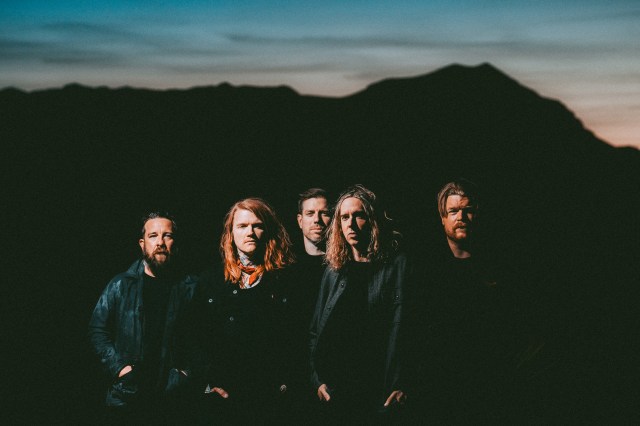
Underoath has always done what they want, not what was safe, not what was easy, but what the Tampa-born post-hardcore quintet has been interested in pursuing. After achieving their “big break,” as cliché as it is to say, with their fourth full-length studio album, They’re Only Chasing Safety, they faced two paths: stick to the more commercial sound that broke them into the mainstream, or stay true to their artistry. What follows is their 180-degree follow-up LP, the harsher, rawer, Define the Great Line.
That record, which defined the trajectory of their career, turned 20 years old this year. Founding band member Aaron Gillespie had many opinions on it as he sat down with Hit Parader. Talking about Define the Great Line was just the beginning of this conversation, and it ended up covering so much more. Fully aware of the luck the band had needed to reach this point, the gratitude resonated throughout the room for the entire interview. But what a joy it was to talk about it all.
Hit Parader: So, with this year being the 20th anniversary [of Define the Great Line], what qualities from that era have functioned as a throughline for the band, even after all the experimentation afterward?
Aaron Gillespie: That’s a good question. No, I think that we do whatever we want. And I think it really started before then, but I think this sounds so weird. But we make music for ourselves. That’s why with the band, you’ve never heard records that sound the same very often. But I think on that record, what we probably should have done, music business talk, songwriter talk, was make a Chasing Safety part two, and it probably would have been huge. And it probably would have been huge for 15 minutes, and then we wouldn’t be in this room today. I think Define the Great Line saved our career in the sense that we had a little case of the “fuck-its.” And really, it was simple. Back then, this is pre-computers on stage and stuff. So we were like, “This record we just put out that was successful, Chasing Safety, we didn’t sound like that live.” It was more chaotic, and it just had more of an energy. So we’re like, “How do we capture that on an album?” Hence, Define the Great Line.
HP: It was definitely a detour from the sound because it was a lot more jagged, like you were talking about.
AG: Yeah, and I think that it saved our career, and I’m glad it was successful, and that’s awesome. But honestly, what I consider more important than that is the fact that we’re here now. And I think we’re here now directly is linked to that album and the way that we made it, because I think our fans came with us. They grew with us. So every time we put something out, even if they hate it, they’ll listen to it. And I think it’s because they just don’t know what’s coming next. I hope the expectation of not knowing what to expect keeps them interested in it. And in truth, it would be cool to be like, “Well, we make stuff weird.” We don’t know what we’re gonna do ever.
HP: And that keeps it interesting for you as well. That’s how you stay invested in a career 20-plus years.
AG: Well, my favorite thing, I write a song every day for somebody else. I have a studio on Music Row, and I’m in that whole mix. And I’m 43 years old, and I still love every day not knowing. I don’t know. You think you know sometimes. Some country singer will come in, and you’re like, “I know what this is. I know what this is going to be today.” And then they tell you something about their family or something they’ve been going through, or they tell you they heard this snippet of something and they want to make this pivot, and you get to be a part of that. And I still love it very much, and I think it’s a miracle in some ways. As woo-woo as that sounds, you open your computer every day, and you don’t know what the fuck is going to happen. That’s what gets me out of bed in the morning.
HP: There you go.
AG: Because the rest of it is bullshit.
HP: Tell me more.
AG: Just the business of it all is bullshit. It’s bullshit. All of it’s bullshit. You have to live through your phone. That’s bullshit. It’s what we do, but it’s bullshit. But waking up every day, before any public or any fan or anybody hears it, it doesn’t exist, and you get to be part of that birth. As woo-woo as that sounds, that’s the only part that isn’t bullshit.
HP: And the only part that actually has some form of creative input, as dumb as it sounds.
AG: Well, and I would say now, as sad as this comment is, it’s probably the least important part. Now it’s engagement, it’s activation, which is fine. I’m not one of those people that’s like, “I hate the internet.” That’s not what I’m saying. But I’m saying it’s probably the least important part now. But to me, you can’t make none of the bullshit without that.

HP: Fair enough. When Define came out, it was a very unique time in the heavier music scene, with the Warped [Tour] scene, MySpace, and metalcore on the rise at that specific time. Was there a specific time when you realized that Underoath became something bigger than a band, beyond your personal bubble and the scope that you could actually comprehend at the time?
AG: I think there’s two types of bands in this respect. I think there’s a type that believe their hype, and there’s the type that don’t. The five of us, nothing is serious. We make the music, and we take it very seriously, and we put on a really good show, and we take it really seriously. But the rest of it is bullshit. And what I mean by that is we’re like brothers. I can be the best I can be, and I can’t impress Tim. He might go, “That’s fucking cool,” but he won’t go, “Dude, you’re the guy.” We’re not gonna say that to each other. We’re just not. I could say that to you right now. I don’t know you. But we’re like brothers. So there was a few seminal moments with Define the Great Line. When it was released, it sold 100,000 copies in five days, which is a funny thing to say. And I think we were all like, “Wow.” But the things that people say, like that statement, I just don’t know how to take that. I’m just a guy in a band that got lucky.
HP: There are also two types of people in the industry: people that can recognize that, and people that can’t, in terms of just being grateful to where they got to be.
AG: Tim calls it stepping in shit. So we all have older kids. My son just started his first band. He’s 14, just started high school last week. And I asked him one time, and I don’t remember the context of the conversation, but it was a conversation like, “What do you want to do when you’re bigger?” One of those, “When you grow up, what do you want to be?” And he said, “I’m gonna be in the family business.” And I said, “What’s the family business?” He said, “What you do.” And I said, “This is like getting struck by lightning.” It really is that way. And if you can believe it that way, and still make the best shit you can make and put your best foot forward, but you can believe it that way, maybe you’ll be a good person still. I believe that. Maybe you’ll still be a good guy that people want to talk to, or a good gal that people want to talk to and hang out with. If I went around carrying with me what you just said, if I went around, I would be an asshole. I don’t want to be an asshole because of 11 songs that I was a part of. I’m so thankful. We’re so blessed and lucky that people really resonate with something that we made. But if it defines you, you’re in trouble.
HP: If you were around 22/23 at the time when the record came out, at that age, if you could put yourself in your shoes at that time, how did you envision where you were going after that, creatively, in terms of success? And what do you think they got right and wrong at that point in time?
AG: I got everything wrong. Well, what are you, 21, 22?
HP: 22, yeah.
AG: Yeah. Can you imagine what you’re gonna be like when you’re 43?
HP: I’ve got nothing.
AG: That’s what I’m saying. And it was dope to be successful. And I grew up on food stamps, poor as hell. It was awesome to not be poor, and it was awesome to have what seemed like the semblance of a career. But I didn’t think I’d be in a dressing room 20 years later still talking about it, or going on this tour for it. It’s the biggest tour we’ve ever done. I didn’t think that. You don’t think that way. That’s when you get older, I can see 63 now, easy. It’s different, right? But when you’re 22, 23, with all due respect, you’re an idiot.
HP: No offense taken.
AG: And I mean actually an idiot. You don’t know what’s gonna happen. And then you’re 43, and you’re still an idiot. You just know a couple other things. I don’t think I had anything. Just like you just said, “I got nothing.” I think that’s really what it was like: “I’ve got nothing.”
HP: That’s fair. With They’re Only Chasing Safety, we were talking about how it made the band a little bit more accessible, and then Define the Great Line was a bit more abrasive, in a sense. How conscious were you of risking momentum to keep true to what you wanted to make at that time?
AG: I just don’t think we cared about it.
HP: So it wasn’t that deep.
AG: No. Like I said a few minutes ago, we could have made a Chasing Safety part two, and it would have been huge. KROQ in L.A., which is still a radio station, was at the time the most important radio station in the country for rock music. If you got on that, that was making a band. They came to us and said, “If you do an edit of ‘Reinventing Your Exit,’ we will give you drive-time play. It will be huge.” And we were like, “No, thanks.” And if some kid said that to me now, I’d be like, “You’re an idiot.” But the reality is, I really think it’s why we’re sitting here.
HP: Did you know that at the time?
AG: No, fuck no. No, fuck no. I just didn’t want them to take the screaming out of the song because I thought it was sick. And the brutal truth is, if I would have been alone, I probably would have done it, which scares me a lot. I probably would have been like, “Yeah, do it. Fuck it. I want to be on the radio.” Being like, “This is a dumb idea.” You get together, and you’re with your boys, and you’re like, “Wait, why would we? We made this what it is, and it’s successful because of what it is. So why would we make it something different just to be more successful? It makes no sense.” Again, there’s that mentality of we didn’t grow up with anything, so more is more is more is more. It’s like, wait, at what point do you not need anything else? At what point is enough enough? We wanted to sell out 400- and 500-cap rooms, not a fucking arena. We could tour before Chasing Safety came out, and when it first came out, before it happened, we could tour for $250 a night, $200 a night, and just be happy eating Wendy’s and playing for 100 people. Warped Tour ’04, when it blew up, we were getting $150 a day to play for the band.
HP: How many stops was that at the time?
AG: Between 40 and 60, something like that. It was all summer. There would be historic runs back in the day of Warped Tour. You’d go 17 in a row, 20 in a row, 18 in a row. Granted, they’re 30-minute shows, where now we play for 90 minutes or whatever the fuck it is. But we thought it was awesome because we were selling merch like crazy, more than we ever had. Every day, the shows got bigger because the record was growing. I didn’t give a shit about the $150. We didn’t care. You could do it then. Now it’s like you gotta have in-ears, and you gotta have this bullshit, and you gotta have all this stuff.
HP: You gotta build a playback session.
AG: Yeah, it’s crazy. And if you don’t know what you’re doing, if I were a 21-year-old kid and I had never opened Ableton, I’d be terrified. “I want to do what now? I gotta split this how? I need what to get this from A to D?” It’s just different, bro.
HP: It’s different in the sense that it’s also tougher to access that sort of stuff, but it also is somehow more accessible than it ever has been in terms of the tech stuff.
AG: In a cool way. I think the great thing about all the bullshit is you could feasibly, if there wasn’t Paramore playing [in the room right now], record a guitar and a vocal in here and put it on Spotify. That’s cool. When we started, that didn’t exist either.
HP: Has your relationship to any of the songs changed after the 20 years of playing them live and hearing them?
AG: I don’t know. Sometimes you wince at lyrics. When you’re 43, and you’re singing something you wrote when you were 22, you’re like, “That’s silly,” or, “That feels trivial or childlike.” But you’re on stage making a living, and there’s all these people that know all the words and have them tattooed on them, some of them, and it means all that to them. And it meant all that to you, and you wrote it down. So somehow, in that symbiosis of that happening, it means everything to you again. If you read me lyrics or something, I’d be like, “Ew.” But when you walk out there, and you see it all, and I see the exchange happen. It’s a spiritual exchange that happens with those people and back and forth with you. That’s magic, and that’s why you did it. And then it becomes as important as it was when you wrote it down 20 years ago, in that moment. But on a Friday night in my hometown right now, I’m like, “I don’t know.”

HP: With the 20th anniversary tour coming up in November, there’s a tendency for anniversary tours to sometimes become nostalgia exercises, but Underoath has always prided itself on evolution. What’s your approach to celebrating the record without feeling constrained in any sense?
AG: The set list is the record, right? But we fucked with the songs and in between the songs, and we played over spots that we’re not supposed to. And it’s just us doing our thing. You can’t really change the songs, but there are things that, in between songs, we’ve done. And there are songs that have no real music to them, that we’ve added music to. When we did the Chasing Safety run, we put a couch on stage, brought people on stage, and started the record backward. We did all this shit to just make it—you don’t want to just go phone it in because then it is a nostalgia exercise, or whatever the hell you said [laughs].
HP: [laughs] I just feel like doing something that is too close to the record is sometimes against the intention of the art.
AG: You gotta play the songs like they are. But we’re not going to present them as we did 20 years ago.
HP: Yeah, of course.
AG: Because that would be untrue to us. And you gotta play “Writing on the Walls” the way it’s written. You’re not going to play it acoustic. People will fucking throw shit at you. You have to do it, but you still gotta make it artful, and you gotta make it a special night for the people who paid. Tickets aren’t cheap anymore. You’re not going to come see Define the Great Line for $15. So give people their money’s worth. Let them know that you worked on it. That’s my thing. That’s what I’m saying.
HP: Yeah, of course. The saying I always love is anyone could listen to the record on Spotify. They came to the show to see you.
AG: Well, and those are different people. I think it’d be cool if I went and saw the Stones, and they played “Satisfaction” acoustic. It would probably be a horrible idea for their audience, but I think it’d be cool because I know how the sausage is made. I want to see you put the sausage on a pizza. But the fans who literally put our kids through school and pay for the roofs over our heads, they want to see how the sausage is made. They don’t want the sausage on the pizza, so you gotta give them that. But give one for you, give one for me. I’m gonna do some bullshit in between these two songs, some musical experiment. I’ll give you Define the Great Line, but let me fuck around in between the songs a little bit.
HP: Yeah, that’s fair.
AG: I’ll bring you the sausage, but I’m gonna do the slice of pizza on the way to give it to you.
HP: Just to wrap up, top three things you’re most excited for for the rest of the year.
AG: I’m excited for Christmas. I don’t have a weekend off from now until Christmas, so I’m excited for that. I’m stoked for the tour, of course, just because it’s a celebration, but I also feel like it’s a period in the last two crazy years we’ve had. We’re gonna attempt to go away and see what writing songs looks like, which we haven’t done in years. So I’m excited to do that. This is next year. For the rest of this year, though, we’re doing a bunch of cool festivals. We’re going to Mexico City in two weeks. I love that place. I’m excited to be on a regular tour.
HP: The Road to Warped shows?
AG: Yeah. We played 500-cap rooms. It was insane and 1,000 degrees, and it was so fun. But I’m excited to just go on a regular tour to where I can have a routine again. And then we’ve been flying every weekend. We were in Canada last weekend with Alexisonfire for their Crisis 20-year thing, which was bananas. But I’m excited to be on a regular tour and have a routine.
HP: What’s one thing about touring that you value now but didn’t know you needed back when you were playing smaller rooms?
AG: I love this. I don’t know. Now, it feels the same in the sense where you’re on stage every night, obviously, and you’re doing that thing. But that’s not the best part of touring. The best part of touring is the little conversations you have with people and the connections you make. And back then, you didn’t know. It was whatever I can do to get to the show and get through the show. Now it’s like, what are these micro-connections to make during the day or after the show? I think about this often too. I’ll see someone on the front row, and I wonder what they’re thinking about. And it’s a fun game that I play with myself. Where’d you come from? I love that thought. I don’t know if that makes any sense, but I look at someone or a group of people, and they may be over here or 10 rows back or whatever, but they’re having this great time, and you wonder, “Where’d they come from?” And even smaller, did they have a good day or a bad day? What’s it like to be them right now? And what happens to them when they go home, when they get in the car with their significant other or their buddy? What are they going to talk about? And it’s not, “Are they gonna say we were dope, dude? It’s fucking sick, Joe.” No, it’s more, “What are they gonna eat tonight? What are they doing here?”
If you would have told me when I was a kid that people would pay money they made at their job, a lot of them, and get in a room and watch you do something, it’s the most odd shit to me ever that I don’t understand. I love it. I’m so thankful.
HP: But the throughline is that they care about your music.
AG: It’s crazy, and I care about making it for them.