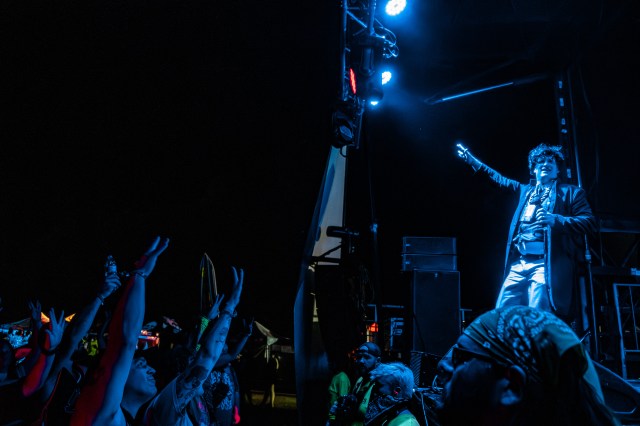

At one in the morning on Wednesday, August 19th, I walked onto the Cyclone Stage in Macks Creek, Missouri with MC Snax and rapped about Edgar Allan Poe for a restless crowd of Juggalos who had traveled in from every corner of the earth.
I went on after Crossbreed and before Bible Belt Massacre. Two hours earlier, Acid Kult had opened the night with something billed as a Goat God Summoning. I am a Stanford English major who has spent twenty years writing songs about nineteenth-century literature, so on paper I was the strangest thing on that bill.
I want to explain why I was the least strange thing on it.
It Starts with a Cassette

In the early Nineties, when I was a kid in rural Carmel Valley, California, I traded tapes through the mail with strangers I met on Usenet. Prank calls, mostly. You found your people on a text board at two in the morning, argued with them about something nobody else on earth cared about, and then mailed each other cassettes. Bootlegs of bootlegs, every copy a little more worn down than the last, like a photocopy of a photocopy of somebody’s laugh. When the pranks ran out before the tape did, whoever dubbed it would fill the leftover space with whatever else they had lying around.
That is how two clowns from Detroit ended up in my Walkman.
Nobody sold them to me. No algorithm recommended them. A stranger in Michigan had extra room on a cassette and thought, “here, kid, you might need this.”
He was right.
This was my fourth Gathering. I first came in 2018 with Mega Ran, and I have been back since to both perform and to host, but this was the first one with my own set, billed under my own name. From a stranger’s leftover tape space to the Cyclone Stage takes about as long as it sounds like it takes.
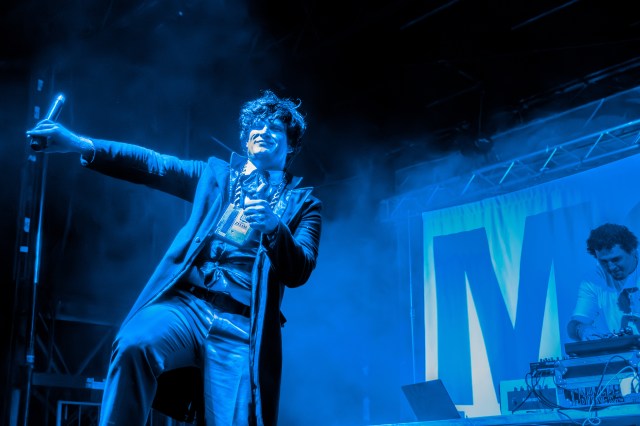
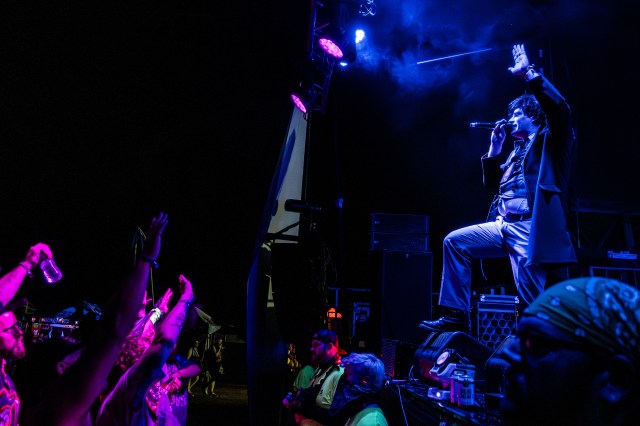
Some of the Juggalos already knew me, but most did not. There was a short beat of pure confusion when I started talking about Poe and lit-hop instead of launching straight into the music. I took the mic and explained, simply, that I had loved this world for a long time, that nerdcore and horrorcore had always been cousins, and that the Dark Carnival and the Gothic tradition were speaking the same language. By the end of the set the confusion had turned into dancing.
Snax is a Canadian rapper, a Juggalo, and my co-host on Hatchet Chat, a podcast where we go through the ICP catalog album by album and treat the Dark Carnival as a body of work instead of a punchline. That show is the homework, and it is also the reason I was standing on that stage instead of watching from the lot.
The Lake is Already a Horror Story

This was the 26th Gathering and the first at Mother Nature’s Riverfront Retreat, a quiet bend of the Lake of the Ozarks. No Juggalo had ever camped this ground before. Almost none of them knew what they were camping on top of.
The Lake of the Ozarks is not a lake. It is a reservoir, fifty-four thousand acres of it, created when Bagnell Dam blocked the Osage River. Construction began in August 1929, weeks before the stock market collapsed. It was sold as progress. It began as a fraud.
Thirty thousand acres had to be cleared first. Homes were burned. Old Linn Creek, the county seat, was razed and now sits under about forty feet of water. Families who had farmed that valley for generations were bought out, forced out or condemned out. Survivors said afterward that their lives simply fell apart. Local folklore still claims that on the right night you can hear the Linn Creek church bell ringing under the water.
Then there are the graves. Union Electric documented roughly sixty cemeteries in the flood zone and about 2,800 graves. Only 1,121 stones were clear enough to locate and move. The rest were marked with rough rocks, with initials, or with nothing at all. Exhumations happened at night so families would not have to watch. Where the remains had already turned to soil, crews moved a shovelful of dirt as a symbolic transfer and called it finished. A few families stood over particular graves with shotguns and refused. Those graves stayed.
More than a thousand people are still down there.
Here is what I could not stop thinking about once I knew it. The fourth Joker’s Card is The Great Milenko, the carnival’s illusionist. He never hurts anyone. He would not dream of it. He simply shows you a beautiful thing you almost have, and takes a little more of you for it, and then a little more. The card came printed with its own warning, and the hook is the entire history of that valley in one line. Great Milenko, wave your wand. Don’t look now, your life is gone.
The lake was sold as progress. A Midwest paradise. Jobs in a depression, power for everybody, a bright new shoreline. That was the wand.
Here is what was under it. A Kansas City land bank was stuck with a pile of foreclosed farms it could not sell, dead paper rotting on the books. So, the bank swapped those dead farms for bottomland along the Osage, and a power company announced it needed that same bottomland for a reservoir, and the man running the bank was the man running the power company.
He was selling to himself.
On the ledger it looked like a market had appeared out of nowhere. There was no market. There was a valley that had to go underwater for the numbers to work. That is the whole trick, and it is the oldest one in the tent: make a real place disappear and worthless paper turns into an asset. He got eighty-eight counts and a cell in Leavenworth in 1933, and by then it did not matter, because Union Electric had bought the rights and the dam was already going up.
The people who paid were farmers who had been on that ground for generations, and the dead who could not be moved cheaply enough to be worth moving. Rich men drew a line on a map, and more than a thousand graves went under.
That is not a metaphor for the Dark Carnival. That is the exact thing the Dark Carnival was built to warn you about. The illusionist waves, the beautiful thing appears, and the people at the bottom of the lot are the ones who pay for it.
So that is where they put the Gathering. On top of the con, in the flooded valley, in the one place in America where you can stand on the evidence.
You could not write it better.
The Parlor Game

There is a game I have been playing since I was a teenager and have never been able to stop. Name any sick, beautiful, or awful thing Edgar Allan Poe wrote about. Any of them. I will show you that Insane Clown Posse made a song about the exact same thing.
Poe wrote about a man driven to murder by an old man’s clouded eye, who hides the body under the floorboards and then hears the dead heart beating until he confesses just to make it stop. They have that one.
Poe wrote about a lunatic who stabs an animal and bricks a body into a wall. They have both. Poe wrote about a man escaping a pit and a descending blade by inches. They have it. Poe wrote about cannibalism born of pure desperation. They have that one too, and honestly, I wish they didn’t.
Poe wrote “Annabel Lee,” love surviving into the tomb and past it, the narrator lying down in the sepulchre beside her. ICP wrote “In My Room,” where a dead girlfriend comes back as a bloody ghost and gets into bed with him. It is the most Poe thing ever committed to tape. A couple of years ago it became a TikTok hit, which means the American gothic clawed its way out of a garret in 1849 and onto the For You page on a record by two clowns from Detroit.
And then there is “The Masque of the Red Death,” where the rich lock themselves in a castle to party while a plague takes the poor outside, sort the guests by rank, and Death walks in wearing a costume and takes the people who assumed the walls were built for them. That is a Poe story. It is also the single most Juggalo sentence I can construct. The clowns have been making that exact argument for thirty years.
Here is the part that should keep you up at night: they did not get it from him.
Nobody handed those guys a Norton Anthology. There was no syllabus. If one artist copies another, that is influence, and influence is boring. When two artists who never met arrive independently at the identical horrors, a hundred years apart, that is something else. That is the thing being real.

In school you get the optimists. Emerson, Thoreau, Whitman. Nature is good, people are basically good, trust your own heart. They had a shadow. We call them the dark Romantics, the anti-transcendentalists: Poe, Melville, Hawthorne. Same country, opposite verdict. Nature is brutal, people are corrupt, and the proof is everywhere if you are honest enough to look. Their monsters were never just scares. A monster was a funhouse mirror for everything that can go wrong inside an ordinary person, including you.
Horrorcore is that branch grown again from the root, in Detroit and Houston and Sacramento instead of Boston and Baltimore. Esham, who basically invented the lane, refused to let me shrink it to a genre when we had him on Hatchet Chat. “A lot of people think it’s a sound,” he said. “It’s not necessarily a sound. It’s a feeling. It’s a bunch of feelings, actually.”
That is not a description of scary noises. That is a description of reporting the truth of where you are standing, when where you are standing is grief and dread and no money. Which is the entire content of Poe’s short, ruined life.
And where do respectable people file the American gothic every time it surfaces? The trash. Which is exactly where Poe was standing while alive: broke, sneered at, dead at forty in Baltimore in somebody else’s clothes. The literary establishment then took a hundred years to slowly decide he was a genius. In 1997 a Disney-owned label got frightened of ICP’s The Great Milenko and pulled it off the shelves the day it came out, and the recall is what made them platinum. Garbage is the return address on every piece of American art that ever mattered. ICP is just still inside their hundred years.
What the Week Actually was
I was not a guest. I was staff.
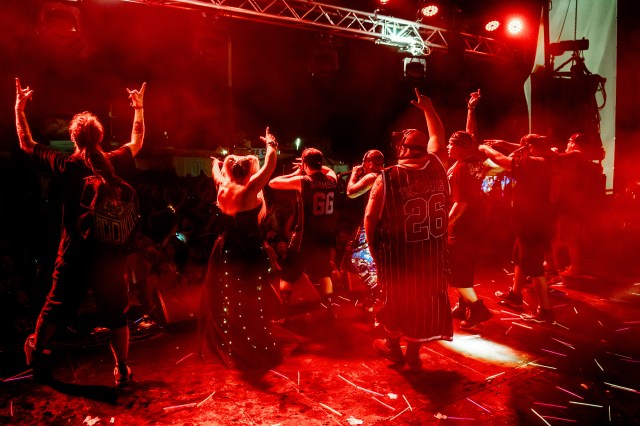
Across four days I hosted contests, stage-hosted the Thursday night concert on Cyclone from eleven until half past two in the morning, and ran Saturday evening on Kraken from six to eleven. They gave me an all-access wristband and meal tickets for a catering tent that served a late meal from midnight to one in the morning, which tells you everything about the schedule that place runs on.
When we first signed in, Jumpsteady, J’s brother, handed us tick spray like it was the most normal welcome gift in the world. That is the whole operation in one gesture. Everybody outside thinks it is pure chaos. Inside, somebody has thought carefully about ticks.
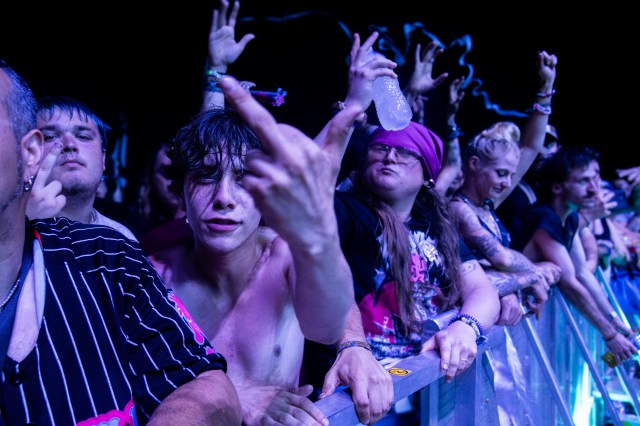
The golf carts never stopped. They raced up and down the hills all night, headlights cutting through the trees, people hanging off the sides. Different generations kept finding us: older Juggalos who had been coming for twenty years, younger ones who only knew the TikTok era, and a group of Australians who spent half the night swimming in the river like it was the most natural thing in the world to do at a festival in the middle of Missouri. At three in the morning the place was still fully alive, and riding the cart made you feel like the only person with somewhere specific to be while the carnival kept turning around you.
Miss Juggalette was the one that stayed with me. The easy version of this story sneers at it. The real version is that the women who got on that stage were brave. Some of them read poetry. One did skateboard tricks. They treated the contest like a performance and a declaration at the same time. Nobody was there to be laughed at. They were there to be seen, and the crowd saw them.
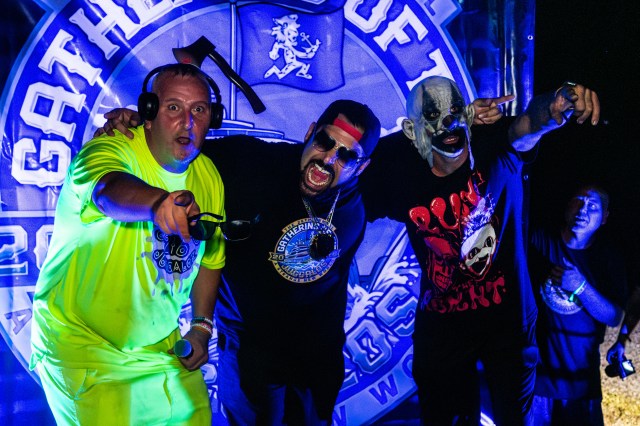
The music was genuinely good, and I want to name names, because the easy version of this article treats the lineup as background noise for the chaos. Kung Fu Vampire played “Cyclone” around quarter past one on Thursday night, a Bay Area lifer still delivering on pure independent grind. Acid Kult’s “Goat God Summoning” opened Wednesday and was closer to a ritual than a set, dense and esoteric and actually lyrical. Long Live Evil, the Ohio collective around Alla Xul Elu, played multiple sets with total commitment to a very specific doom-bap tradition. Diggy Graves came through Thursday evening with the most melodic and emotionally direct material of anyone I saw. The Hatchetman Project rebuild classic ICP songs as heavy metal, each member representing a different Joker’s Card, a love letter executed with real musical muscle. Ouija Macc brought the eerie late-night Psychopathic atmosphere only he seems able to lock into, dark trap with real weight behind it, the kind of set that sounds like it is coming from inside the mythology rather than standing next to it.
Every one of them is independent. Every one of them is building a world instead of chasing a lane.
Snax and I debuted a new song that Wednesday night called “The Black Cat Came Back,” off my Poe record, and then I sold merch and signed things for a long time afterward. The people who came up to that table already understood the crossover. Nobody needed the thesis explained. That was the quiet proof of the whole thing.
What Poe Would Have Made of It

The first Gathering happened in 2000 because ICP got tired of waiting for a promoter to book them a festival, so they built one. No permission, no gatekeeper, just a lot and a family. That is the actual lesson under all the face paint, and it is the one I have organized my entire career around: when the midway is rigged, and it is rigged, you do not beg the barkers for a fairer game. You walk to the edge of the lot and you put up your own tent.
The FBI once classified their fans as a loosely organized gang. An actual federal document, filing the fans of a band next to cartels. So they printed it on t-shirts.
There is a word for that. Nassim Taleb calls it antifragile: not merely surviving stress but feeding on it and growing. Glass breaks. Plastic endures. Some things eat the attack. Every meme built to humiliate the Juggalos spread their mythology further. Every insult became a badge. They turned ridicule into ritual and exclusion into the thing that defines them, and you cannot beat a group like that by attacking it, because the attack is the food.
Aristotle had the other half of it. Catharsis. Looking directly at the terrible thing, in the safety of the theater, does not damage you. It cleanses you. It lets the fear move through instead of hardening inside. A horror story does that. A horror song does that. The people who pretend the dark is not there are not braver than the people who write about monsters. They are just less ready for the night the monster actually shows up.
One thing before I close, because borrowing has rules. The Dark Carnival is not mine. ICP spent three decades building it as a serialized morality cycle, a judgment machine that looks at how you lived, what you did with what you were given, and how you treated the people at the bottom. Hell’s Pit for the cruel and the fake. Shangri-La for the ones who told the truth and took care of their people. When the sixth card turned over in 2002 they dropped the act entirely and said what the freak show had been the whole time: a sermon, smuggled past everyone who would have refused to hear it in church clothes. I use their architecture the way I would borrow a sonnet form. The reading is mine. The cards belong to Detroit.
Which brings me back to the water.
Underneath that festival is a valley where the state burned the houses, moved a shovelful of dirt where a body used to be, and let the rest go under so a bank could clean up its books. That is a genuinely American horror story and nobody put up a plaque. Ninety-five years later, thousands of people the mainstream also decided were disposable pitched tents on top of it, painted their faces, and spent four days insisting out loud that they are family and that they are not going anywhere.
Not a fan club. A family. The kind that shows up. The kind you get free with your losses.
Poe would not have found that ironic. He would have found it correct. He spent his whole life arguing that the thing you refuse to look at does not leave. It waits, and it comes back louder, and it usually comes back wearing something ridiculous.
I did not go to the Gathering as a tourist. Some stranger put those clowns on the end of a tape thirty years ago because he had space left over and thought I might need them, and he was right, and this August I finally got to say thank you into a microphone at one in the morning to a field full of people who already knew.
Whoop whoop.