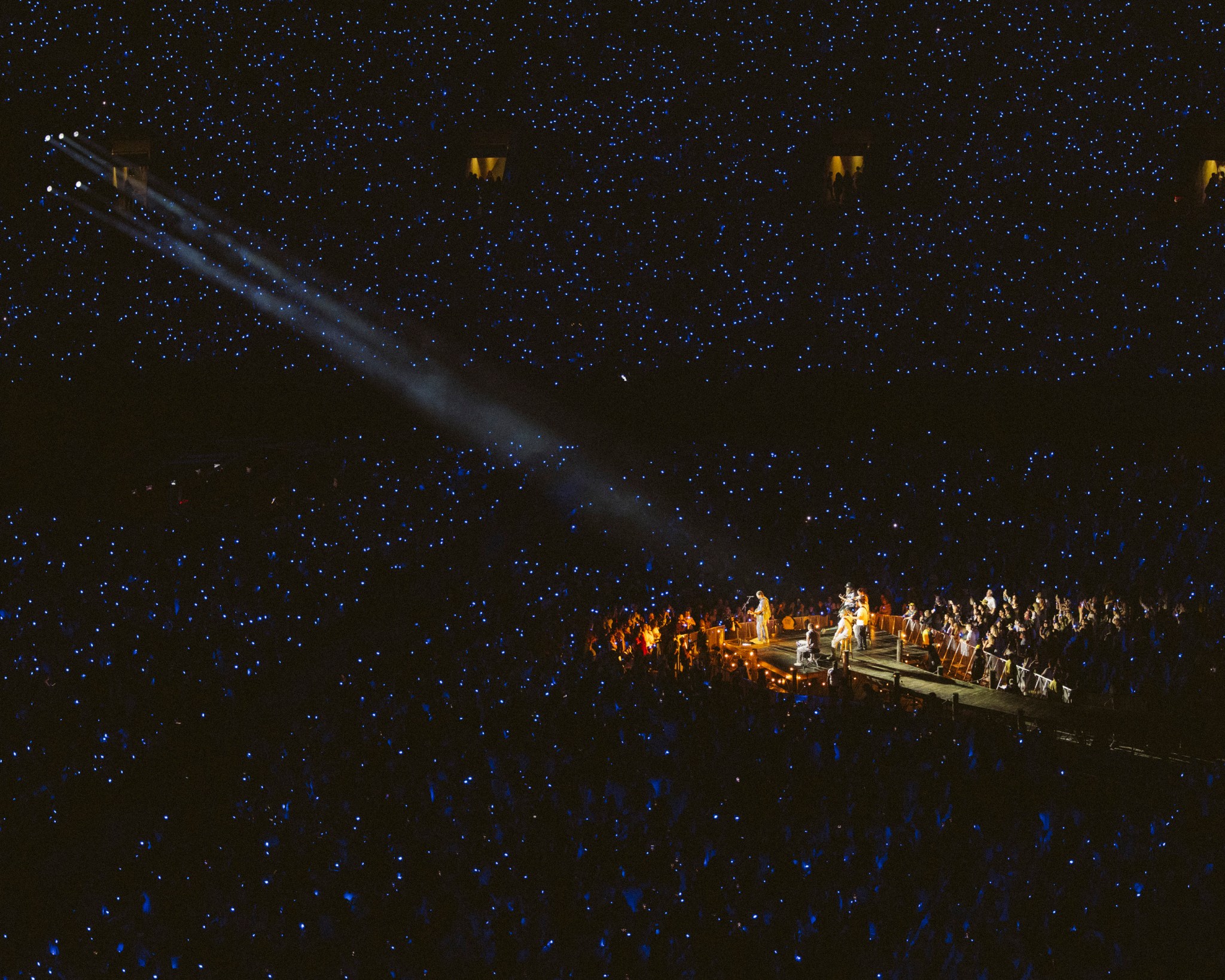
I’ve never been told to arrive at a concert three and a half hours before the artist came on stage, so my expectations were already high. But I quickly realized this wasn’t going to feel like a normal concert. Noah Kahan really did shut down Pasadena.
By 4:30, streets were blocked off, parking garages had lines, and people in cowboy boots, bug costumes, and Noah Kahan merch seemed to be everywhere. Pure mayhem. As we drove toward the parking lot, I kept seeing more and more people dressed for the concert. I finally looked up how many people the Rose Bowl could hold and saw 92,000 people. That is about four times the capacity of Crypto.com Arena, which I already thought was huge. Safe to say, I had no idea what I was in for.
I also found out that people had shown up the day before just to get merch, and some arrived at 8 a.m. even though early merch access didn’t start until noon. That was my first clue that this wasn’t just a huge crowd. These were committed fans.
When we got to the shuttle line, it was PACKED, so we decided to add a little excursion to the experience and took a pedicab to the front of the Rose Bowl. I think everyone should do this at least once in their life. It went way faster than I expected and was hilarious, especially because our driver kept yelling at people not to jaywalk.
We shared the pedicab with two other fans, and while we were holding on for dear life, we started talking. That was my first experience with something I would notice throughout the entire night, Noah Kahan’s fan base is incredibly kind. As we got closer, we saw thousands of people walking up the hill toward the stadium. It looked like one giant migration.
When we arrived, the line wrapped so far around the Rose Bowl that we couldn’t even see the end. We thought the merch line wasn’t that bad until we realized it just kept going and going. I don’t blame them, though. This was some of the best and most wearable concert merch I’ve seen. The ladybug shirt was definitely my favorite.
Security gave everyone a bracelet that would light up during the show, and once we got to our seats, we caught the end of Annabelle Dinda’s set. Her last song was “Gunpoint, Headlock,” a song that captures what it feels like to be trapped inside your own mind during a panic attack. The fast lyrics and overwhelming feeling of the song make anxiety feel almost physical. Hearing thousands of people sing along made the meaning even stronger. A song about feeling isolated suddenly became proof that you aren’t alone in those feelings.
The sound system was also incredible. Even when I was walking around toward the back, I could hear every lyric clearly without an echo.
Then came Gigi Perez, whose music deals with grief, identity, religion, family and other difficult emotions. Somehow, she makes painful topics sound beautiful. Her performance reminded me that beauty can still exist within difficult experiences. As a huge Lana Del Rey fan, I was also thrilled when she covered “Summertime Sadness.” Her voice had so much emotion behind it while still being strangely comforting.
As more people filled the stadium, I started looking around. Most people had come with someone, whether it was their family, friends or a whole group. Everyone had brought their own little community with them, and together those smaller groups were becoming one massive community, one big enough to sell out the Rose Bowl.
Then a countdown appeared on the screens.
5… 4… 3… 2… 1.
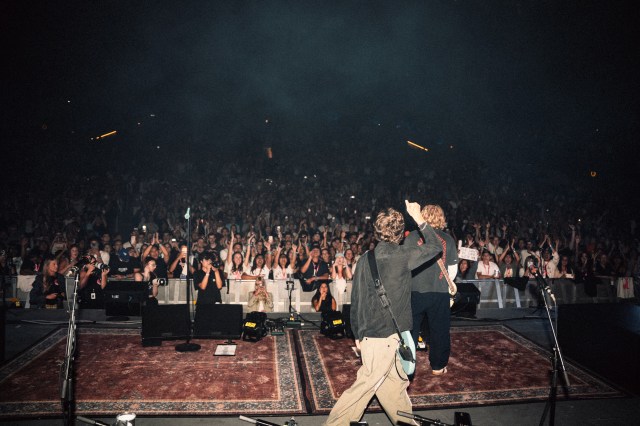
That was my first time hearing what around 90,000 excited people actually sound like.
Every bracelet lit up. Part of the set lowered down, and Noah Kahan walked onto the stage to “American Cars.” The song explores the heavy emotional toll of watching a family member spiral into severe alcoholism. With thousands of bracelets glowing around the stadium and everyone singing together, it was one of the most beautiful concert openings I’ve ever seen.
It also didn’t take long to realize that Kahan wasn’t going to be one of those artists who says, “I love LA,” thanks everyone for coming, and goes right back to singing.
He talked to us like we were his friends.
He joked with the crowd, thanked the people in the suites for shopping at Erewhon, and even pointed out that there were so many of us and only one of him that we could all technically team up and murder him. It sounds ridiculous written down, but that was exactly what made the show feel so personal. Somehow, in a stadium filled with tens of thousands of people, he made it feel small.

He told us this was the biggest headline show he had ever played.
After a few songs, I noticed something else. It felt like 95 percent of the stadium knew every lyric to every song. There wasn’t one hit everyone was waiting for. The crowd was just as loud for the deeper songs as they were for the biggest ones. That says a lot about the relationship his fans have with his music.
He dedicated “The Great Divide” to California, telling us, “Sing it California, this one is for you.” The song is about distance between people and the fear that sometimes we realize too late that someone we care about is struggling. In a stadium full of people singing it together, a song about separation somehow created connection.
Then a phone started ringing.
Kahan walked over and picked up a giant yellow rotary phone. “God from all religions” was calling, which he made sure to clarify so everyone felt included. God apparently thought his biggest show ever needed a special guest.
The crowd went crazy.
Later, Kahan joked that his team had told him he had an opportunity to spread love and peace to 90,000 people. Instead, he said, “f**k that,” and told us he wanted everyone to be assholes for the next song, “Dashboard”. Apparently, everyone had been waiting for permission, because the stadium got LOUD.
At one point, I had to go to the bathroom, and somehow even that added to the theme of the night. A girl complimented my nails and then let me cut in front of her because I really had to go. It was another tiny interaction with a stranger that made this enormous concert feel surprisingly friendly.
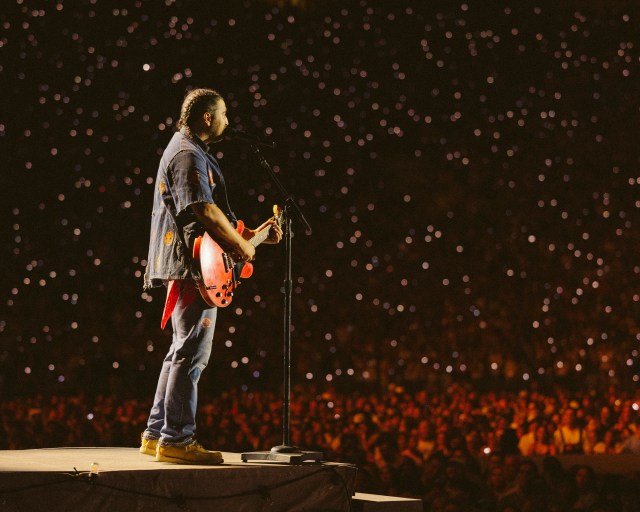
The stage itself was one of my favorite concert sets I’ve seen. It looked like an old wooden general store, covered in vintage signs with “Kahan’s General” written on the side. It perfectly matched the small-town feeling of his music, even though we were sitting inside one of the largest stadiums in the country.
Gigi Perez returned to sing “She Calls Me Back” with him, a song about being unable to fully let go of someone and constantly feeling pulled back toward them.
Then came my favorite performance of the night: “Dial Drunk.”
The song is about someone at one of their lowest points, drunk, arrested and desperately trying to call someone they still care about even though that relationship has fallen apart. The live performance turned the song into an entire scene. Sirens went off, our bracelets flashed red and blue, Noah ran across the stage while a fake police officer chased him, and eventually he was thrown into the back of a police car. Even with everything happening around him, he kept the emotion of the song. It didn’t feel like he was just singing it. He was acting it out.
One of the funniest moments came during “Pain Is Cold Water” when his voice cracked. Instead of ruining anything, it made the concert better. In a show with massive screens, fireworks, lights, and 90,000 people, that tiny mistake reminded me that he is still just a person standing up there. No performance and no person has to be perfect to be meaningful.
Throughout the night, Kahan repeatedly shouted out his New England and New Hampshire fans, never forgetting where he came from.
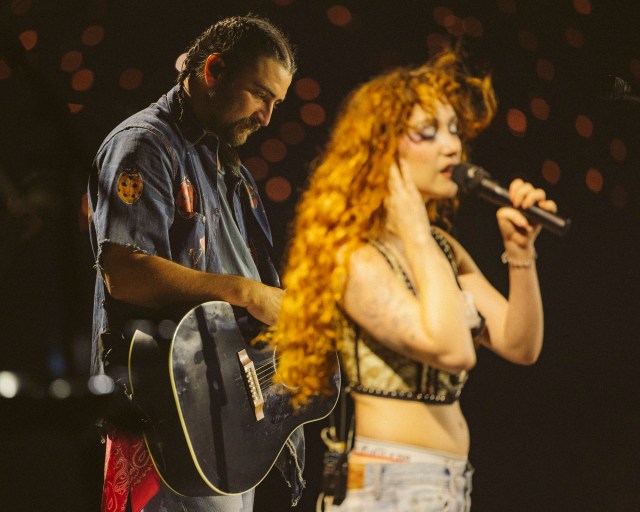
Then suddenly everyone started screaming.
I looked closer at the stage and realized Chappell Roan was there.
She performed “California,” a song about homesickness, loneliness and realizing that chasing your dreams doesn’t always feel the way you imagined it would. There was something especially powerful about hearing that song at this concert. Noah Kahan grew up on a farm in a small New England town, and now he was standing in front of a sold-out Rose Bowl. Chappell Roan’s song shows the painful side of chasing a dream, while the concert itself showed what can happen when you keep going anyway.
Before singing “Orange Juice,” Kahan took a moment to talk directly to people dealing with sobriety. The song is about reconnecting with someone after addiction and trauma have changed both the person and the relationships around them. He told anyone going through sobriety that he was proud of them and then told us that the entire crowd was proud of them too.
That moment captured what made the night different. His songs talk about anxiety, addiction, grief, loneliness, regret, love and feeling like you don’t belong. These are deeply personal experiences. Yet when 90,000 people sing those songs together, they stop feeling quite as lonely.
Then came the finale: “Stick Season.”
The song that helped define Noah Kahan’s career is about being stuck between the past and the future, trying to move forward while memories of someone or somewhere keep pulling you backward. It is a song about change, loneliness and learning to live with what is gone.
As he started singing, I turned to my mom and said, “Wouldn’t it be cool if they had fireworks?”
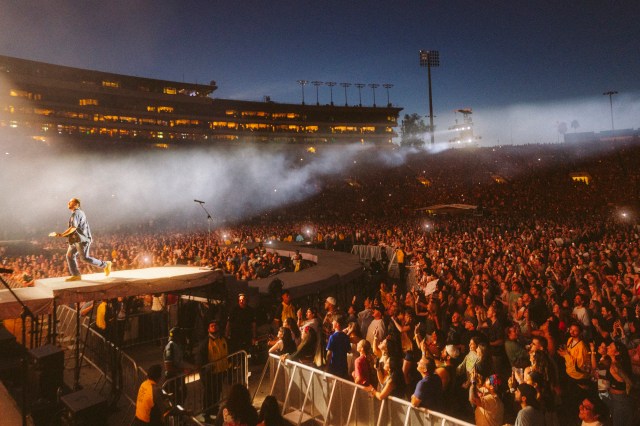
Boom.
Fireworks exploded over the Rose Bowl.
For a few minutes, 90,000 bracelets were glowing, fireworks were going off above us, and almost everyone in the stadium was singing the same words.
Getting out afterward was exactly as chaotic as you would expect. Cars were literally driving across the grass. But somehow, I didn’t even care. I was still caught up in what I had just watched.
At the beginning of the night, the size of the crowd was what amazed me. Ninety thousand people. Closed streets. Endless lines. A sold-out Rose Bowl. By the end, though, the number wasn’t what mattered.
What mattered was what brought those 90,000 people there.
Throughout the night, almost every song dealt with something that can make a person feel alone: panic, grief, addiction, heartbreak, homesickness, regret or simply feeling stuck. Yet those songs brought an entire stadium together. Families came together. Friend groups came together. Strangers talked to each other in pedicabs, complimented each other in bathroom lines, and sang the same lyrics at the top of their lungs.
The tour may be called “The Great Divide,” but for one night, there really wasn’t much of a divide at all.
Noah Kahan didn’t just shut down Pasadena. He brought 90,000 strangers together and made the Rose Bowl feel like one very, very big small town.