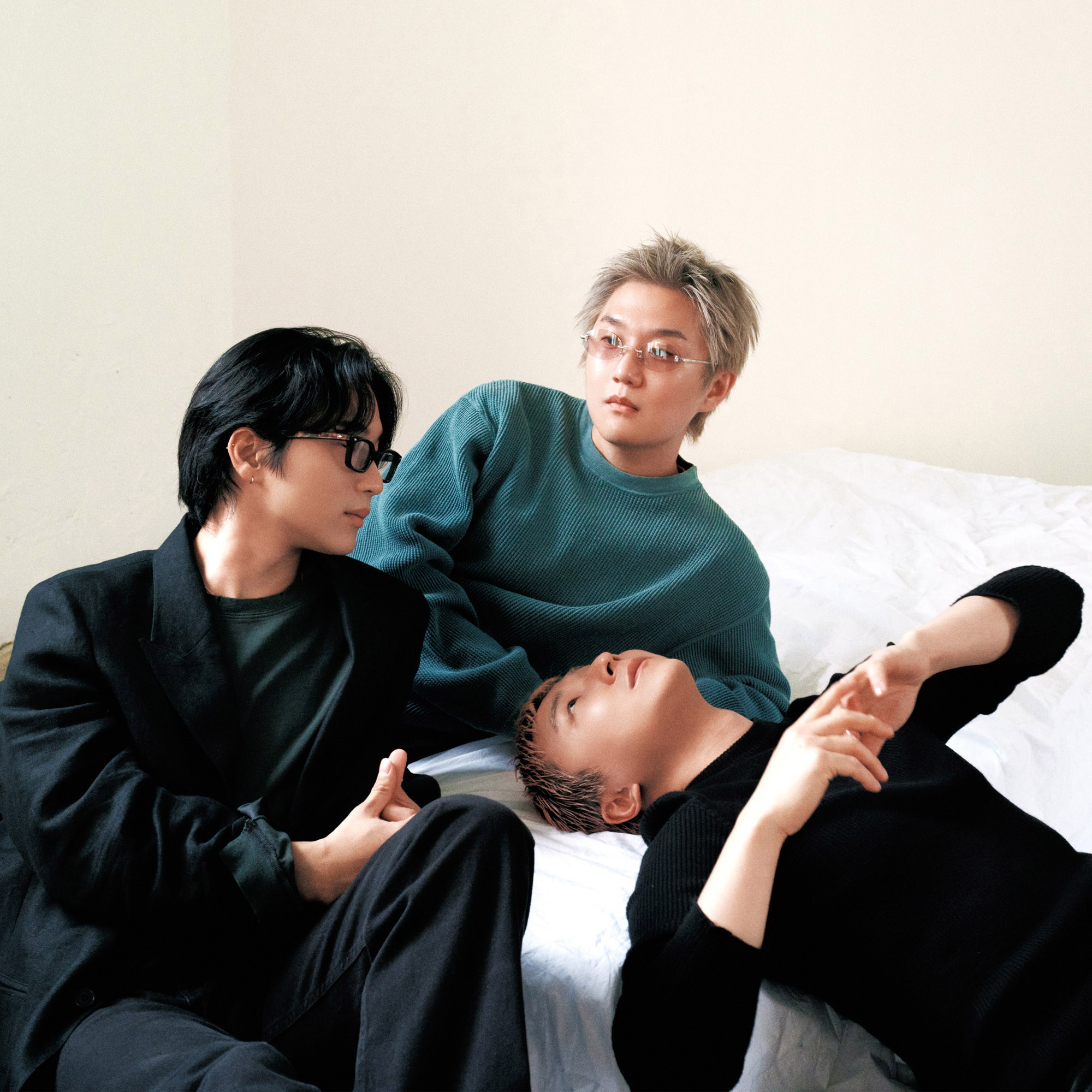
Tranquility is more than just a feeling but a combination of environment, mood, and circumstances. There are not many projects that lend themselves more to helping along this feeling than wave to earth’s new LP, bad pieces. The Seoul trio of Daniel Kim, John Cha, and Dong Q is back after a 2-year gap since their last entry in their discography. With an innovative take on a previous sound and a willingness to break what would be perceived as their old formula. The band has spent the time diligently heading towards a sound that feels both mature and inspired. The sat down with us to give us a glimpse into the writing process, talk creative risks they took on the album, and the intent behind the title.
HP: How is your year going so far?
Daniel Kim: We’ve been working hard trying to make a good album. I’ve also been working on my other band, The Poles. We’ve also been prepping for the tour.
HP: What’s the last notable song you guys listened to?
DK: I recently watched the new Spider-Man movie, and in the end, Steve Lacy’s “Oh Yeah?” is on the soundtrack. I’ve been listening to that one a lot.
John Cha: I bought some vinyls from the old Stevie Wonder records. It was the aquarium album. I’m not sure about the tile. It had “Higher Ground” and “Ribbon In The Sky.” (Original Musiquarium)
Dong Q: Amie Blu
HP: Getting into the album title Bad pieces. What is the story behind the title and what inspired it?
DK: While we were in the process of making the album, one of our team members showed us a photo of Yoko Ono and John Lennon’s bed peace protest bed-ins. We thought it would be fun to play around with those words.
HP: What were the themes that you wanted to display through invoking that imagery?
DK: This album contains songs about growth, about being confused, and about trying to find peace. But apart from that, through the process of creating these songs, a lot of them came out spontaneously, Like, Pieces. We wanted to convey the message of how these are somewhat bad pieces or ugly pieces, but when we put them together, they become one beautiful piece.
HP: Speaking on that spontaneity, when talking about performing in a jazz venue, you were able to improvise more than in other venues. Is that something you plan on bringing to this tour?
JC: It will be more of a curated show because, for bigger venues, we somewhat can improvise, but we set a more detailed show. So it has a large amount of structure to it. For the jazz venues, we have experience with small gig shows. We had jazzy songs and the space for that in the music. For the big venues, it is more structured and curated.
DQ: We actually don’t really think about improvising or internationally trying to improvise. It’s more about what we feel on that day while we are playing and the vibes of the room. WE try to focus on our performance, and then that brings out the improvising. It’s not an intentional thing.
HP: When talking about this new album, it feels like you guys have matured into your sound in a lot of ways. What were the objectives and themes that felt like a focal point going into the writing process?
DK: This album was made in a pretty straightforward, simple process compared to our previous records. Some of these final versions were actually the exact same as the demos. We’ve used the demos as the final version, and there was a lot of mixing. Tossing around demos and masters throughout this entire process. We tried to figure out a way to make a cohesive album throughout with that workflow. Overall, I think as artists, we as individual artists have grown and matured. I think that’s displayed on the album.

HP: With the tones on this project, you guys still maintain the key feeling of wave to earth. There is this feeling of “warmth” that’s consistent throughout all of your work. How do you guys focus on keeping those key elements while experimenting with new sounds?
DK: Personally, that’s my preference, the warmth and vibe of wave to earth. This album we used a lot of songs from my other two members. I think in that process we could have had a completely different color and vibe to the album compared to our previous records. I try really hard to keep the original essence of our previous wave to earth records on this one as well. That’s just who we are.
JC: Still, the whole process is all from our hands. Even though we got quite sought out, we still don’t have any external producers. We’re still all producing. He’s doing the producing (points to Daniel). The entire project is coming out from our studio. From the mixing, recording, and mastering, all of that. That really felt quite essential to us to maintain that character of wave to earth. I think that’s why it contains the same soul.
HP: One thing that really stuck out to me—maybe it’s just the tracks that caught my attention—but there seemed to be funk and blues elements. Was that something that you naturally went towards, or was it something that was an intentional incorporation?
DK: For this album, in terms of what you asked, there was a lot of intention behind those things, incorporating blues and funk elements. We focused a lot on the essence of those genres. We tried to incorporate the essential elements of those genres into our songs. While trying, we also had to manage getting the wave to earth sound into it as well. That was the entire workflow.
HP: It was very impressive because even the tones of the guitars and the basses—you could tell the inspiration was there. But it felt true to you guys in a way that was very hard to do. It felt very well thought out.
JC: We also talked about it. We also heard the references to the genres. British and African American neo-soul are two different extreme ends, but they somewhat got mashed up. We were used to that sonic sound, but it felt like it had a wave to earth feeling to it.
HP: When it comes to writing, there is also The Poles and John, your solo stuff as well (Potatoi). How do you guys parcel through what is a wave to earth song versus the other bands in your creative radius?
DK: In regard to John. We listened together to a lot of his demos that he had. Some of those go to Potatoi, and some go to wave to earth. When I listen to the songs, I intuitively know which song should be on a wave to earth album. The same goes for The Poles. It’s more of my intuition and my feeling when I listen to the song.
HP: With the naming of this album, you guys have broken away from the decimal system from previous albums. You’ve also talked about how that was there to create the feeling of a work in progress. Is the lack of a decimal a sign of this project being closer to “finished” than others?
JC: We are kind of implying that theme as bad pieces is already incomplete.
HP: (That went totally over my head till this moment in the interview.)
DK: We don’t really want to stop using the decimal system. It is not about giving up the decimals. We will be utilizing the decimal naming scheme somewhere else.
HP: You guys obviously sing and write most of the music in English. I can imagine there are some words that don’t directly translate as well. Is there a Korean word or phrase that you would love to use in a song, but the translation isn’t fitting or succinct enough?
DK: When I write, I try to write in English. I don’t think there’s a lot of frustration in terms of not finding the right English phrase for a Korean phrase I have in my mind. More of the frustration is maybe because I haven’t grown up in an English-speaking country, so it’s not my natural language.
HP: What is the song off of the album that took the most out of you guys creatively?
DK: All of the songs on this album were probably the hardest for me to write. More than any other song in my life. But for me, “skylark” was the one that was the longest and the most out of us. It was a new type of song for all of us, a new type of music for all of us, and it took a long time to create. We had many blocks in the process while we were creating this song. Eventually, what really resolved the writer’s block was going back to our very roots. When we started music, we listened to a lot of Motown, and I think those elements helped us finish the song.
HP: That’s fascinating because that’s my favorite song off the project. There is a very clear amount of thought and intention that bleeds through the track.
JC: We had almost gathered up all our songs at that time. I had a little synth loop with the drum. It was right after listening to Olivia Dean’s “Man I Need.” It had shuffle groups. We still didn’t have any shuffle discography. So we talked about, “What if we do a shuffle thing with a taste of early 80s or 90s Michael Jackson?” We were going back and forth. At the production arrangement stage, it was quite blocked. He somewhat saw somebody playing a fretless bass. He was like, “Hey, John, you should get your fretless bass in that.” It is very unobvious to play a fretless bass in a funk group.
DK: That was crazy.
JC: It was crazy and very odd, but very nice and amazing at the same time.
HP: Yeah, I saw fretless bass in the credits for the song, and that stuck out to me. What do you think drew you to the fretless compared to a normal bass?
JC: Oh, the tonals. It’s very hard to match up, and I never tried to play one. Buying that fretless bass was also a rare experience. We went to some guitar shop, and there was a specific bass that was kind of broken. It wasn’t selling for such a long time, and we just felt that if we’re not buying it, nobody is going to. We got it somehow. We were pretty much considering how to use it in the album, and we were pretty much not doing it. He just made a spark and used it in no other way. So it was so special to play that only in that one song.
HP: What’s one band or artist you think should be more well known?
DK: He is relatively well known, but Nick Hakim. I think he deserves to be more mainstream. I’ve been listening to him since I was young.
DQ: Ryan Beatty, I hope he gets more attention than he has now.
JC: Potatoi.
HP: Any last message to the fans or listeners?
DK: This is our first full-length album in a very long time, and it might not be as good as your expectations, or it might be exceeding your expectations. But whether it’s good or bad, I just really hope that this album sticks with people for a long time and that I see you guys on the tour.