
Hit Parader Archive: Talking With Lars Ulrich After Releasing The Black Album

Metallica’s fifth studio album, Metallica, turns 35 years old today. The self-titled record was released on August 12, 1991, and has become one of the most recognizable and loved albums of all time. Filled with many of Metallica’s most well-known songs, including “Enter Sandman” and “Nothing Else Matters,” this record has stood the test of time. We’ll celebrate this historic album today by revisiting the Hit Parader interview with Lars Ulrich during the release cycle for The Black Album.


Metallica – All Guns Blazing

By Mike Gitter

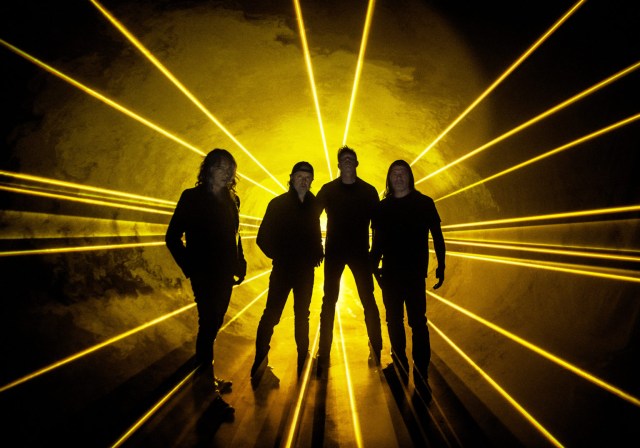
Portrait of Metallica. ‘‘Let’s put it this way,” Lars Ulrich, the man never at a loss for words, starts in. “Y’know, when you start a project, and the tunnel is way long and it’s blacker than night at the other side… well, now it’s less black.” 

Ensconced in a Southern California recording studio since October, Metallica’s loquacious skinsman is getting a bit antsy to see the San Franciscan power metal quartet finish up work on the long awaited, still-untitled Metalli-album number five.

It does get really tedious,’’ Lars admits of the meticulous rhythm tracking that’s been the bane of the band’s existence for months now, “but I guess no one gets as messed up about these things as we do. When we make a record, we’re notorious for spending a hella long time making it solid; building the foundations, the drums, the basic rhythm guitars. Just over the past three weeks, things have started to pick up. James (Hetfield) has started to put a lot of the guitars on the record that really color it up with melodies and harmonies. He’s finally finished some of the basic vocals, too. We’ve just gotten to the stage where the songs start to speak for themselves—it’s like one huge second wind.”

Ulrich is eager to chatter away concerning the latest Metalli-doings. He still speaks in the same intense tones, the same undeniable enthusiasm he did in younger, hungrier days. To him, the band is still an all-consuming passion, an obsession from which even the distractions of nearby Hollywood can’t deter him. 

“You know what’s weird about recording in Los Angeles instead of Denmark?” the Danish-born drummer poses. ‘‘It’s been a lot more intense than anything we’ve done in the past.” For the first time in nearly six years, the Metallidudes have eschewed their time-honored tradition of recording in snowy Copenhagen with producer Flemming Rasmussen. They’ve opted instead for Los Angeles’ sunnier climes and a fresh approach to knob-twiddling from Motley Crue/Bon Jovi/Cult producer Bob Rock. Still, you aren’t likely to see them hangin’ at the Rainbow, the Whiskey, the usual Hollywood watering holes. “Sure, you’ve got to allow yourself the freedom to go out drinking . . . and the misery of coming in the next morning with a hangover!,” Ulrich laughs. ‘‘We’re putting in six-day weeks with 12- to 14-hour days! It’s weird, but there are a lot fewer distractions this time around, a lot less screwing around or clocking out at six while we’re in the middle of something. This is perhaps the most concentrated and hardest we’ve ever worked.

‘‘Y’know, I don’t even consider it real work.” When asked how the band and producer Rock have been getting along, Lars grins.

“Well, we’re no longer telling him ‘No,’ the minute he brings up a new idea—Ha! That was the joke we had with him. Only now, since we’re finishing up with the vocals, an area that’s really his specialty, ideas are really starting to come to the fore. One of the most important things he did from the beginning was basically making us feel comfortable and confident with what we were doing—not spewing a bunch of shit at us about how we were going to do it his way.”

“We’re the kind of band that has never experienced working with someone like Bob before,” Ulrich continues. “Flemming had a great ear for technical stuff, running the board, the tape machines, but Flemming would never do anything like tell me to put some cymbals in for dynamics. Bob is great like that, and everything he does, he does as a suggestion. So what if he’s done this thing with Bon Jovi, that thing with Motley Crue, the other thing with Loverboy? He’s very clued into what this band’s about. He has a lot of respect for this band. We’re very stubborn, I’ll be the first to admit that. We don’t easily trust anyone but ourselves, but Bob has enough of an understanding of our vibe to let him in. He’s won our trust.”

Lars rattles off a litany of new Metalli-tunes: “‘Wherever I May Roam’, ‘My Friend of Misery’, ‘The God That Failed’, ‘Of Wolves and Men’, ‘Enter Sandman’, ‘Sad But True’, ‘Don’t Tread on Me’, ‘The Unforgiven’, ‘Through the Never’, and ‘The Struggle Within’. There’s no great all-encompassing theme to the record,’’ Ulrich mentions. “The last record was very politically oriented. Master of Puppets was very concerned with themes of manipulation. That isn’t the case this time around. This record’s a lot more personal, much in the same vein as Ride the Lightning dealing with fears, thoughts and emotions.”

What’s the best way of describing it? “Simplistic,’’ Ulrich smiles. ‘‘Here’s a guitar riff, a verse, a chorus and that’s it. Just like, let’s say, Kill ‘Em All, where it’s one mighty guitar riff after another without 25 middle parts and lots of excess screwing around. It’s still rough around the edges in a very cool way and it’s still packed to the gills with attitude. It bleeds ‘tude.”

Can we expect a mellowed-out, more commercially acceptable Metallica than last heard on their double platinum . . . And Justice For All opus?

Lars gets pissed.

“Look, I’m not going to try to defend it. The bottom line is that this is the only thing that still felt like a challenge to us. It’s really a challenge to write a song that doesn’t have fourteen tempo changes in the middle because that’s what we’ve spent the past three albums trying to do. It’s almost weird for us writing a song that goes straight from the second chorus into the guitar solo. If that means it’s more accessible, I’m sorry. Sure, if ‘more accessible’ means not going into Emerson, Lake & Palmer Revisited in the middle of a song, I guess it is ‘more accessible.’ I don’t think having shorter songs necessarily means we’ve sold out. Look, I stopped trying to defend this band the day we formed nine years ago.

“This album feels right,” the drummer insists. “It’s the sharp turn that needed to be taken in order for us to be excited about Metallica album number five—that would have really been selling both our fans and ourselves short. 

“We’re Metallica and we’re not about to do that.”
Honoring Chris Cornell: The “Architect of Grunge”

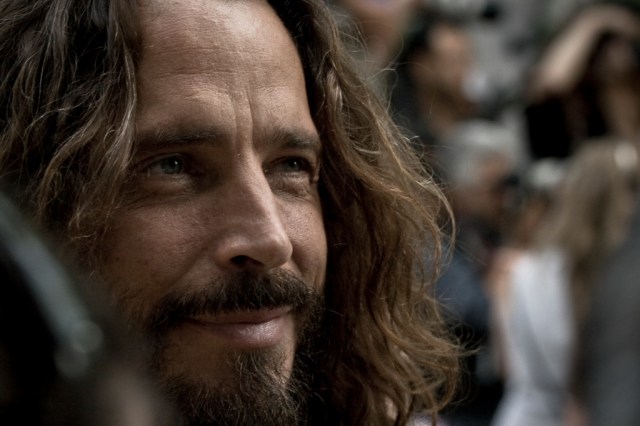
Today, July 20, 2026, is Chris Cornell’s birthday. The legendary frontman of Soundgarden, Temple of the Dog, and Audioslave, as well as a successful solo artist, would have been 62 today.

As grunge exploded in the 90s and Hit Parader became a major chronicle of the scene, Cornell was an unmistakable presence in the mag, appearing both on covers, like August of ’94, and frequently inside the pages.

It was impossible to document the grunge scene without Cornell, who basically co-founded the scene with his Soundgarden bandmates.

While Nirvana are thought of as the instigators of the grunge movement, the reality is Soundgarden was the first act signed to the legendary Sub Pop label in 1986. In fact, Sub Pop co-founder Jonathan Poneman was so impressed with Soundgarden he offered $20,000 in funding to Bruce Pavitt, turning Sub Pop into an actual label.

That was just the first of many firsts in Soundgarden’s run to the Rock and Roll Hall of Fame last year. After Sub Pop, they then were the first of the big four to sign with a major label (A&M in 1989) and the first of the quartet to get a Grammy nod (Best Metal Performance in 1990). Soundgarden paved the way in creating the interest from the music industry in what would go on to become the grunge scene. 

How big was Cornell’s influence on the scene? He founded Temple of the Dog as a tribute to his late roommate Andrew Wood. Temple was the band that united Eddie Vedder with the members of Pearl Jam. And rock photographer Greg Watermann, who shot Nirvana’s first national cover for Spin, and Stephen Webster, former art director of the mag, recounted how it was Cornell recommending Nirvana to listen to during his photo shoot that led them to the cover.  

“I remember this vividly, Chris Cornell walked over to his army duffle bag – digs around, comes back to me with a CD in his hand – it’s a CD with a naked baby floating underwater. He casually says, ‘This is a brand-new album from our buddies in Seattle, they rock and you guys should check them out,”” Webster told me.

Simply, you cannot write about grunge or the mark it made on music without acknowledging Chris Cornell as the true catalyst for the movement that changed music.  


Hit Parader Magazine – September 1995

By Steve Atkins

It’s a little hard for Chris Cornell to accept the level of public acclaim that now surrounds his band, Soundgarden. No longer are these quintessential Seattle rockers the “underground” sensations they were when albums like Louder Than Love created an international uproar back in 1989. And no longer are they a force struggling to make their mark on the rock world. Today every sound they make, every word they speak, seems to set new precedents for rock and roll; every musical utterance issued by Cornell and bandmates Kim Thayil, Ben Shepherd and Matt Cameron is studied, analyzed and dissected by their rabid horde of followers, all of whom are on a continual search for any hidden meanings behind the band’s Holy Grail of fire-breathing tunes. Even mainstream rock society, most of which didn’t even know of Soundgarden’s existence prior to the platinum success of their most recent release, Superunknown, has started casting votes of recognition the group’s way, going so far as to bestow upon them a prestigious Grammy Award for top heavy metal song. Even if Cornell finds such recognition a bit humorous, he’s still more than happy to accept any awards that might come Soundgarden’s way.

“I don’t know if | really feel comfortable with being classified as a heavy metal band,” the vocalist said. “But if that’s what they wanted to do, we won’t argue with them. We were proud to even be nominated, and we were glad to win. Hey, we got the chance to stand up on national television and say a few words. That was kind of interesting. Maybe in a couple of years we’ll get the chance to be nominated for best ‘rock’ act. That would really be something special.”

Whether or not Soundgarden’s hard-edged rock attack is truly “metal”, that is of course, if metal as we’ve long known and loved it still even exists in these ever-shifting musical times, the fact is that they have now solidified their position as one of the hard rock form’s premier exponents. Lacking the moody selfishness of Pearl Jam or the quirky unreliability of Alice In Chains, Soundgarden has established itself as a “music first” juggernaut that seems designed both for immediate success and long-term stability. Having already spent nearly a decade slowly cementing their credibility and creating a smoothly functioning internal chemistry, Cornell and company are something of an anachronism in present-day rock society, a band whose members actually seem to like one another and who appear to enjoy what they’re doing. In fact, guitarist Thayil can’t help but note the irony when he contrasts the relatively sedate inner workings of Soundgarden with the turmoil that characterizes so many of his band’s Emerald City rock brethren.

“Obviously a lot of those guys are our friends,” he said. “We know them, and we know what’s up with their bands. One of the best things about being part of what happened in Seattle during the late ‘80s is that you share a real camaraderie with all the musicians you hung out with in those clubs. You all want everyone to do well and be happy. It’s too bad that not everyone we grew up with in a musical sense has been able to stay happy, or even stay alive. Back in the early days | think we were all pretty happy. We just enjoyed playing music. We didn’t know which of us, or if any of us, would make it. And we certainly didn’t know how we’d react if we did.”

While success proved to be too much for the likes of Nirvana’s Kurt Cobain to handle, and seems to be the continual bane of Pearl Jam’s Eddie Vedder and Alice In Chains’ Layne Staley, Soundgarden has begun to almost relish their ever-expanding role as rock and roll superstars. If, in fact, Cornell’s vocal problems hadn’t forced the band prematurely off the road last summer, sales for Superunknown may have exceeded the double platinum sales status the album still managed to attain. And now, with the band making plans to release their next album by year’s end, it appears as if Soundgarden is perfectly positioned to emerge as hard rock’s Band Of The ‘90s, the group most responsible for providing shape, style and sound to an entire era. What Nirvana may have started back in 1991, and Pearl Jam expanded a year later, Soundgarden now seems prepared to take to the next horizon, a lasting place in the rock history books. While Cornell acknowledges that it’s usually only one band that emerges as the flag-bearer for their era (as Led Zeppelin was for the ‘70s and Motley Crue for the ‘80s), the singer’s still not sure that his outfit is destined to hoist the ‘90s banner to its greatest height.

“I’m not the one who’s gonna guess how history might view Soundgarden,” he said. “That would really be kind of silly to me. When you start thinking like that, you’re destined for a big fall. All we can do is make sure we make the best records we can, and then hope that people like them. We’ve always made records to please ourselves, and that attitude isn’t going to change. Just because more people may know who we are and what we’re about doesn’t mean we’re gonna start changing the way we work. To me that sounds like a very dangerous way of working.”

It’s still a bit too early to let anyone in on the “secrets” contained on Soundgarden’s upcoming album, but according to Thayil it seems safe to say that if you enjoyed Superunknown or its platinum predecessor, Badmotorfinger, you’ll probably like the new one too. That’s not to say, however, that the new disc won’t be radically different in some ways from its illustrious forbearers, in fact, you can count on that. The success Soundgarden has enjoyed in recent years has spurred the band to strive for new creative heights, motivating them to continually reach deeper into their musical bag of tricks in the hopes of pulling out even more radical and stimulating rock musings. Quite honestly, they couldn’t care less about their future role in the rock history books; all they want is to keep making some of the best music the rock world has ever heard, and maybe pick up another Grammy Award or two along the way.

“Being given credit for your work is fun,” Cornell said. “I may not have felt particularly comfortable standing on stage thanking people for our award, but it was the right thing to do. My wife (the band’s manager, Susan Silver) is always good at advising us about the right things to do in those situations. You’ve got to get out there and let the people know you appreciate the fact that they like your music. It might seem cool to just stay at home and ignore them, but it’s not smart, and as we get older we’re trying to be cool and smart.”