Metallica’s fifth studio album, Metallica, turns 35 years old today. The self-titled record was released on August 12, 1991, and has become one of the most recognizable and loved albums of all time. Filled with many of Metallica’s most well-known songs, including “Enter Sandman” and “Nothing Else Matters,” this record has stood the test of time. We’ll celebrate this historic album today by revisiting the Hit Parader interview with Lars Ulrich during the release cycle for The Black Album.
Metallica – All Guns Blazing
By Mike Gitter
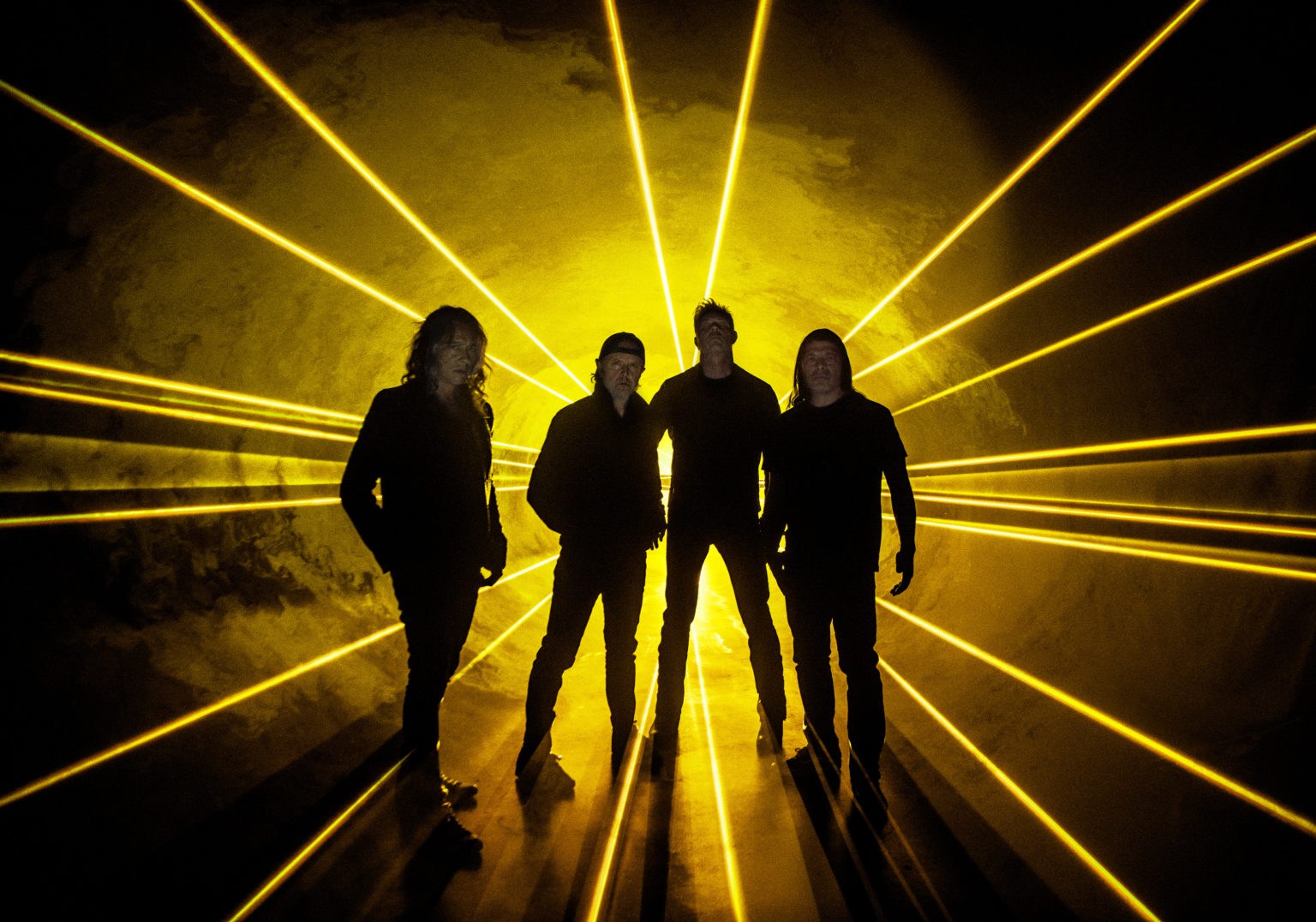
Portrait of Metallica. ‘‘Let’s put it this way,” Lars Ulrich, the man never at a loss for words, starts in. “Y’know, when you start a project, and the tunnel is way long and it’s blacker than night at the other side… well, now it’s less black.”
Ensconced in a Southern California recording studio since October, Metallica’s loquacious skinsman is getting a bit antsy to see the San Franciscan power metal quartet finish up work on the long awaited, still-untitled Metalli-album number five.
It does get really tedious,’’ Lars admits of the meticulous rhythm tracking that’s been the bane of the band’s existence for months now, “but I guess no one gets as messed up about these things as we do. When we make a record, we’re notorious for spending a hella long time making it solid; building the foundations, the drums, the basic rhythm guitars. Just over the past three weeks, things have started to pick up. James (Hetfield) has started to put a lot of the guitars on the record that really color it up with melodies and harmonies. He’s finally finished some of the basic vocals, too. We’ve just gotten to the stage where the songs start to speak for themselves—it’s like one huge second wind.”
Ulrich is eager to chatter away concerning the latest Metalli-doings. He still speaks in the same intense tones, the same undeniable enthusiasm he did in younger, hungrier days. To him, the band is still an all-consuming passion, an obsession from which even the distractions of nearby Hollywood can’t deter him.
“You know what’s weird about recording in Los Angeles instead of Denmark?” the Danish-born drummer poses. ‘‘It’s been a lot more intense than anything we’ve done in the past.” For the first time in nearly six years, the Metallidudes have eschewed their time-honored tradition of recording in snowy Copenhagen with producer Flemming Rasmussen. They’ve opted instead for Los Angeles’ sunnier climes and a fresh approach to knob-twiddling from Motley Crue/Bon Jovi/Cult producer Bob Rock. Still, you aren’t likely to see them hangin’ at the Rainbow, the Whiskey, the usual Hollywood watering holes. “Sure, you’ve got to allow yourself the freedom to go out drinking . . . and the misery of coming in the next morning with a hangover!,” Ulrich laughs. ‘‘We’re putting in six-day weeks with 12- to 14-hour days! It’s weird, but there are a lot fewer distractions this time around, a lot less screwing around or clocking out at six while we’re in the middle of something. This is perhaps the most concentrated and hardest we’ve ever worked.
‘‘Y’know, I don’t even consider it real work.” When asked how the band and producer Rock have been getting along, Lars grins.
“Well, we’re no longer telling him ‘No,’ the minute he brings up a new idea—Ha! That was the joke we had with him. Only now, since we’re finishing up with the vocals, an area that’s really his specialty, ideas are really starting to come to the fore. One of the most important things he did from the beginning was basically making us feel comfortable and confident with what we were doing—not spewing a bunch of shit at us about how we were going to do it his way.”
“We’re the kind of band that has never experienced working with someone like Bob before,” Ulrich continues. “Flemming had a great ear for technical stuff, running the board, the tape machines, but Flemming would never do anything like tell me to put some cymbals in for dynamics. Bob is great like that, and everything he does, he does as a suggestion. So what if he’s done this thing with Bon Jovi, that thing with Motley Crue, the other thing with Loverboy? He’s very clued into what this band’s about. He has a lot of respect for this band. We’re very stubborn, I’ll be the first to admit that. We don’t easily trust anyone but ourselves, but Bob has enough of an understanding of our vibe to let him in. He’s won our trust.”
Lars rattles off a litany of new Metalli-tunes: “‘Wherever I May Roam’, ‘My Friend of Misery’, ‘The God That Failed’, ‘Of Wolves and Men’, ‘Enter Sandman’, ‘Sad But True’, ‘Don’t Tread on Me’, ‘The Unforgiven’, ‘Through the Never’, and ‘The Struggle Within’. There’s no great all-encompassing theme to the record,’’ Ulrich mentions. “The last record was very politically oriented. Master of Puppets was very concerned with themes of manipulation. That isn’t the case this time around. This record’s a lot more personal, much in the same vein as Ride the Lightning dealing with fears, thoughts and emotions.”
What’s the best way of describing it? “Simplistic,’’ Ulrich smiles. ‘‘Here’s a guitar riff, a verse, a chorus and that’s it. Just like, let’s say, Kill ‘Em All, where it’s one mighty guitar riff after another without 25 middle parts and lots of excess screwing around. It’s still rough around the edges in a very cool way and it’s still packed to the gills with attitude. It bleeds ‘tude.”
Can we expect a mellowed-out, more commercially acceptable Metallica than last heard on their double platinum . . . And Justice For All opus?
Lars gets pissed.
“Look, I’m not going to try to defend it. The bottom line is that this is the only thing that still felt like a challenge to us. It’s really a challenge to write a song that doesn’t have fourteen tempo changes in the middle because that’s what we’ve spent the past three albums trying to do. It’s almost weird for us writing a song that goes straight from the second chorus into the guitar solo. If that means it’s more accessible, I’m sorry. Sure, if ‘more accessible’ means not going into Emerson, Lake & Palmer Revisited in the middle of a song, I guess it is ‘more accessible.’ I don’t think having shorter songs necessarily means we’ve sold out. Look, I stopped trying to defend this band the day we formed nine years ago.
“This album feels right,” the drummer insists. “It’s the sharp turn that needed to be taken in order for us to be excited about Metallica album number five—that would have really been selling both our fans and ourselves short.
“We’re Metallica and we’re not about to do that.”