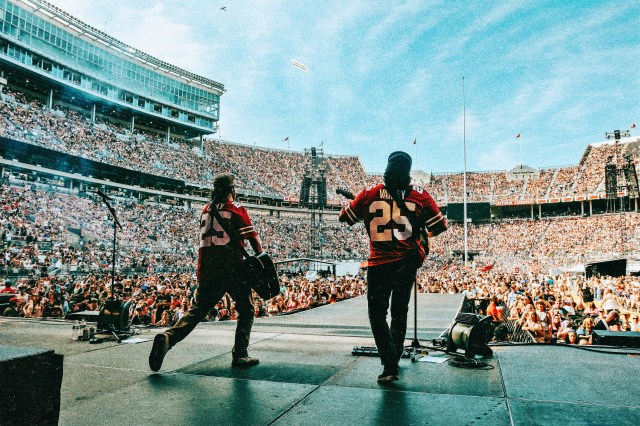

Ministry’s swan song album, coming out October 30, might be called Hate To Go, but don’t read too much into that.
Al Jourgensen, the founder and architect of the legendary industrial band for 45 years, has absolutely no ambivalence about saying farewell with the group’s new album and tour.
“We’re all just ready to move on and we’ll leave this as our epitaph. This is our tombstone, this record, but I think it has everything that Ministry has been over the last 45 years. and it still sounds fresh,” he says.
Jourgensen still has a lot to say about the state of the world on the new record, but, as he says, he has been delivering that message for decades.
“I’m too old, cranky and tired to keep trying to explain it. So, I said my piece and I’ve said it for repetitively for going well over three decades from a political font or angle,” he says. “I’ve said enough. It’s time for me to shut up, let the young kids talk about what matters to them.”
But Jourgensen is not going out quietly. He has a lot to say, as evidenced by this eye-opening interview.

Hit Parader: Why now to hang it up?
Al Jourgensen: I figure it’s time. We’ve taken our genre and this band as far as we can go. I’m really happy with this album and I think it’s a culmination of 40 years of the same elements. Like I said, it’s a good one to go out on. I’m really happy with the way this came out. But I’m not enthused about continuing to keep doing this kind of music or music in general. I just think that Ministry has run its course. And I’m glad it was here when it was here. But I have no regrets looking back on it and everything. It would get boring, and it would get really repetitive. And I don’t think the product would be as good if I tried to do another one. So, I think it’s the proper time. Plus, I’m 68 years old. It’s like, God bless the Rolling Stones. They’re in their 80s. They do a new record and this and that. But I just have other interests. Basically, I never wanted to do this anyways. It’s pretty well documented that I just wanted to be a history professor for high school and college. And then I had these demo tapes that started selling and all of a sudden, I’m in a band and I’m trying to put together the band. I auditioned like 10 or 12 singers. I did not want to be singer. If anything, I always wanted to be Jimmy Page, not Robert Plant. And here I was, it just kept dragging me in. I kind of felt like Michael Corleone in Godfather 3. Every time I try and get out, they pull me back in. So, it just kept getting to be more and more of this behemoth. I didn’t really set out to do this path to start with, but I guess I was able to do it well enough to sustain a 45-year career but there comes a time.
HP: Is there anything that you could imagine pulling you back in?
Jourgensen: I feel like I’ve done everything that I can accomplish. I don’t need or want more financially or aesthetically. I’m quite at peace and somehow, I survived all this with my health intact, which for the last few years I’ve been pretty healthy. There was a time there in the mid-2000s where I said I have to quit because I was throwing up blood and pissing out blood and shitting out blood. And I didn’t understand what was going on. Finally, I had an ulcer perforate in my upper intestine and I was dead. They brought me back and it took me a couple of years to get back health wise. And now that my health is good, I think it’s a good time to stop because I’m able to get out of this, as [Jim] Morrison said, world alive.
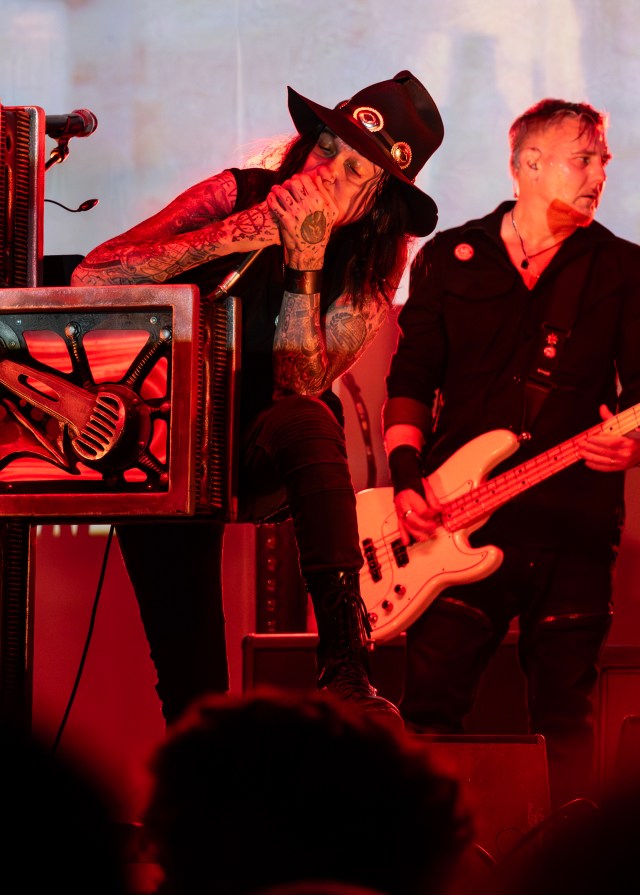
HP: With this being the final album, do you think about your legacy?
Jourgensen: Yeah, actually, this might freak you out as an answer, but I don’t want to be remembered. I would like to be the Greta Garbo of industrial music. And I just want to be left alone. I don’t care. I just want to blend in and see what you have to remember. I haven’t had a real job in 45 years, which is two thirds of my life. I would like to be just a normal person amongst the masses, and I might get a whole different perspective on stuff. So, yeah, I just want to be Greta Garbo, man. I don’t care if I’m remembered. You’ve got one more chance to see us and then I really seriously want to disappear because I’m over it. No offense against you but I’m over the interviews, doing videos, all the promo sexual work is my most hideous aspect of this job. I don’t like being a promo sexual. I figure if you do your music, you did your job and let the public decide if they like it or not. But it doesn’t work like that, as you know. There’s the whole promotion machine and this and that dictates and fits it into little niches that might sell and might make somebody some money here and there and this and that. I don’t want to think about that. I don’t really care. I did what I did. I’m happy with what I did for the most part. I have certain songs I like more than the others and other songs that I can’t stand or haven’t listened to in years. But it is what it is. It’s just time to get off of the hamster wheel that is being in the entertainment business. Just over it, man.
HP: I do not get offended at all by the fact that you don’t like interviews. I have a lot of artist friends who don’t like them. I’m a huge Nick Cave fan and at the beginning of Faith, Hope and Carnage, the interviewer, the journalist says to him, I’m really surprised you did this because I know you hate doing interviews. And Nick Cave goes, why would I want to do interviews? That’s like having your soul sucked out.
Jourgensen: It’s not only that, but also it’s redundant enough to being like your [banging] head against the wall because you remember the interviews start after you’ve already gotten your joy in the studio hearing the last playback of it loud and you’re excited about the music and all that and then six months later you have to go back and talk about it and explain it and this and that. The music should speak for itself so that’s why I hate it; it’s backtracking and right now I’m just trying to make this next final tour the best tour that we could have ever done and so my minds on that. But in between the promosexual cycle I have to go back and talk to everybody and explain what I did, something that got me off six months ago, that’s not getting me off right now. Now I have to go back and re-listen to this stuff before I talk to you lot and just go, “Oh, yeah, okay, that was pretty good.” I’ve already forgotten about it. It sounded good at the time. I put my full effort and intention into it, and that’s done. So why do I need to talk about it? Either you like it or you don’t. I wish it was that simple but it’s not.

HP: Do you remember the band Bread from the 70s? Do you know anything about the lead singer, David Gates?
Jourgensen: No, I don’t know anything personally about him except for that one song that was annoying me for a couple years in the 70s.
HP: He had all these hits. One of the biggest songwriters in the world. He retired. He runs a ranch. He’s 84 years old. He’s been married to the same woman for 68 years. And I find that so fascinating. It’s so admirable that he just walked away from public life.
Jourgensen: You know what, just in your honor I may even go back and listen to a Bread song tonight because that is admirable and that is my path. That is what I’m really working hard towards. It’s just like peace out man; you hope you got something out of it. I know I did but time to go and literally all I’ve been doing is searching for land in Calabasas, a little bit bigger plot of land so I can get goats. I just want to be a simple goat herder and be able to go to Trader Joe’s and not have people ask for a selfie and this and that. Just be some local goat herder weird dude that lives up on that land, that’s my dream.
HP: When you think about doing this upcoming tour, are there songs that you’re particularly excited to see how fans respond to them or that you’re very curious about?
Jourgensen: No, not particularly. It doesn’t matter. The shows are almost this perfunctory job that we have to do. The rehearsals are the most interesting part. When I see the band’s reaction to how a song is coming together in rehearsals and how we like it versus how other people like it; they’re subject to our taste, we’re not subject to their taste. I think I have a 260-song published catalog, so we’re going to learn 40 songs and the band is going to choose which 40. I’ll tell you what we’ll do. The band will choose 35, and we’ll leave it up to the public on social media to choose five, and then we’ll learn that. But we’ll do about 20, 22 songs a night. We’ll have about 18 rotating in, so it’s not the same show. And I think we can find 40 songs in the Ministry catalog that the whole band can agree is fun to play. At this point why would I care what people think? We’re leaving so it’s not like, “Oh my god, they’re going to hate us, after this they’re never going to buy another record.” We don’t have another record, so we’re basically doing this for us and as and as a consequence also doing it for our hardcore followers for many years. We’ll give them a couple of choices and then we’ll do the majority of it that makes us happy in rehearsals. And like I said, the shows are perfunctory. I know so many of my friends, the guys in ZZ Top and Cheap Trick, I know those guys well, Rick, Robin, Billy, they still get a charge out of playing live. They love the audience reaction and stuff. I don’t even hear it. I don’t hear if the crowd hates us or likes us. I’m just up there. We’re doing our job. And I know what we liked in rehearsals and what the band liked. And I can hear if the band is fucking it up, if somebody’s too drunk that night or something. So, we talk about that, but we don’t talk about like, “Wow, that set went over great, man, those people love this.” I’m oblivious to that. I don’t even recognize or hear applause. And a lot of that is because we do our sets live where I don’t even give them a chance to applaud, kind of like an old Ramones thing where you just go and you’re done with the song. “Bam, one, two, three, four. Next song.” You’re lucky if you can even see the name of the song. We just go do our job and get the fuck back to the bus, man.