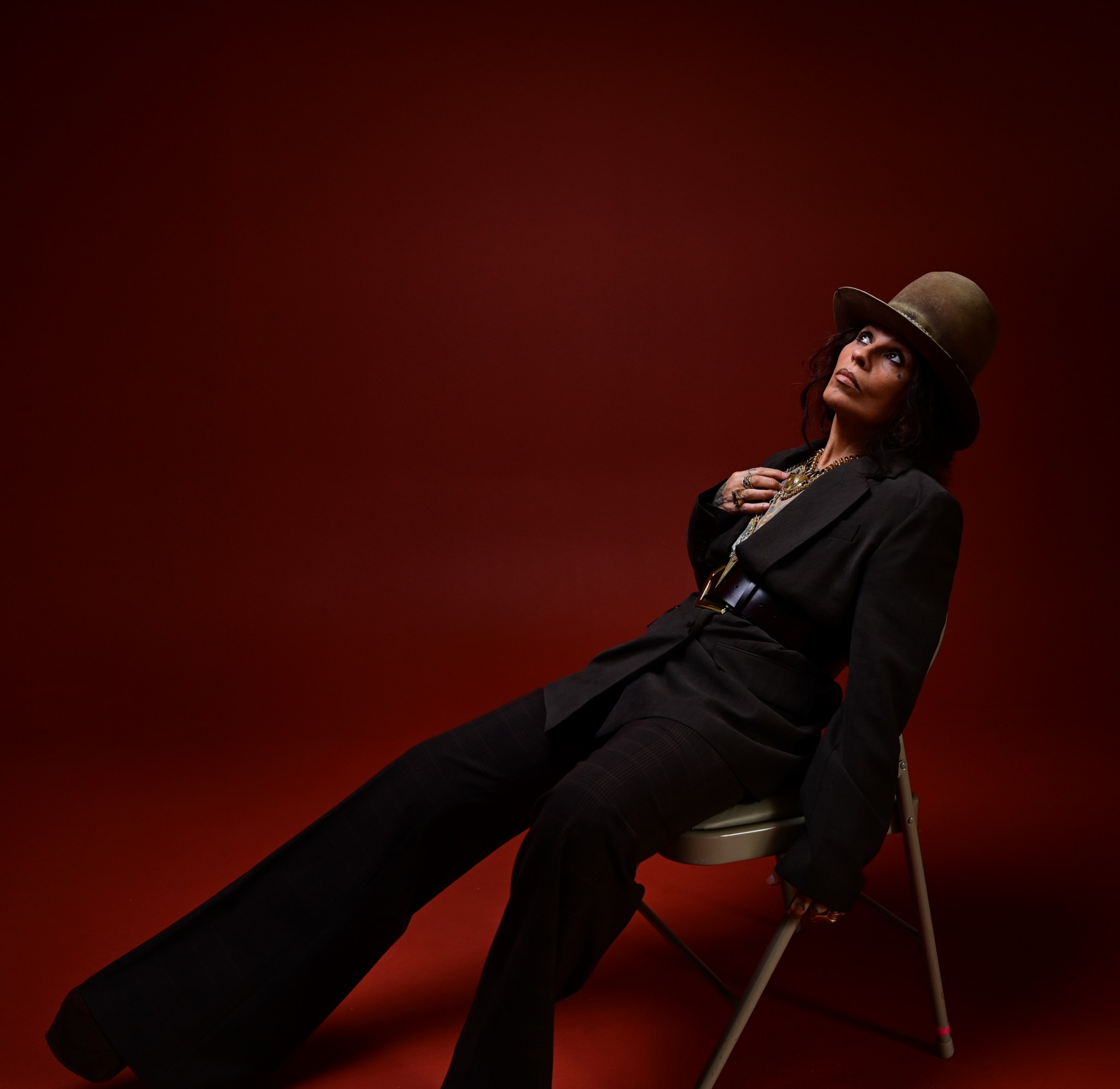
In the mid-90s Linda Perry had an anthemic hit with 4 Non Blondes’ “What’s Up” that had her poised to be a massive rock star. The only thing, as she says, she wasn’t ready for any of it. So, she said fuck it, walked away from performing for the most part and became a mogul behind the scenes, producing and songwriting for Pink, Dolly Parton, Christina Aguilera and more.
However, after more than three decades behind the scenes, Perry decided she is finally ready to step in front of the mike. And she is doing it in a major way, with a brilliant solo album and documentary, Let It Die Here, and an upcoming 4 Non Blondes reunion album.
The week Parton passed away, an emotional Perry spoke to me about why she is stepping into the spotlight now.
Hit Parader: Let’s go back to the 90s and you decide that you do not want to be a rock star at that point; you want to be behind the scenes. What makes it fun, to me, is you can never fucking predict that one day you’re going to be in a studio with Dolly Parton.
Linda Perry: Are you trying to segue this into a Dolly Parton story?
HP: No, you can talk about anybody you have worked with. To me, it’s the idea of the unpredictability. I always think of Steve Van Zandt from the E Street Band. We were talking about him playing with Bruce Springsteen and him being on The Sopranos. I asked him what his 14-year-old self would think of that. And he’s like, “There’s no way that you could have dreamed my life.” And I think that’s what’s beautiful about that.
Perry: Totally, those are the things that I think about. There is a plan and there is a design. You just don’t know about it. It’s like, to me, someone wrote the story and you’re just getting clues of what the story is. And then you improvise most of the time, but you’re improvising with these clues in your hands. Like, “Okay, this is the realm of where I’m supposed to be. So, I know I’m in the right ballpark.” Then you’re exploring that parking lot to get into the ballpark. Okay, I’ll give you this. There are things that happened to me when I was young. And this has happened a few times now. Since you brought her up, I’ll give you this because I like you. And I’m not talking to people about Dolly because I’m very emotional about it. But when I was a kid, I was so drawn to her frequency. I don’t know what it was. I didn’t even like country music. I just was drawn to her. There was something about her that I was just captivated with; there was a sense of kinship. Then when I met her and we became friends, I was like, “Of course, that’s exactly what it was. I was destined. We were going to meet. I was drawn to her. Our energies connected.” So, when we finally met, I already knew that frequency, I already knew her tone. Because that’s how I operate, I operate with frequency, feeling, energy. I am drawn to certain things and people. It’s by that. So, when we met, I was taken aback going, “Oh my God, this is that tone. This is that sound. She’s it.” And listen, no one had a higher frequency than that woman. No one. I never met anyone with that sort of frequency. Dolly is one of the biggest stars in the world and will continue to be bigger than Elvis because she related to everybody and everybody related to her. She stood for everything, but also nothing at all. You know what I mean? She was able to just weave in and out. And that’s why people love her and adore her. And then on top of it, she’s just a fucking nice person that just spread really beautiful energy all over.
HP: It’s interesting because what you’re saying about the frequency and being drawn to it. Sinead O’Connor, who I got to interview multiple times, and to me was a genius, said that as a writer, you have to be careful what you write because you can will things into existence. So, do you feel that you manifested working with her?
Perry: No, I think it was just inevitable. It was interesting with Sinead O’Connor because I saw her at the Stone in San Francisco. There’s her on the stage and I was right there in front. And one of the greatest records of all time, The Lion and the Cobra, it was just a brilliant piece of work. Masterpiece. And, I was like, “Oh, I know this energy.” Then we would go on to meet at Roger Daltrey’s 50th anniversary or 50th birthday at Carnegie Hall where I manifested that one. But she was really amazing. She was sitting outside of my dressing room and I was like, “Oh, my God, there’s Sinead O’Connor.” So, I went and sat with her. I’m like, “Hey, how are you doing?” She’s like, “I’m good.” She was rolling a joint and I’m like, “Do you not have a dressing room?” She said no. And I’m like, “Take mine, I don’t need it.” She’s like, “Oh, great.” I felt she was very isolated. But as soon as I met it, I knew that dark energy. She had a dark frequency, but highly intelligent, so incredibly intelligent. And then I talked to her a few times on the phone, she would call me and just want to talk and get advice. I felt like that was my thing. I feel like we’re drawn into certain situations to either help or be helped, or figure out how we can find solutions.
HP: Being around all these different people as you look back on it, what have you learned?
Perry: When I had my struggles with 4 Non Blondes and the whole recording of “What’s Up,” my next chapter was meeting Bill Bottrell. It was like going to Yale; being able to sit with him taught me everything I needed to know about production and engineering and how your ears should work. He fine-tuned me, and if I didn’t have that experience with him, I never would have ventured off and started going into this producer songwriter area. I know that the subject matter was songs that have shaped me, but honestly, I couldn’t do it because songs don’t shape me. Experiences do. The experiences are what is shaping me. My experience with 4 Non Blondes, my experience with Bill Bottrell, my experiences with Dolly, Sinead, Gwen, Christina, Pink, you know, with Dave Navarro when we recorded “Misty Mountain Hop” for the Led Zeppelin tribute, meeting Madonna in a club and asking her if she believes in seizing the opportunity. She’s like, “Of course.” She was so cool and down to earth, I guess that’s where my obsession to want to work with her is because I really would love to talk with her again. And I don’t feel like I got enough from that experience, working with Mike Campbell, one of the greatest underrated guitar players and songwriters to me. We have an album that we have coming out together. That was so fun. So all of these experiences; having a child, dogs dying, my mom being abusive and dying and family being fucking crazy and me not knowing how to play an instrument until I just put it in my hand and learned how to play it. My brother being a total rock god and me inspiring to be him. All these experiences have shaped me and still are.
HP: You say songs don’t shape you. But were there early ones that spoke to you?
Perry: One of my first emotional experiences with a song, something melodically going on in it that bumped me was the song Kai sings in Jungle Book and “Trust in Me” in the 1963 or whatever version. That song, it’s something about it, the melody structure. Then it turned into Karen Carpenter, hearing, “Close to You,” there was something in her tone again, and the melodic structure and the delivery. Then it happened again with Lulu’s “To Sir With Love,” and then The Association, “Never My Love.” Then it was, “Don’t Worry, Baby,” The Beach Boys. and now I can put a connection to it. All those melodies were very elongated and very emotional, and they felt depressing and they felt like cries, like someone mourning or crying. That’s basically the style of music I was drawn to because I was a depressed child and I didn’t know that. I was very dark; I had a very bad childhood. So, I was drawn to these very elongated melodies that just sounded so emotional.
HP: Something you were just saying about Dolly I found interesting. You mentioned the warmth of it and how you wanted to cuddle. Do you feel like as someone who, as you said, had a rough childhood that music gave you a nurturing feeling that you weren’t getting at home?
Perry: I found music, I believe it’s always been around me. I’ve always tinkered when I was a kid, tinkering on a piano, a guitar, something, singing along to things. But I didn’t really quite understand what it meant for me in my life until, honestly, I was 18 or 19. And then it became a release. Then the big voice showed up; my gigantic, huge voice showed up and I was like, “What the fuck is this?” That was the pain, the release, me dealing and accepting and then releasing it. That was all of 4 Non Blondes; it was constant screaming, on 10 the whole fucking time. And then it wasn’t until I was out of it that I started sitting down and understanding what exactly I am and who I am in this business. Then I decided that I needed to find my own frequency; 4 Non Blondes was not it. It was annoying. My frequency in that band was annoying to me. Not the band, but me. And I can’t even listen to it because she’s, and I call it she, so inexperienced. There’s no control in my voice in 4 Non Blondes. And then on In Flight, I discovered control. I discovered the darker side of me, the deeper voice that’s really focusing on melodies and just sitting there with a glass of wine and a cigarette and telling the story. Then when I became a songwriter, I was like, “Okay, this is how I can be of service now. I can help these people find their own frequency.” And so that’s just me. Do I use pain and my depression and darkness and all that stuff to fuel me? Absolutely. But I use it in the best way possible now. And I use it to help other people. I have a long way to go, I tell you. But I definitely have a purpose. And I do believe my purpose is to help and to be an empath and to guide people to their truth. I believe that is my purpose and I will do it through song.