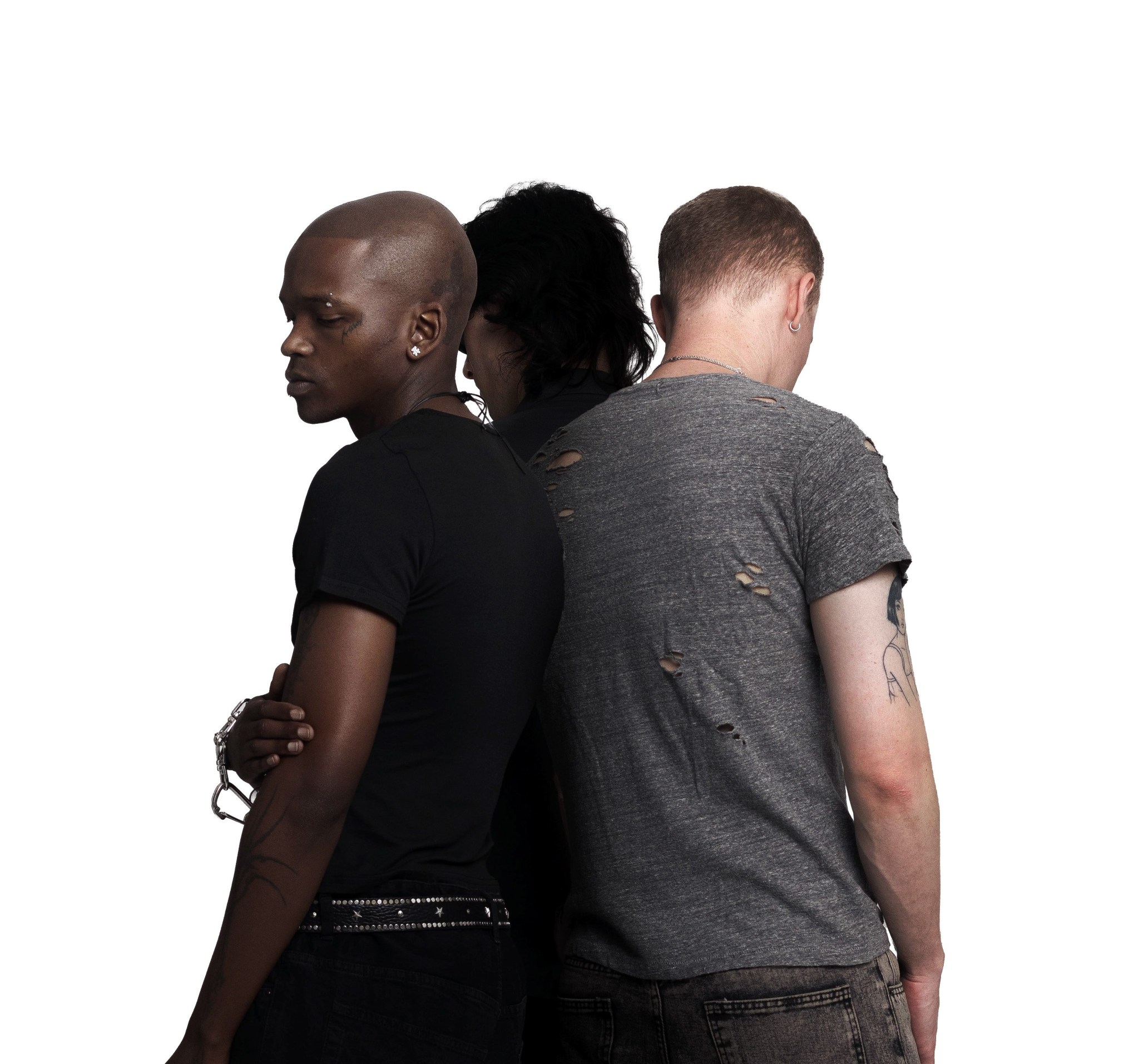
Creating a path for yourself in an environment that may not be ready can take an irrational amount of confidence and belief. Luckily, the South African trio Internet Girl is well past the stage of it being unfounded. Made up of Ntsika “Tk” Bungane, Matthew “Neese” Burgess, and James “Griggs” Smith. They have become much more than someone attempting to make a lane. They are cultivators of a quickly rising community in their home turf. Shedding genres with each project, it can be particularly hard to nail down what genre you could describe them as. Coming off a run of Eps and attention on and offline. The group has been gearing up to drop their debut LP, YES, for quite some time. Taking every lesson learned from each drop, this project is by far their most complete to date. The trio is focused on maturing with their art, and the music stamps that ambition.
Hit Parader: How is your year going so far?
TK: It’s been good. Things only started happening in the last few months. We’ve just been cooking in the studio, locked in for a long time. It’s been a good year, all things considered. We’ve just been stressing about the first album, the expectation of everything. But looking back, we made some great music. Matured a lot as a trio together. We’re going into a new era. I’m grateful for this year.
Neese: Agreed.
HP: I can imagine you guys all have different inspirations. What was some of the stuff you were listening to when you were younger?
TK: Neese, I don’t know if you remember, the first album we started listening to was Coldplay. The one with “Paradise.” (Mylo Xyloto) That was on the airwaves back then. That was the first time we started listening to music. Then there was one holiday. Neese went to see his cousin, and his cousin introduced him to dubstep. I had gotten an iPod Touch with green headphones. Then it just made sense. We came back from school holidays, and Dubstep/EDM was running that whole time.
Neese: It started; at least my musical journey started with electronic music. Skrillex and Porter Robinson, then Hardwell. The super commercial EDM. Then it started going into more underground-y EDM. From there it went into hip hop and indie. Now it’s just everything. But for me and TK, it started mostly with electronic music.
Griggs: I’d say my love for electronic music grew as I got older. To the point where I love it now. What I grew up on and wanted to make after hearing it was hip hop. I really got into that in high school, which changed a lot for me. As soon as I could start making something. As soon as I got a laptop, I started making hip hop music. Even when I was younger, I was playing a little bit of guitar before I started producing on a laptop. A lot of bands like Bloc Party. Real riff shit.
HP: Porter Robinson is a good shout. I went back and have been listening to Nurture.
Neese: Nurture!
Griggs, we were just speaking about this earlier.
TK: Worlds is still number one for me.
HP: Also, “WannaCry” with Ninajirachi is ridiculous.
TK: Ninajirachi is on a crazy run right now.
HP: Earlier in your careers, you guys talked about how you had to make your own lane in your region. How has the reception around you guys changed as you’ve grown?

Griggs: I feel like we’ve shaped the South African taste slightly through us being around that last couple of years. I think we opened people up a little bit more to alternative music. Of course, there were artists that came before us. But I feel like we’ve helped that expand, at least in some small part where we’re from. It started overseas. All the motion we had was overseas. As the years have gone by, it has grown more and more in our own country. Which is a beautiful thing to see. We’ve had some influence. The strange music we make is becoming popular here.
HP: You talked about the title Y and how there are a lot of themes that revolve around the confidence required to be an artist. Especially in the early days. You have to have an almost irrational belief in yourself. How did you keep that going in the early stage, and how has it changed since then?
TK: For me personally, having these two guys next to me helps a lot. If I were by myself, it would be ten times more difficult. But holding each other accountable, not trying to waste each other’s time. When you see people around you working and putting effort into this project. It also makes you feel like you need to do the same and match it. Holding each other accountable has really kept us going for this period of time.
Neese: I think for me it was a lot easier to have that irrational, undeserved confidence when I was younger. My mentality was, “Of course I’m going to make it. There’s no way it won’t happen.” Obviously, things don’t turn out exactly how you imagine. As I get older, I have to really make an attempt to hold on to that confidence. I think this album has helped a lot. That’s been the feeling throughout this album. Maintaining that as you get older, as you get wiser. Still holding on to that young confidence that you can do anything and the world is yours.
HP: One of the main things I’ve heard you talking about is how you guys have matured as a group. From this album to last, what do you think that maturation has affected?
TK: For me personally, I don’t know if the boys will agree, but for me the pretense of making music was a lot more of a vain pursuit. I really wanted people to fuck with me. I wanted it to be something outside of me. I think this tape was less pandering. Less about caring what other people want to see and hear from us. We are going to bring what we have to the table. The music I love. What am I trying to hear on the airwaves? That was a big part for me. Realizing that I am a musician. This is what I do. This isn’t about commodifying whatever we’re doing. We’re just doing it.
HP: It also sounds like you guys are just having more fun making the album.
TK: Yeah, definitely in the beginning. As it went on, it became a little bit tougher. But definitely in the beginning because we left in the first month of the year. We left the city and went an hour out of the city for a week and had a writing trip. I think it was really needed at the time just to get the juices flowing.
HP: Was that different from how you guys typically write for projects?
Neese: Yeah, I’d say 90% of the work is not done like that on previous projects. We did go away still, but after that it would take us a year and a half to finish the rest of the project. Those ten days are super important, especially for this album. Just to set the direction and understand where we are headed, then flesh out the rest of it.
Griggs: We wanted to set a tone. We’ve always been writing new music, and it keeps trumping the last thing we wrote. We could go down that path of writing for six months and then write better music the next six months to replace it. We really wanted to set a tone for this one. There was a special feeling about the tone we set when we went away for the first time. We laid down the foundation of what this album is. We rode that wave until the album was done.
HP: In terms of the sound, you guys seem to be constantly inspired by different things. Is it hard to say, “Focused on one inspiration to finish a track”?
Griggs: Each song is different. Some songs just flow out of you. Some songs are a week-long or month-long process. Changing the chorus many times.
TK: Yeah, for sure. The title track of the album “YES” was very quick. I think we finished 70% of the song on the first day. There were other songs that took a little bit more cooking, a little bit more churning. “DA BUSINESS”—we had to change the chorus about five times. It all depends on the mood if it’s coming.
HP: I was going to ask about that because I saw in the bio for that song that the chorus took a while to nail down. What’s that feeling like when you finally find that missing piece to a song?
Neese: It’s a big relief.
Griggs: I was pushing hard for it, and the choruses weren’t coming. Sometimes you just have to force him (TK) to put something down in a way. It’s great. TK always performs under pressure.
TK: It is a nice release.
HP: When it comes to ideas between you guys, how do you go about filtering what you want to spend your time on?
TK: I think that depends. For the most part, if someone has an idea and they’re very confident about it. We all try to see it through and see what happens. We’ve said this before in other interviews. We do have a culture of honesty. If you’re not understanding something, if we’re not really feeling it, maybe that means you need to explain the idea a little better. Maybe the idea just isn’t that good. I think having transparency has always helped in terms of navigating which way we go. But for the most part, if someone is very confident and can see it in their minds, it’s like, “Let’s just run with that and what comes out of it.”

HP: The only two credited features on the project are Kenny Mason and Ledbyher. Why did these two artists feel like the right addition to the project?
Neese: Kenny is someone that we’ve wanted to work with since ROLE MODEL. That song just felt like the perfect opportunity to do that. He followed us on Instagram or something, so the opportunity was right in front of us. Ledbyher is someone that we really rock with at the moment. We had an instrumental or a song that we thought would be really fitting for her. But at the same time, it is something that she had never been on before. We had never heard her on that sound. We felt like it was a good fit and a cool experiment. She killed it. I’m so excited for that to come out.
Griggs: We FaceTimed him (Kenny Mason). He was talking about how insane it is. This rap-rock mixture was growing over there and over here in Cape Town. We were just really stoked that he enjoyed it and saw the vision of what we were trying to do.
HP: He’s talked before about the struggle of getting labeled only as rap and ignoring the rock part of his music.
TK: For me, I really like the rock, and it became a thing I started to understand. “Wait, this dude is actually a rapper too.”
HP: Do you guys also struggle with some of the labels that people may apply to your music?
Neese: I mean, we also don’t know what to say. When people ask what kind of music we make, we don’t know what to say. As long as it’s reasonable, I’m never going to be really upset about the way someone describes our music. It’s difficult.
Griggs: We’ve gone through so many phases. There were some people who even referred to us as a hyperpop group, and that was back in 2021. When we first started emerging online. Sure, there are small elements of that that still come through. But it’s far from what it used to be. But as Neese says, it’s hard to put a pin on it. We try to not get too caught up in it because it comes from so many different places.
HP: A couple of the songs, like “All The Same,” “Keep The Money Coming,” and “Big San Tony,” you guys have thrown a lot of elements of other genres. Specifically, the last minute of the songs. How do you guys decide when you’re going to do that and when it fits?
Neese: We were trying to find a good balance because we love doing it. We love having the big surprise at the end of a song. As a listener, I love when other people do stuff like that. We love doing it, but we’re trying to find this balance. We don’t want every song to become predictable at the end of the song. We’re trying to be tasteful. I don’t think there’s a method that I can necessarily say we used. It was just a feel for which ones felt appropriate.
TK: Whatever serves the song.
Griggs: I’m going to double down on what he was saying. That feeling of wanting to write this great song. The song’s foundation is laid out, and the song is what it is. Then, we add this moment that is jarring to people or experimental in a way if the accessibility of the main part of the song isn’t there. Like, “All The Same” being ridiculously clipped. Even at the end of “Big San Tony,” you go from like shoegaze to this almost IDM sort of dance thing. Just to give that visceral reaction of so many different things happening.
HP: I did wish the last part of “Big San Tony” was a minute longer.
Griggs: It will be for the live show.
HP: You think you will ever do a project where most of the songs are like that?
TK: I’m not the biggest fan of super long albums. My attention span is not too good. Possibly if we have a lot more to say.
Neese: It might be cool whenever we make one of those outros to just be like, “Let’s not make an outro and turn it into a song.” Every time we turn it into a song and see if it doesn’t work.
HP: If it doesn’t work, you can just blame it on me.
Griggs: We’re allowing ourselves to be more unhinged with this stuff on the live show. Even the “Big San Tony” is extended. We allow ourselves to play more into these insane moments that we might have refrained from on the album for accessibility. It’s what we’re going for in a live setting. We really just have a lot of fun with it and can take it to places we might not want to take on the record.
HP: In a live setting, I feel like you get more leeway for stuff like that compared to an album.
Neese: Totally, it’s all about energy. People are not listening too closely; they’re just feeling the show. As long as there’s feeling in these moments. Usually the point of these switch-up moments is to induce some sort of feeling or change of feelings that works really well live.
HP: You mentioned that you like keeping the albums shorter. Is that a preference, or is it for streaming?
TK: More so preference, but also in general people aren’t willing to listen to an album longer than an hour and a half. A lot of people’s attention spans are very short. At that point, it just becomes background music. You just want to keep things interesting, and you can only keep things interesting for so long.
Neese: There are artists out there who can keep things interesting for a lot longer.
HP: Your guys’ music seems pretty geared to that. I feel like all the production “interjections” that would keep people engaged.
Griggs: We know TK is the star of the show. As much fun as it is to make these moments. I feel like I and Neese are in service of TK as the frontman. There is some decision-making that we want to keep to him because we know the value he brings to the music.
TK: That being said, I think these boys carried on this album. It’s definitely 60-70% them.
HP: On this project, it sounds like you guys have all come into your own on this project.
TK: We’re just getting more comfortable working with each other. A lot of the time, we were just in the same room when making these songs. Whereas on previous tapes it was a lot of sending back and forth. This one, we were just together the whole time. It’s just getting more comfortable, like humming melodies. Before, I used to get very nervous to hum ideas before I’d fully fleshed them out. Now, I just do it in front of the boys; it’s whatever.
Neese: It took us five years to get to this point. It keeps getting better over time. It’s crazy the interpersonal development you have over time working with a band.
HP: When talking about parasocial interaction, you mentioned how a lot of the songs were created and really spread out. They felt all like singular songs. Was it more of a focus for this project to have that fluidity and cohesion?
TK: Definitely, it was all feeling-based. Even from the beat, you could already feel the vibe for the tape. If it matched the feeling of the tape. We were definitely riding on feeling this time. It had to be cohesive. A little more than previous projects.
Neese: Our philosophy was that there’s a string that goes through every track, despite the genre changes. There are a lot of different sounds on the album, but there’s this common string that goes through them. You can recognize that, and you could feel when it wasn’t there. Not based on genre or the type of sound we used. It was the energy of the song.
Griggs: Whereas before we would have a good song, and it would make it on the project out of that merit alone. In this case, there were a lot of good songs that didn’t make the cut. For our debut album, we wanted to go for something that feels cohesive and feels like a body of work. Not just 10 songs.
HP: You guys had a BOILER ROOM set not too long ago. How was that experience?
TK: It was really cool. It was in my hometown in Soweto. So there were some hometown hero vibes there. It wasn’t too crazy, but it was really fun. Just a really fun show. I never thought I would play a show in my hometown, so that was pretty crazy. You don’t really get punk music in Soweto. That only started recently. So to be able to be part of that was special.
HP: What’s one South African artist you think should be bigger internationally?
TK: BrotherKupa for sure.
HP: His song “Today is a good day” is so good. I was playing it almost every morning for like a month.
TK: Such a crazy artist, man. He’s so big here, but it still feels like they don’t understand how special what he’s doing is. He’s so young.
Griggs: He’s like 20.
TK: Very Inspiring. I would say MfanaTouchLine as well. His sound is a little bit more South African. The vernacular he uses is very South African. It’s really psyched out, man. You’ll never hear that shit anywhere else.
Griggs: He’s crazy.
HP: Any last message to the readers, fans, or listeners?
Neese: Yes!
TK: Yes to everything.