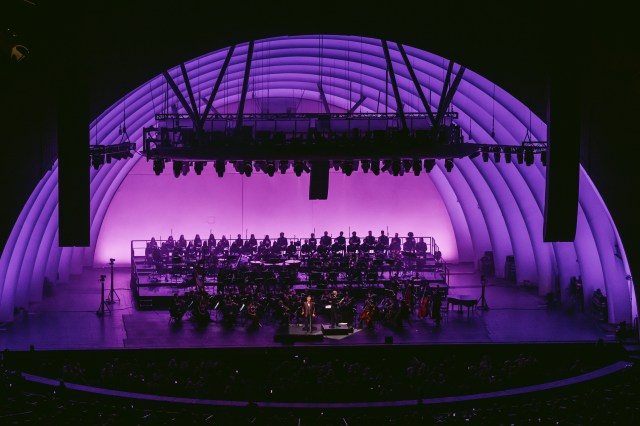
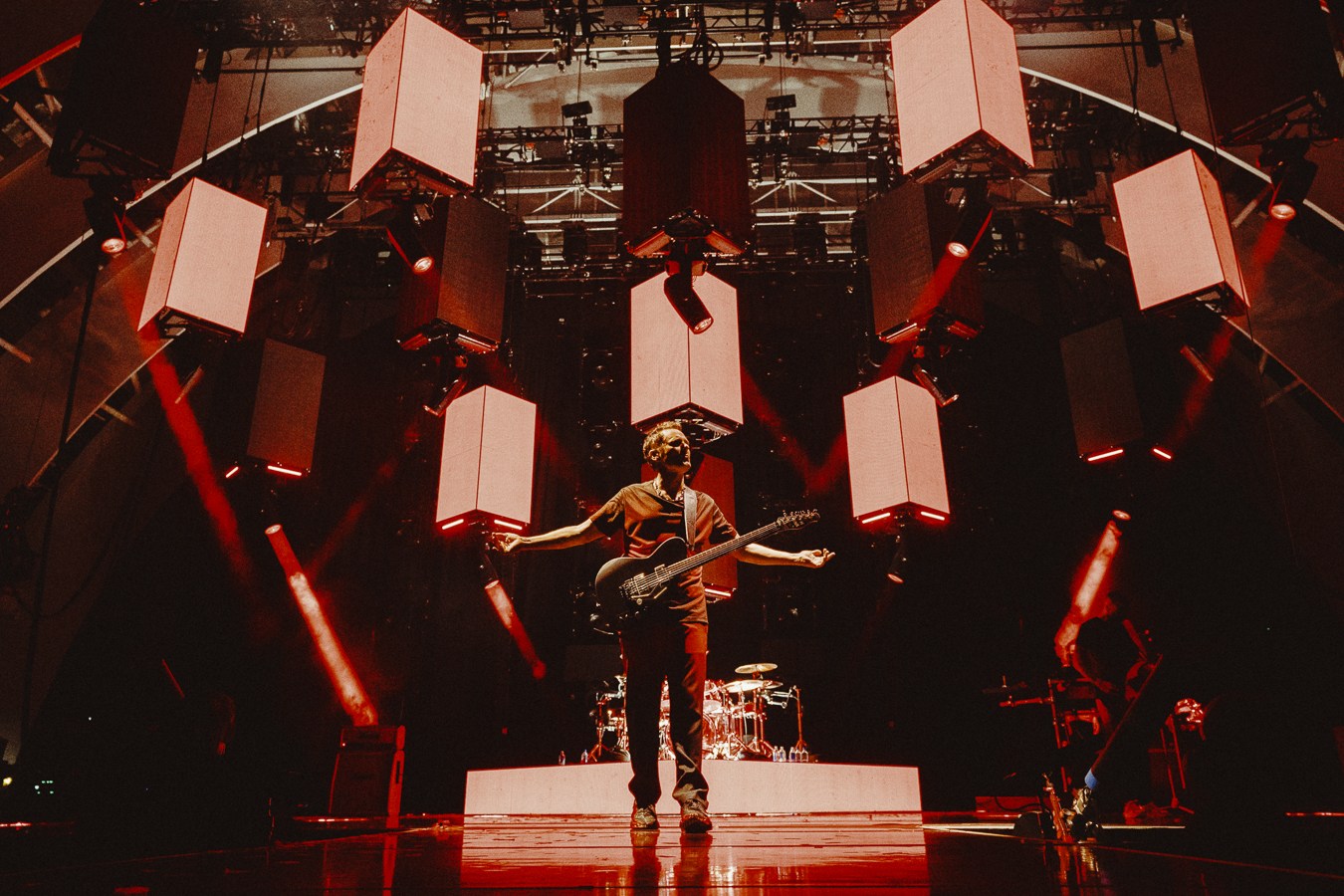
The Hollywood Bowl is built for sitting down. You arrive with your popcorn, find your seat, and settle in for the evening.
However, by the time Muse started their set Monday night, everybody in the 17,000-seat amphitheater was on their feet, and it stayed that way.
The night started with The Temper Trap, whose dreamy indie-rock sound felt right at home in the Bowl. They played “Sweet Disposition,” which I had heard plenty of times before, but there was something fitting about hearing it live in a venue where the whole thing already felt cinematic.
Portugal. The Man followed. I had never seen them live, and John Gourley emerged from a plume of smoke, fully masked, wearing a huge hat with “Suicidal” written around the brim. Their live sound was much more guitar-oriented than I expected from their records, and the band was going completely for it.
When Muse came on, you could feel the amphitheater erupt with excitement. I’ve listened to Muse for most of my life. I remember having their songs on my iPod, listening to them on the bus, studying their guitar riffs, and absorbing them without really thinking about how much those songs were becoming attached to different parts of my adolescence.
“Supermassive Black Hole” sent me straight back to 13, watching Twilight for the first time. I was suddenly in the vampire baseball game and worried for Bella’s safety. Part of that was nostalgia, but the other part was hearing the song played with a ridiculous level of precision and intensity.
The major songs were incredibly close to the recordings. Every guitar line was there, every vocal detail. The little ad-libs. The rhythmic parts that you don’t necessarily notice until somebody gets them exactly right. But there was no doubt they were playing all of it live.
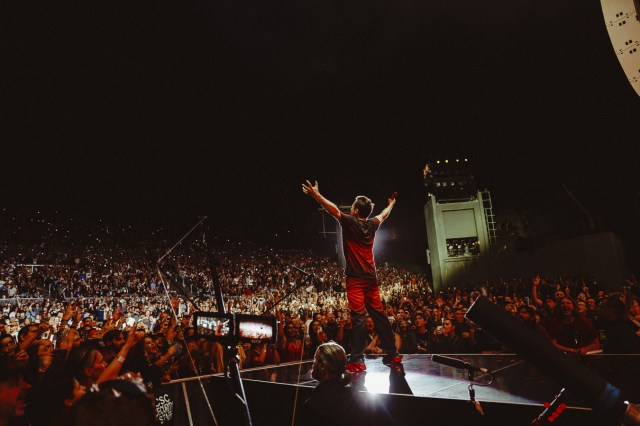
And of course, Matt Bellamy was doing the most as always.
He was jumping around the stage with a guitar while singing with absurd levels of control. His vocals stayed pitch-perfect throughout the set, even when he moved into some of the band’s more melodically and vocally demanding material. He switched between several guitars, including a seven-string, and was constantly changing sounds through an enormous pedal setup.
Then he’d walk over to the piano and hit the cleanest glissando I’ve ever heard live on stage, as if he had briefly been reincarnated as a classical pianist.
Chris Wolstenholme and Dominic Howard were just as important to the scale of what was happening. Wolstenholme moved between fingerstyle, pick and slap bass, while Howard switched effortlessly between electronic percussion and multiple acoustic drum setups. Together, they gave the songs their constant forward motion and made the entire thing feel much bigger than three people onstage.
Dan Lancaster, the band’s touring multi-instrumentalist, was handling keyboards, synthesizers, additional guitar and percussion, with a setup that looked like the control panel of a Star Trek spaceship. I have no idea how much of it was strictly necessary. Does it matter? Absolutely fucking not. It looked sick and sounded even cooler.
Bellamy is obviously the person you watch. He’s the singer, guitarist, pianist and frontman, and he’s thrashing around the stage while doing all of it. But Wolstenholme and Howard are doing an enormous amount of work underneath him, driving the songs forward without ever getting swallowed by Bellamy’s showmanship. Lancaster adds another layer of instrumentation that lifts the whole thing even further. For a band with only three core members and one additional musician, Muse makes a genuinely absurd amount of sound.
Then Bellamy came back out wearing a glowing neon jacket.
I don’t know who else could get away with that onstage while making it look cool. T-Pain, maybe.
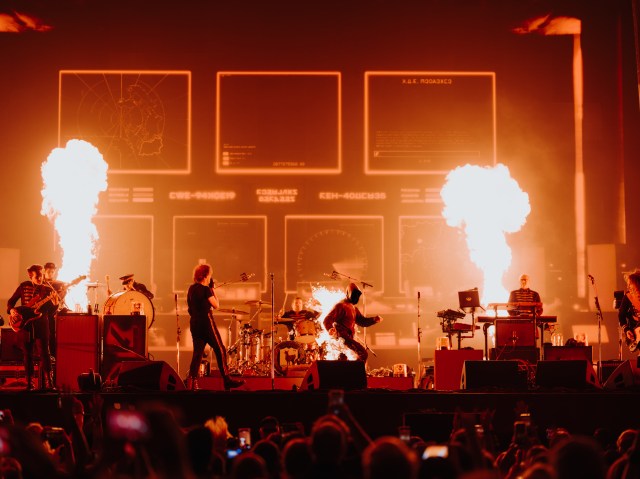
The show had plenty of the theatricality Muse is known for, but the thing I kept coming back to was how much musicianship was underneath all of it. The lasers, streamers and pyrotechnics weren’t making the songs feel bigger than the band. The band was big enough already.
“Plug In Baby” was ridiculous. I was headbanging in the reporter box with the other reporters, which probably tells you more about the show than anything I could write about it.
“Madness” got me in a completely different way emotionally.
And by the time “Knights of Cydonia” came around, I knew I was watching one of my favorite concerts I’ve ever been to.
The song already sounds like a collision of influences, and hearing the opening harmonica line from Ennio Morricone’s “Man with a Harmonica” before the band launched into it made that even more apparent. Muse can take a spaghetti-western reference, turn it into a guitar anthem and somehow make it sound completely natural.
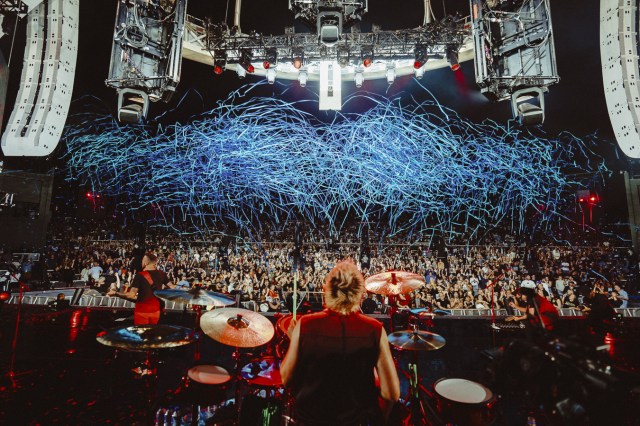
By this point, the set had been going for over an hour.
And nobody sat down.
People were still dancing. Still singing. Still completely locked in.
Bellamy barely talked. Maybe 20 seconds total. He didn’t need to keep stopping to tell the audience to get louder. They were already there.
What I wasn’t prepared for was how emotional I would feel after it was over.
I felt like I was 10 again.
Watching them reminded me why I wanted to perform in the first place. There was something about seeing such skilled musicians living inside of their musical world that brought me back to the part of being a kid where music wasn’t a career, or a project, or something to be analyzed. It was just something you loved.
Walking out of the Bowl, I realized I hadn’t just spent the night hearing songs I grew up with. I had watched a band take everything I remembered about them—the guitars, the huge songs, the ridiculous laser-filled theatrics—and make it feel completely new.
Somehow, Muse had turned the Hollywood Bowl into a rock arena, a nightclub and, for a couple of hours, my old iPod.
I’d go back in a heartbeat.