bbno$ on Virality and Vulnerability: An Interview

There is a certain amount of luck that comes with a hit song that is hard to quantify unless you are bbno$, of course. The Canadian-born rapper has made going viral something of a matter of fact compared to a hope. His unique flows, willingness to explore new sounds, and one-of-a-kind personality allow for a draw that most couldn’t compare to. Not to mention his ability to make anyone of any ilk feel comfortable at his shows or in his community. Proving just how intertwined an internet persona and real life can become if working is all that you do. The question is not how authentic he is compared to the persona but how both are iterations of the same authenticity. He sat down with us right before his Bonnaroo show to discuss that as well as his scholarly ambitions post-music career. 


Hit Parader: How is your year going so far? 

bbno$: The year is going pretty well. I just got back on antidepressants four days ago. So I’m about to become a machine here very shortly. 

HP: As long as the side effects don’t get too crazy. 

bbno$:  Only side effect is you don’t really get hard or horny. But hey, man, when you live in a capitalistic society, it helps. 

HP:  When talking about your process for making music, you mention that you use analytics to think about what to experiment with for the next project. Whether it’s a certain bass or bpm. From the last project, were there any analytics that you noticed that you’re going to use for the next song or album? 

Cred. Taylor Regulski from Bonnaroo Music and Arts Festival

bbno$: Not really. I made this song called “it boy” in early 2024 and put it out in May. The house rap music wasn’t really popular as it is now in North America, specifically. I was very inspired by European Gabber and Jump style and stuff like that. I was like, “Okay, how do I have my own little taste of it?” “How do I show North America?” I just really doubled down on the house rap staff, and it really elevated my career. So, as far as what I have coming next, it’s probably a little bit more developed in that world. We are listening to a ton of funk this morning, and I was like, “Damn, I got to make a funk album.” I think that would be really, really fun. No one is really making proper funk these days in the semi-mainstream. I think it would be really interesting if I did my own little taste of it. Not disco or house, but pure funk. It would be really sick. 

HP: Your internet personality is very entwined with who you are as a person. As your career has progressed, have you found that balance of that intertwining? Do you try to separate it at all or just kind of leave it as is? 

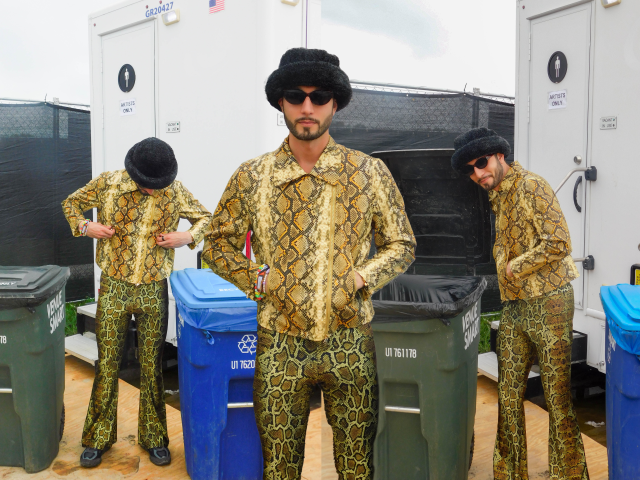
bbno$: I don’t really work on anything other than work. So, it’s hard to differentiate between Alex and bbno$. What I was wearing prior to this (currently wearing a full suit made of snakeskin) was Lululemon Shorts and a white tank top because that’s what is comfortable to me. But I want to be extravagant, all over the place, and energetic. A showman, so I’ve always used my platform to be me times ten. So, do I blur the lines between them? Yeah, a little bit, but at the same time, I stand on the right side of history. My ethics and morals are on the correct side. I’m just advocating for people who may feel displaced and stuff like that. I have such a big following and platform now that I have to spread love and positivity. That’s what I originally wanted to do when I was growing up. I wanted to be a doctor and help people. I feel like I’ve helped more people than I ever could have. 

Cred. Taylor Regulski from Bonnaroo Music and Arts Festival

HP:  You’ve mentioned before how you make things as extravagant as possible, and that has opened up other people to feel more comfortable in the audience. 

bbno$: Yeah, I think that just comes across via the authenticity that I show via just being myself. If it offers them a safe place to smile and have a good time, Fuck yeah! Not enough people, specifically in this day and age, are spreading the love and positivity. There’s so much hatred out there right now, and I don’t want any part of that. 

HP:  In the Daniel Wall interview, I saw you talking about how there’s no research for what a hit song does to an artist. As someone who’s probably experienced that a couple of times. In your anecdotal experience, what would you think the results of that would be? 

bbno$: Interestingly enough, I’ve been talking about this for a while. I just realized that this is something I want to do after I’m finished with music. I want to spend money on a research study because the sample size is so small with people who have hits. People who do social media at the grandiose level. Why would you study that? It just seems like a waste of money for a school, right? So I want to fund a study and write a thesis on the emotions and the tumultuality that I have historically dealt with because of what I do. I don’t know when I’ll be able to do that because I’m doing this. It’s an unspoken pressure that no one really knows how to articulate. I was talking to a friend of mine who’s a twitch streamer, and I was like, “For all I know, you could be a psych ward patient; we could be psych ward patients.” With the scope and the level of the public eye that has been drawn historically. Let’s say the Beatles, it was just television or newspapers. People were not always in your everyday life. So I don’t necessarily know; I wish I had the answer, but I’m genuinely very interested in studying something like that. Releasing a study because there’s no research at all. 

Cred. Taylor Regulski from Bonnaroo Music and Arts Festival

HP: The idea on a much more micro scale than what you experience is what someone experiences if their whole high school likes their photo on IG. When they are used to 40 likes. That jump from “Low” attention to the feeling of all of these eyes on you. That feeling weighs on people. The research would do a lot of different things that we may experience, but don’t think to connect. 

bbno$: I think the variable would be at a large, mid, and low scale; it would be insane. I actually think I will probably do a big study on that. 

HP:  Any last message to fans, readers, or viewers? 

bbno$: Don’t be a dickhead; spread love and positivity.


Catch bbno$ on tour here.

Alana Springsteen Helps With Stunning New Album

Alana Springsteen is one of those artists. You know the ones, the type of artist who completely sneaks up on you. You hear a song or two, think, “Oh, this is cool.” You like it enough to go just a little deeper and find that as you keep mining the material it just keeps getting better. The more you listen to, the more you recognize the honesty of the lyrics and vocals, the consistent quality, the depth of the songwriting and the power of the emotion in every song.

Before you know it, Springsteen, no, no relation, has gone from cool to a must-see live. Springsteen’s tour de force new album, I Hope This Helps, out tomorrow (May 29) is an absolutely stunning collection. Throughout the masterful record, Springsteen weaves deeply personal and intimate stories into tales everyone can relate to all well.

In the opening lines of the stark and powerful “Feels Good,” Springsteen sings, “Last night I was two more shots away from trying to talk myself into Heaven’s Gate/Some regret tastes better at the bar.” She repeatedly does that through the record, capturing the highs and lows of being human. Springsteen understands the best work is intensely personal and, at the same time, universal.

Hit Parader spoke to her at length about the writing of the record, heroes like Sheryl Crow and Patsy Cline and much more. 


Hit Parader: What makes a perfect Nashville day? 

Alana Springsteen: First of all, the weather, no humidity, the sun being out, 70 degrees, no crazy pollen giving you allergies, seeing a bunch of friends, connecting with people. It’s just been a really, really great day overall. 

HP: This is one of those albums that just screams therapy in the best way possible. So, was this an awakening for you?

Springsteen: Massively. The last two years have been the most transformative of my life. I feel like I had to pull myself apart and put myself back together to write this album. And these songs have been my roadmap through all of it. They’ve helped me understand myself and have healed me, have shown me the sides of me that I’m insecure about, and allowed me to make peace with it. And I’m walking out on the other side, just a much better version of myself. 

HP: I was looking at the title; I Hope This Helps. Do you mean this for other people or for yourself? 

Springsteen: I love that. It’s actually both, which is why I love the title. It’s kind of simple, but it really touches on all the parts of it. I hope it helps me make peace with my inner child and get to know myself better and just be a better version of myself for me, and for the people around me. But I also hope it helps. The people out there that hear it.  There were so many times writing this record that I truly didn’t know if I could continue. I was in the middle of therapy, on one of the biggest tours of my life with Keith Urban, trying to be in the studio, write this record, just doing it all at once. It almost broke me many, many times. And the thought that kept me going and got me back in the studio was that maybe the next song that I would write would help someone out there feel less alone in what they were going through and give them the courage they needed to choose themselves and to ask life for more and to do the hard work, knowing that it’s going to be worth it on the other side. 

HP: I saw Joni Mitchell at the Gorge a few years ago. And Joni Mitchell singing “Both Sides Now” at 80 is one of the most beautiful things in the world. But Joni Mitchell wrote that song when she was 23. What the hell? Can anybody understand writing a song like that when you’re in your 20s?

Springsteen: I didn’t realize she wrote that song when she was so young. That’s another one for me that I heard again for the first time in a while, a few months ago, and I was just sobbing in my car. It’s so emotionally deep. But I think there’s something about being young that allows you to get out of your own way. You don’t know what you don’t know, so you don’t overthink it. And you’re just feeling it. And I think that’s kind of what I’ve tried to focus on with this record; just getting out of my own way, not trying to write a perfect song, but just write something honest. 

HP: Nick Cave said something so interesting to me. He said that as a writer, you always write what it is you’re longing for. And to me, this album screams that.  Do you feel like you were writing for the questions that you needed answered?

Springsteen: Yes, 100 percent. I think my debut record asked a lot of questions, and I was just starting to really get to know myself. And I wrote songs like “Chameleon” about the way that I’ve always been a people pleaser, just constantly shape shifting. But I didn’t understand why until I wrote this record. So, in a lot of ways, Twenty Something asked the questions, and this album helped me find more of the answers. And obviously, we never fully finished the journey of this. We’re constantly asking questions, but I think I started to get to the root of a lot of these patterns in my life. And I had to go back a long way to that inner child, to sometimes four or five, six, seven years old, to rewire these truths that I believed.

HP: What were the questions and answers that surprised you the most when you were writing this? I was interested in a song like “No Man,” which was very interesting to me. I will not ask if that was autobiographical or not, but I was thinking about it. And sometimes it’s probably easier to write autobiographically when it is in third person.

Springsteen: That’s true. I do feel that. I’ve written a couple songs autobiographically from third person. And that’s a really interesting theory. I’ve never really dissected that much. That song specifically isn’t exactly to the tee my story. It’s one of the few songs that I’ve written where all the details aren’t about me. I pulled from several different people in my life and different stories and created this character that I very much identify with. I was able to get lost in this person in the song in a way of just not feeling like you fit, wanting to escape, wanting something more for yourself, wanting to get out, and not wanting to be tied down. So badly wanting love and wanting connection, but never wanting to be limited by it. And I think for a while, love always felt conditional for me for most of my life. And I’m just now getting to the place where I’m realizing that love should never ask you to be something else. It should never ask you to be small. It should just empower who you are and make you want to be better and just chase your dreams down and know that you’ve always got a place to come back to and a soft place to land. But that song, I’ve always loved country music because of the storytelling. So, I wanted to write a song that was just an incredibly beautiful story about a girl choosing herself and refusing to stay small.

HP: Who are the country storytellers that are some of your favorites?

Springsteen: I think Emmylou Harris is at the top of that for me. There are some of her songs that are just hauntingly honest. I think about her song, “Red Dirt Girl.” It’s one of my favorite country songs. And it’s just this beautiful snapshot of what it’s like to be from a small town and maybe never get out, and some of the things you face and the people that you meet along the way. And you’re like, “I see myself, I see my family members in that song a little bit.” And I love when songwriters can just put you in a place like that and make you relate maybe to something you’ve never experienced, but it’s so emotional that you can’t help but feel yourself in it. So, she’s up there for me. Maybe you wouldn’t consider her country, but Sheryl Crow is one of my favorite artists. And to me, she’s country. I listen to those songs now. I listen to her self-titled record, and I’m like, “That could be on country radio right now. It’s all about storytelling.” She’s an incredible musician. She produced it all herself. She’s just this outlaw in so many ways. She paved her own path, and she has inspired me so much and continues to do so. Another songwriter that always inspires me is Hayley Williams. Again, she’s not considered country, but to me, she’s done such a great job always of not being afraid to write about these nuanced subjects and her own truth and stand behind it and say things that a lot of people are afraid to say sometimes. To me, that is the definition of an outlaw. So those are all people that I’m inspired by.

HP: You look at a song like “Selfish,” which I love. Is that a song that you could have written at any other time in your life?

Springsteen: I don’t think I would have had the courage to write that. And it sounds crazy, but I think growing up, as a woman, as an eldest daughter of four kids in the South, you’re just raised with these expectations and these requirements and pressures that are put on you. To act in a certain way, present oneself a certain way, to always be kind and serve other people, be gentle, not rock the boat too much, just be quiet, defer to other people, on and on. But I think a lot of my life, when I started to learn to set boundaries and to choose myself, it ruffled a lot of feathers early on because that’s just not what people expected from me. It’s not what they were used to getting from me. So, I was called selfish a lot. And I wrote this song as a reminder to myself that it’s not selfish to put yourself first. And you can’t take care of other people or show up for other people in your life until you know how to show up for yourself, until you meet your own needs. There are so many women in my family, strong women — my mom, my grandmother, people that I’ve looked up to my whole life, that I’ve watched sacrifice so much at the expense of themselves. So, this song was a reminder to me and hopefully a reminder to all the women out there and people in general, it’s not selfish to choose yourself. And sometimes you just need the reminder because it felt so against my nature to write that song. But it’s something that I needed to hear in the moment for sure. 

HP: Who are those artists that you really admire for the way they were able to break out of whatever shackles they had and set their own course? 

Springsteen: You think about throwing it back to Patsy Cline. When she was releasing music, she was creating a type of music that just wasn’t, quote unquote, country at the time. She redefined country in the way she used her voice, the way it was more of a soulful R&B flow, to the way she sang, and the way she had strings and orchestras in her production. It was much more of a pop approach, but it was the first time people had heard anything like that. And she redefined the genre and really opened up a whole new pathway. That was just from staying true to herself, leaning into how her voice sounded best, and the music that she loved. I think that is a massive example for me of a woman going, “No, this is the music I want to make. I don’t care if people don’t get it or if they do get it. I’m just going to. pave my own path and trust that the art I love is going to cut through.” I think about Miley Cyrus, too. I’ve always loved her music and the way that she is constantly able to redefine herself. She’s had so many different eras, and this latest record that she just put out felt like pure art to me. Coming off the previous record, Endless Summer Vacation, which was full of hits, this latest record just felt like it was pure art, like she was making it for her. And sonically, she made some choices that were just so off the wall and unexpected. I love artists that are fearless that way. And a lot of times they’re ahead of their time. That’s the kind of artist I want to be. I want to constantly push the boundaries and live in that space. I like to color outside the lines. I’ve never been a black and white person. I’m more of a gray area person. 


Alana Springsteen’s new album I Hope This Helps is out tomorrow 5/29.