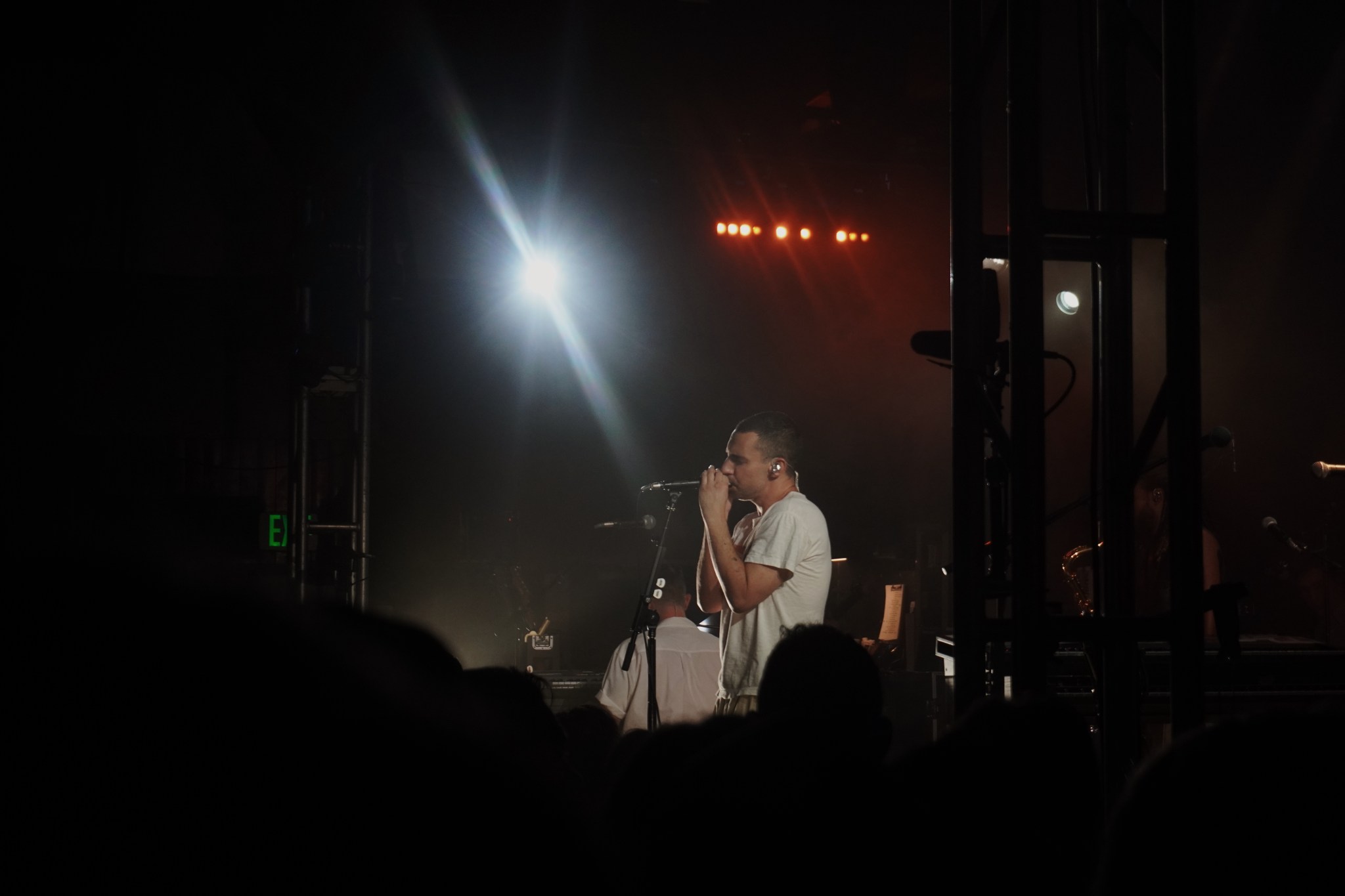
The Troubadour is small (iconically small), so when we walked in for Bleachers, I expected it to be packed.
And it absolutely was.
We pushed through the excited crowd, found a spot against the wall next to a couple of photographers, and watched people continue to file in. I’ve been to the Troubadour a few times, and one of the things I love about the room is that there really isn’t a bad place to watch from. Even pressed against the wall, you’re able to see everything easily.
Before the band came out, Frank Sinatra’s “My Way” started playing. Almost immediately, the entire crowd started singing. It was a fitting introduction to a night that would end up being as much about the relationship between Bleachers and its audience as the music itself.
When the band finally took the stage, the room erupted.
The band managed to pack a surprising amount of equipment onto the stage. Multiple guitarists, two saxophone players, keyboards, drums, tambourine, chimes, percussion, and a glockenspiel-like instrument were all squeezed into the setup. Somehow, the musicians still managed to move around the stage with ease, which I found particularly impressive.
The musicianship and chemistry of the band were truly a treat to see live. The saxophones added another dimension to the songs, while the percussion and keyboards filled out the arrangements. I especially enjoyed the occasional tambourine (a lost art these days), and the joy between the musicians onstage was infectious.
At one point, Jack Antonoff asked how many people had already been to another night of the Troubadour run. An impressive number of people immediately shouted that they had.
And I get it. Antonoff spent the entire performance kicking and jumping across the stage, constantly finding new ways to pull the crowd into the fun. That intimacy is one of the things that makes the Troubadour so special, and you could tell this performance meant a lot to the band.
The Troubadour was the first venue Antonoff ever headlined, long before his career grew to the massive scale it occupies today. He spoke about how full-circle the experience felt, and as a musician, it was inspiring to see the gratitude he still has for the experiences that helped get him here.
He eventually picked up an acoustic guitar for “I Wanna Get Better.” After spending most of the night surrounded by a full band and an enormous collection of instruments, he stripped the song down to something much closer to its original form.
It was one of the quieter moments of the night, and because of that, one of the ones that stayed with me most. There was no need for the full production. It was just Antonoff, an acoustic guitar, and a song he had written years ago, now being played in the same room where he had first headlined.
Then the full band came back in, and the Troubadour became deafening again.
By the end of the night, what stuck with me most was how naturally Bleachers fit into a room that is so much smaller than the stages they could and have occupied. The production was ambitious, the musicianship was dense, and the crowd was completely locked in, but the show still felt personal.
For a room that has hosted countless artists at the beginning of their careers, it was pretty cool to see someone return years later to one of the first places that gave their music a chance.