
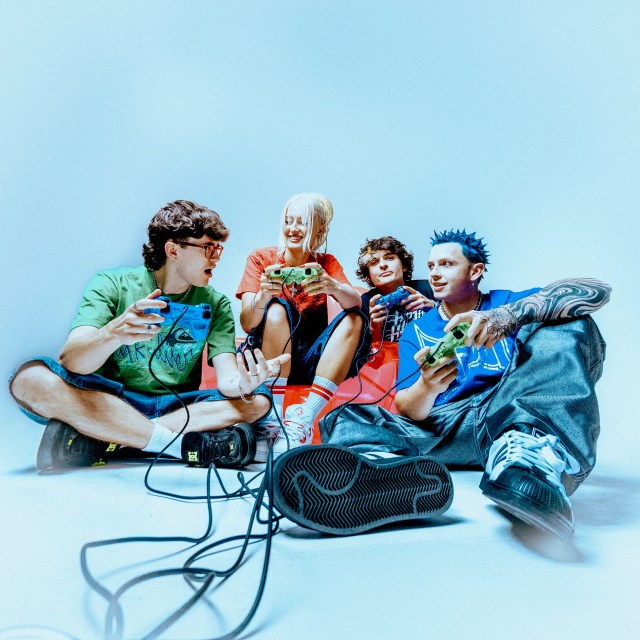
South Arcade has spent the last year moving at the speed of a loading screen that never quite finishes buffering. One city dissolves into the next. Time zones blur. Vans replace bedrooms. For Cody Jones and Harmony Cavelle, that disorientation is not a side effect of momentum, but the point itself. The band’s ascent has been defined by motion — by an almost gleeful refusal to stay still long enough to overthink what is happening. When Jones describes the year as feeling “teleported to about a million places,” it lands less like a complaint than a mission statement.
There is a particular kind of vertigo that comes with a first headline tour, especially one that stretches across the United States. South Arcade has felt it keenly. Cavelle jokes that they have spent more time in a van than in a house this year, but the joke lands because it is true. For a band whose sound thrives on velocity, friction, and sudden left turns, the road has become both workplace and laboratory. “I wouldn’t change a thing,” Jones says, echoing Cavelle almost word for word. That unanimity feels earned. Touring has not diluted their identity. It has sharpened it.
Life inside the tour bus is not the communal jukebox fantasy fans might imagine. More often than not, the band disappears into headphones, retreating into private sonic worlds between shows. When music does bleed into the shared space, it is usually courtesy of their tour manager, who delights in throwing on whatever strange artifact he has recently unearthed. Horror soundtracks, unsettling atmospheres, things that make everyone glance around the van, wondering what exactly they are listening to. Jones laughs about it, half amused and half horrified, but the randomness feels instructive. South Arcade is a band that absorbs chaos and finds melody inside it.
Jones has also been digging backward, rediscovering a European nu-metal band called Pleymo, a relic from the Nineties with at least one song that once seemed unavoidable. Revisiting that album has become a minor obsession. Cavelle, meanwhile, gravitates toward artists like Ericdoa and Thxsomch — voices that live in the space where pop, post hardcore, and internet culture bleed together. On a tour that also includes Jutes and Wes Ghost on festival bills, those listening habits feel less like guilty pleasures and more like reconnaissance. South Arcade is paying attention to the ecosystem they are moving through.
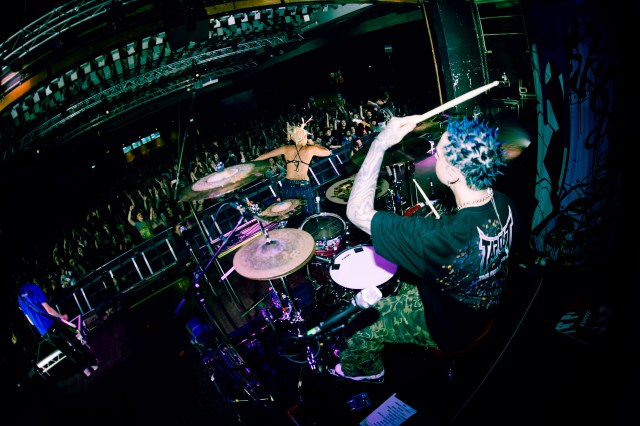
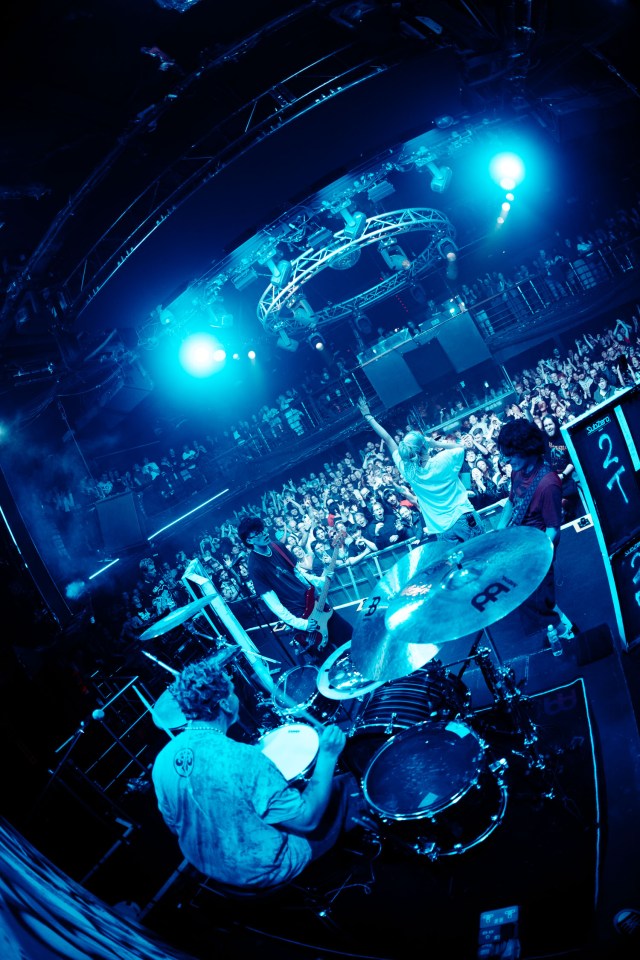
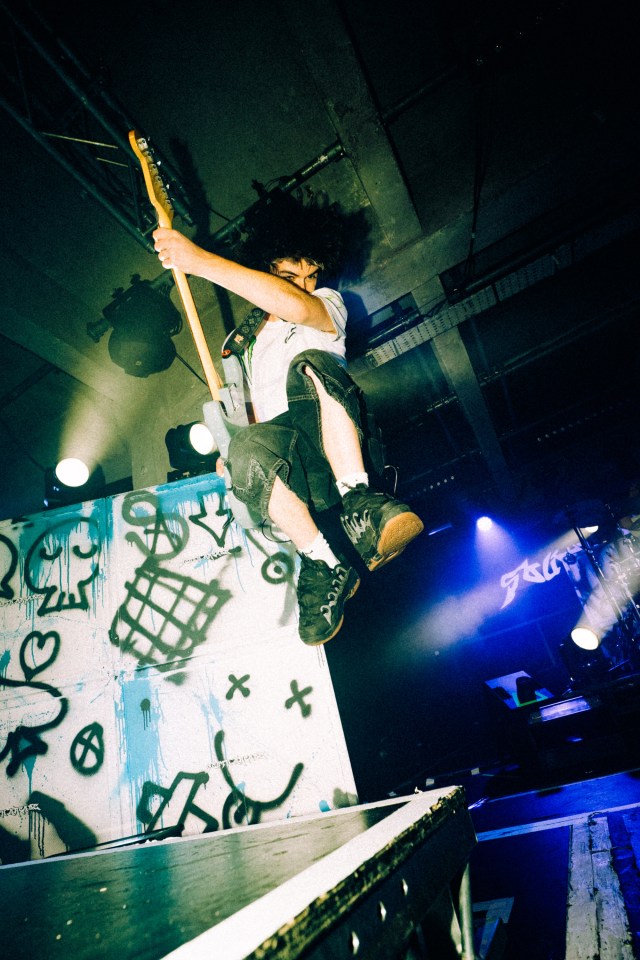
That awareness becomes most obvious onstage. This run marks their first headline tour in the US, and the response has been immediate and physical. Jones singles out Los Angeles, specifically the first night, which doubled as a Halloween show complete
with costumes and an audience ready to abandon self-consciousness at the door. Cavelle notices a broader pattern. American crowds tend to commit from the first note, while U.K. audiences often hold back, arms crossed, waiting to be convinced. Neither approach is judged harshly, but the contrast has been illuminating. In the US, South Arcade is greeted with a kind of open-armed enthusiasm that mirrors their own performance philosophy. Play hard. Decide later.
They have also had the benefit of learning in public, opening for bands like Bilmuri and Magnolia Park. Jones speaks with particular reverence about Bilmuri’s drummer, describing him as a machine, a force of precision and stamina. Watching from the wings, hanging out after shows, absorbing those details has been formative. “You learn from the best,” Jones says, framing it less as imitation than selective theft. Take what works. Leave the rest. Cavelle boils it down further, calling it simply “learning from the peers,” but the implication is serious. South Arcade sees themselves as part of a lineage, not an anomaly.
That sense of participation extends to their online presence, which has exploded over the past year. Both Jones and Cavelle laugh when the topic comes up, equal parts proud and sheepish. Social media, they admit, was once a source of anxiety and performative desperation. Early on, they chased trends with a kind of frantic sincerity, trying anything that might trigger the algorithm. Jones winces, remembering street covers posted before they had any original music out. Cavelle recalls scrolling back through their archived posts backstage in Seattle and cringing at how much they cared.
What changed was not strategy so much as self-understanding. The content that resonates now is an extension of what they are already doing. Live footage. Band practice chaos. Four cameras are set up in a room while friends mess around and make noise. The humor is loose — the stakes low. Ironically, that lack of concern has made the output feel more authentic and effective.
“The less you care, and you still be yourself,” Cavelle explains, “you do not hate doing it as much.” It is a rare admission in an industry that often treats authenticity as a branding exercise.
That growing comfort has paralleled a clearer musical identity. Jones talks about how the band had not fully articulated their influences early on, even to each other. Those conversations came later, after enough shared experiences to recognize common ground. What they listen to. What excites them. What they want to write about. The result is not a narrowing of scope but a confidence in their eclecticism. Jones punctuates the thought with a joke about his spiky hair, but the aesthetic shift feels emblematic. South Arcade looks and sounds like a band that has decided who they are allowed to be.
That clarity is audible on their new EP, PLAY!, and particularly on the single “Drive Myself Home.” Much of the EP was written on the road, in snatches of borrowed studio time and long van rides punctuated by laptops passed between seats. Cavelle describes ducking into random studios in the middle of nowhere, places that might have little more than a drum kit and a sense of urgency. Against that backdrop, “Drive Myself Home” came together quickly, almost mercifully. Jones laughs about the relief of a song that simply works, especially when writing on tour can feel like trying to build something solid on shifting ground.
The EP itself was not conceived as a traditional concept record. Instead, Cavelle frames it as a collection of tools for the stage, songs designed to fill gaps in their live set and amplify the energy they want to project. The title, PLAY!, is both directive and philosophy. It references video games, movies, and a distinctly early 2000s maximalism that allows for dance breaks, heavy drops, drop-tuned riffs, and auto-tuned pop flourishes in the same breath. The unifying thread is not genre but intent. These are songs meant to be experienced in motion.

Asked to distill the EP into a single track, Jones gravitates toward “Fear of Heights,” citing its heaviness, its breakdown, and its almost video game-like momentum. He likens it to the sensation of blasting through L.A. traffic with Crazy Taxi energy, a comparison that feels perfectly calibrated to South Arcade’s blend of nostalgia and immediacy. He also mentions “Supermodels” for its all-encompassing quality, while Cavelle insists that every track, including “Drive Myself Home,” carries that same hybrid DNA. The refusal to choose feels honest. This is not a band interested in hierarchy.
The road ahead offers little in the way of rest. The U.K. shows loom, followed quickly by Australia and Europe. New songs will be tested in real time, refined under lights and sweat. Cavelle expresses particular excitement about “Blood Run Warm,” a track that reveals a softer, sadder side of the band. Jones jokes that his current look may not suit it live, but the humor does not undercut the significance. Vulnerability, it seems, is the next frontier.
South Arcade is moving fast, but they are not running blindly. There is intention beneath the chaos, play beneath the polish. In an era where bands are often expected to arrive fully formed, South Arcade are documenting their becoming in public, one show, one post, one song at a time. If the year has felt like a million teleportations, it is because they are building something in transit, refusing to wait for arrival before they start playing.