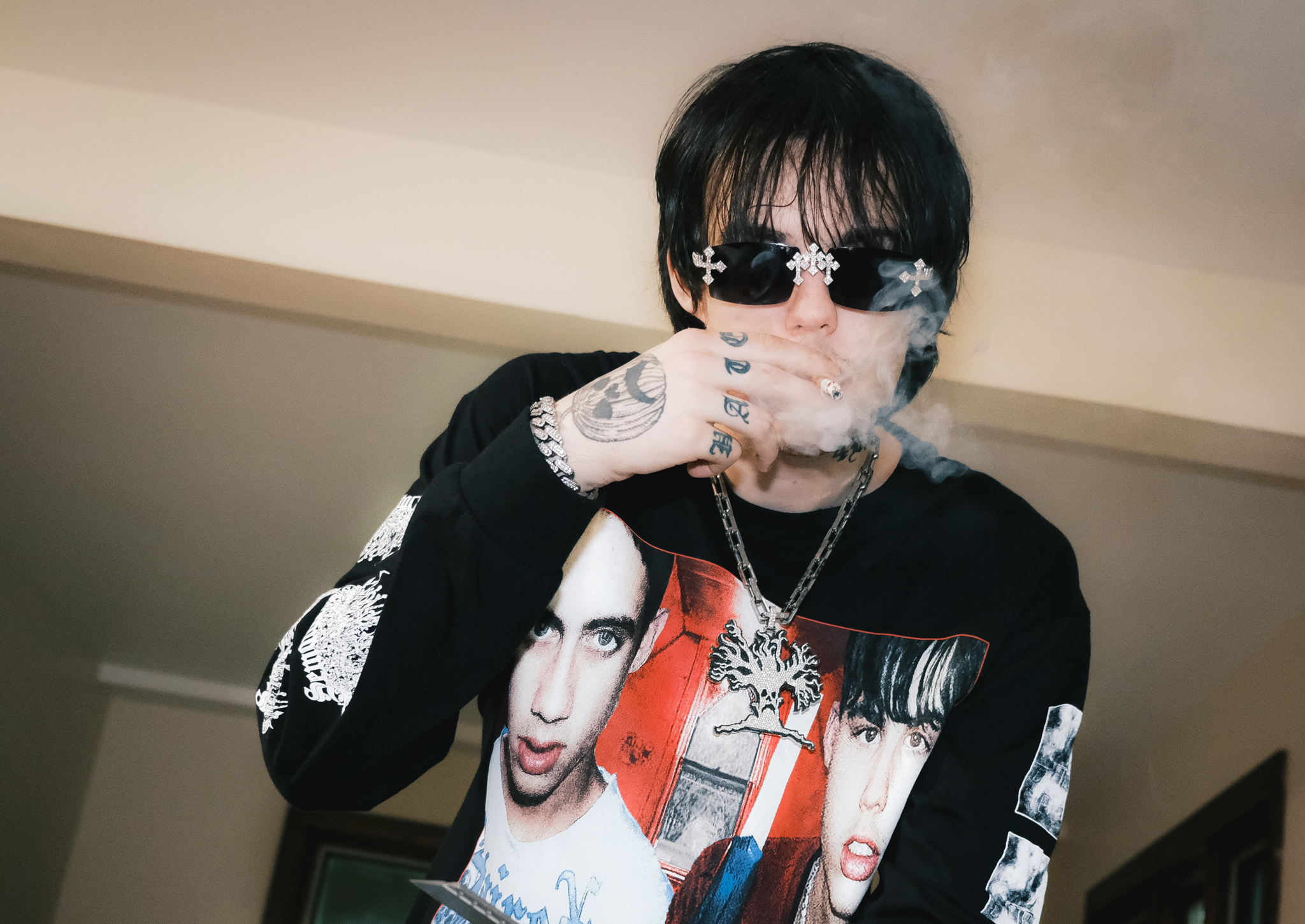
In a world full of easy-to-digest, similar-sounding production, there are a couple of artists who choose a new path. Love it or hate it, the one thing everyone knows about Sematary’s production is how unique and singular the sound is. Sure, there may be attempts at inspiration, but none quite match the tones, feel, and fingerprints of Haunted Mound. The rapper/producer has been releasing music for an online audience for over six years now. As the head of a collective, he leads the charge of a new brigade armed with masks and chainsaws.
Originally taking off on message boards and social platforms, his sound is the personification of someone driven through the noise to find his own sound. Blending sounds from a multitude of eras and samples that are sometimes so short that he is the only one who catches them. He dropped a mixtape this Halloween. Inspired by the deterioration of American cities, the production takes on an Island of misfit toys-esque feel. Taking things people may have overlooked, forgotten, or left in the past and blending them into his own product ready to be heard by the masses.
HP: How has your year been so far?
Zane: Good, I was just working all year on the Halloween mixtape, HAUNT-O-HOLIXXX, I just dropped. Now I’m working on music videos for that.
HP: Are you filming at the Butcher house or different places?
Z: Different places, I’m in upstate New York now. Had to finally leave there. I was there for a few good years. So, I’m out here now in Sopranos country, just somewhere new. Still in the woods, though, shooting videos out here.
HP: When it came to your most recent projects, you talked about inspiration from Gucci Mane and Zaytoven. In another interview, you talked about being really proud of the Three 6 Mafia sample. What type of influence do you find from that Southern Trap sound that really clicked with you?
Z: I feel like no one’s really combined it with sort of the newer plug-style drums and sort of witch house influences. I don’t feel like I’ve heard anybody really explicitly pull those influences back into sort of the newer stuff that’s going on now and that I’ve been doing. I never really explicitly combined it; specifically, that distinct sound brought it back, instead of just being an influence, like it is on everything now. Explicitly pulling back those vocal samples and those loops and stuff and combining it with the newer sound. It’s also sort of the mixtape sound from 15 years ago. I feel like I haven’t heard anybody do that specific combination. So I was happy that I kind of successfully combined a few different generations of underground trap music into one thing. I feel like, for this mixtape, which I hadn’t really heard. People do it, obviously, the Memphis stuff, but I feel like it was just cool to do it for a whole tape like that.
HP: When you do it, are you thinking about blending generations together, or is it more a specific sound that ends up pulling from different places?
Z: It varies from song to song. A lot of times, I have a lot of samples and songs that I like. I’m just listening, and then my DJ software is a big part of it. Thinking up songs or loops, and I’m like, “Wow, that sounds cool. What if I add my drums here and do my own vocals? ” Then it just comes together.
HP: Who is your GOAT of that southern trap sound?
Z: DJ Squeeky is obviously the one who invented all of it, the starter. So definitely him. I really like DJ Zirk. These are old guys I’m talking about now. But definitely those OG dudes, and obviously like Triple 6 Mafia, when they were called Triple 6 Mafia, the super Halloween, mystic styles, that kind of shit—really like that. Children of the Corn is a really good group, Graveyard Productions, they also call it. Just the most hardcore Halloween kind of sounds, even though it’s all pretty Halloween. But those are my favorites.
HP: There was a lot of sampling that I got a Cloud rap feeling from. Was there any
inspiration from that style?
Z: I mean, that’s always an influence. I’m listening to the same music everyone else is listening to and seeing how it’s impacting mainstream and underground stuff. I started rapping because of Young Lean, seeing him in 2016, and I’m pulling from all the same stuff everyone else is pulling from. So there’s always going to be some of that influence. But I was definitely trying to evoke and kind of be in the style of, like, old things before cloud rap. I listen to a lot of old New York, French Montana, and Max B, the way they do those super tacky samples and stuff. But because I grew up with Cloud rap, that’s always probably going to be in my bones of how I sample things, but I’m trying to go back to older stuff and freshen it up, do something different, because a lot of people are influenced by Cloud rap.
HP: How do you balance the influence with trying to create your own sound?
Z: I feel like, because I’m combining things that most people wouldn’t think to combine a lot of the time, it kind of just, by nature, sounds somewhat new, at least to me. There’s a song on the mixture called “HONDA CIVIC,” where I have this super old, like, or not, what’s a better example? The song “LAURA,” which is the fucking “Twin Peaks” theme, is the main sample, “Laura Palmer’s theme.” And then there’s the “Playa Hataz” sample, that classic Triple 6 Mafia song, playing together. Then it’s like, plug in MexikoDro drums. With all my vocal influences and Ghost Mountain, Wicca Phase. I’ve never heard a song like that before, so I feel like just by the nature of what I’m combining, it comes out pretty new.
HP: Speaking on sampling, what do you think is the most niche sample on the record?
Z: There are quite a few. There are so many little things in there. The “WOODSMEN” sample is actually a Children of the Corn sample, which is a really obscure Memphis group. It’s a group called that, and the songs are also all called “Children of the Corn.” I sampled that and was pretty hype. The “MEET UP AND DIE” song—there’s actually a Salem demo, this weird old guitar Salem song looped right there. I don’t think anyone peeped, which was hype to sample.
HP: With this mixtape being 28 songs and the first one of yours with this much content. Were there any songs that you thought about removing but ended up keeping that resonated with fans?
Z: I don’t know; it’s kind of tough to see this early. I feel like when I make a video for a song, people tend to like it more. So I feel like it’s kind of up to that. I don’t know the last song, “‘TILL THE ROBINS COME.” I didn’t love it at first, but all my friends told me I needed to put it out. So I did. A lot of people like that song. I don’t really see a lot of the reactions myself. So I just kind of put it out for me and hope people like it.
HP: I know you said you prefer escapism to preachy art, but I do think there is something philosophical about your music. Is there anything you put into that category?
Z: There’s definitely lots of meaning for me and a lot of things I’m saying and the samples I’m using. It’s all pretty meaningful for me, but I feel like I try to let people take from it what they want to take from it. You know, I feel like that’s how good artists should be, but I don’t know there’s a lot; there’s a lot of meaning for me in the samples I’m using, and stuff like the “HONDA CIVIC” sample, that’s an old black metal song I’ve listened to for years and years and years and, like, made mashups with before, and it’s pretty meaningful to me.
HP: We both share growing up in redneck-adjacent areas. Do you think that affects the way you look at music or consume music?
Z: I don’t know, maybe just because I was the one showing myself the music I grew up with. There wasn’t really a community I was in that showed me stuff. It probably gives me my own perspective on everything.
HP: The reason I asked is because your sound is very unique. Almost pioneer-esque in the way you combine styles or sounds. Do you think that background of being different than the people around you gives you the confidence to do it now in a different space?
Z: Yeah, definitely. I mean, it’s definitely pretty outsider stuff. It kind of stands alone, I feel, and maybe not as much now. I feel like there are artists coming out now that are inspired by me, and I consider them peers now. I know smokedope2016; he personally told me that he was inspired by Grave House when he was starting out. So, I think now people are taking inspiration, because I’ve been around for a few years, but it still kind of stands alone. I don’t know if anyone else could have made it or can make it the way my guys and I make stuff. It’s kind of like the entire bones of what I do, you know. I don’t know if I would have been confident enough to make music at all if I felt like I was doing the same thing as everyone around me or within the scene. I don’t know how I would have felt if it were even worth putting out.
HP: Any last message for the readers or fans?
Z: Thank you to everyone who believes in Sematary, the Haunted Mound, and our underground art that we put out. Thank you for talking to me and having me on the site. Thank you to everyone who believes in us and everyone who listens. Listen to the new mixtape, HAUNT-O-HOLIXXX. I’m putting out new music videos for it, and I’m going to keep working on new music after it. There’s no stopping Haunted Mound; it goes forever.