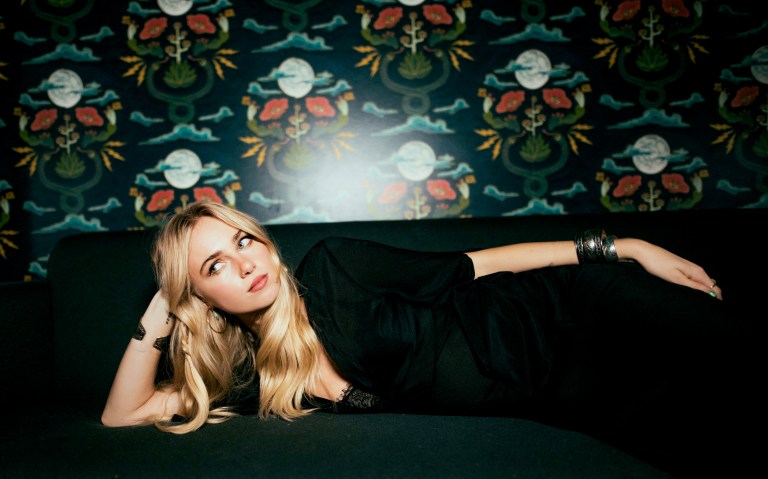
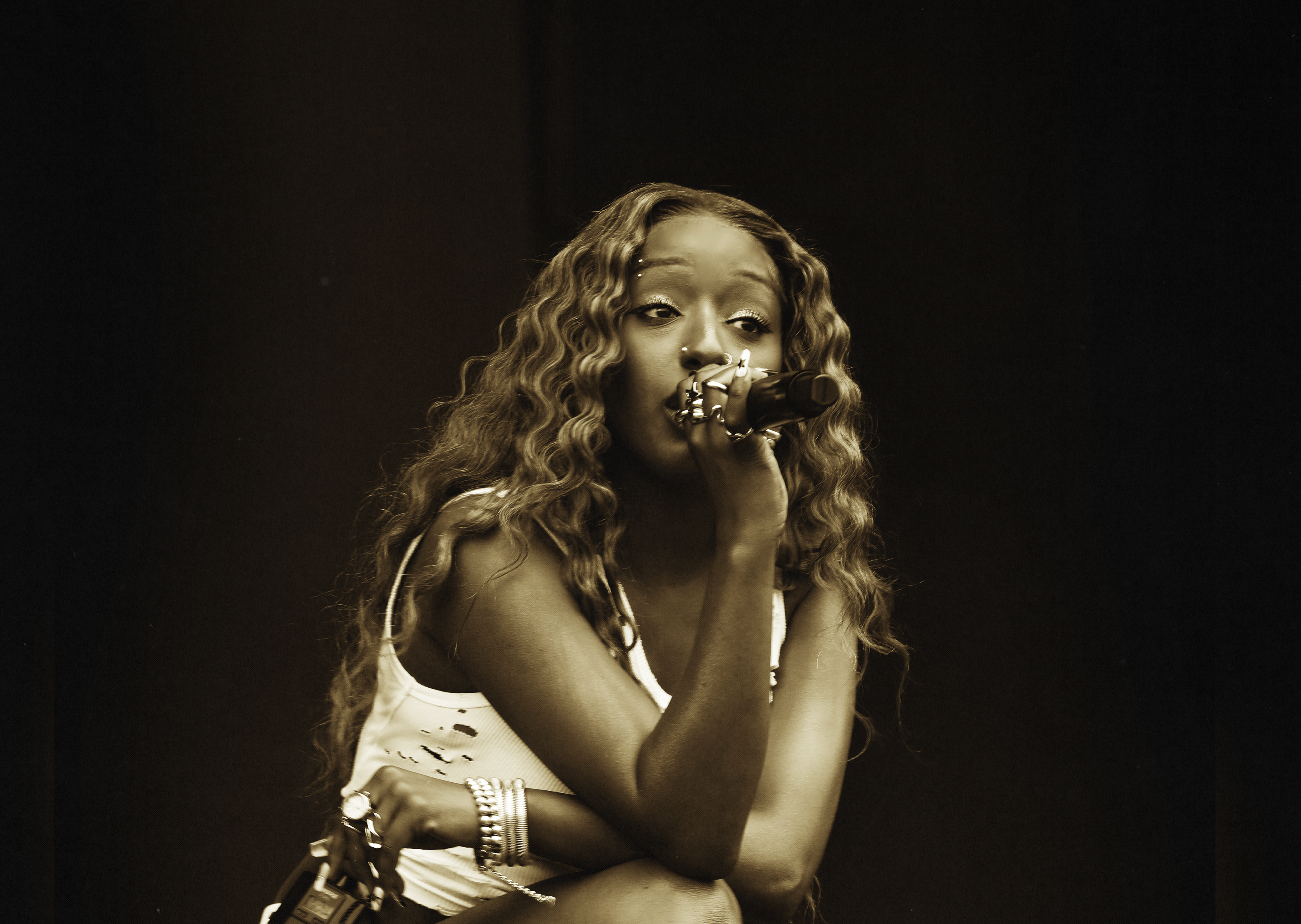
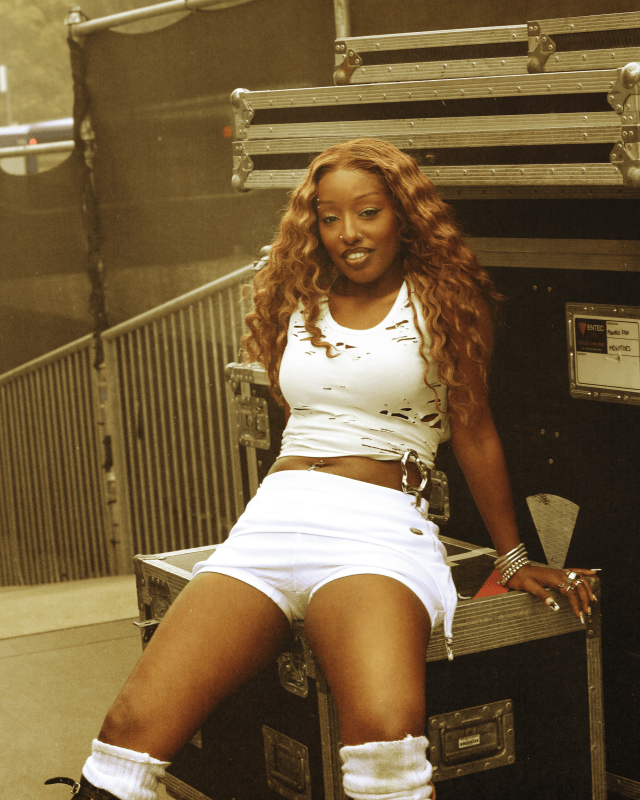
Alemeda is living her life in a way that anyone who grew up on 2000s Disney would be proud of. By day, she is playing in front of thousands, opening for Halsey, and riding jet skis with her friend/labelmate Doechii. By night, she is curled up with 2 cats at home and a family who is none the wiser to her streams or follower count. One could say she is living the best of both worlds. First popping up on playlists and feeds with the 2021 bedroom pop banger, “Gonna Bleach My Eyebrows.” She lets the labels applied to her roll off before you can hit post on a blog or article. The 2024 EP “FK IT” was a rebellious jab at all the things she needed to get off her chest in her early 20s.
Coming back to the studio was a time for reflection. As one gets older, the anger subsides, and one can contextualize more. Her latest Ep “But What The Hell Do I Know,” is a picture-perfect example of this. As time goes on, so should art, and her growth has given color to a project that was already as vibrant as ever. Reflecting on the early childhood, when pop music was a foreign concept to the household. To this day, with the loss of some relationships and the gain from others. She puts all her lived experience into a succinct and well-thought-out EP. She took the time recently post-tour to chat with us, discussing everything from a cat sanctuary as a retirement plan, missed out nostalgia, and an impactful interview in Ethiopia.
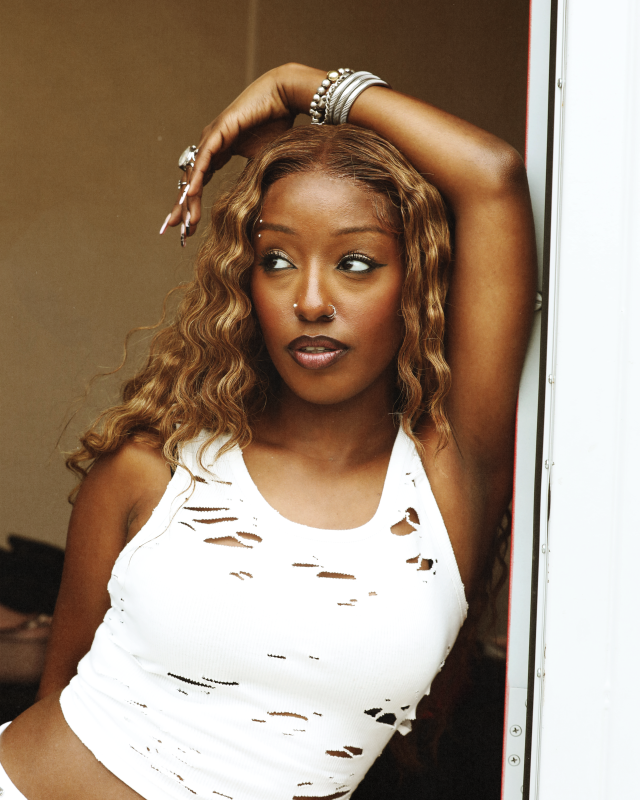
Hit Parader: How is your year going so far?
Alemeda: It’s been pretty busy and pretty good. Just been touring and doing festivals.
HP: I know you are a proud cat mom. What’s one thing every cat owner should be aware of?
A: I have 20 for you. I think they need to be aware of how much they need to be taking care of their cat’s teeth. I get my cat’s teeth cleaned every six months. Every six to eight months. And I think people don’t know that kidney disease and then gingivitis are the two leading causes of cat death and early cat death. You take care of those things, and your cat can live for a good 20-something years.
HP: You have mentioned building a cat sanctuary. Is that in the works?
A: I literally started planning it now. I told myself, “I’ll start planning when I’m, like, 25 or 26.” Right now, obviously, music is my main thing, and that’s my ultimate goal. So I feel like that’s my retirement plan. I guess I’ll just do that in maybe my 30s or something.
HP: In a previous interview, you talked about how the songs of FK It were either hateful or spiteful songs. You said that for a new project, you wanted to branch out. Do you feel like you branched out on this project, and was there a struggle trying to change the framing of the subject matter?
A: I think it’s because I write my music based on what I go through and from my perspective on things. Obviously, your perspective when you’re 20, which is when I wrote the first project, and then your perspective when you’re 25 is like two different people. I think it just naturally came, so it wasn’t really hard at all. But I think when this project came, I was consciously going through it, like, “Okay, I’m not gonna just write an ‘I hate you, don’t call me’ type of song.” I want it to have more depth to it and more of a variety of real feelings that people feel. I don’t think I could have written this when I was 20, because I don’t think I was mature enough or in the right space to do it, but I do think I did what I wanted to do. What I could do on an EP, and it kind of opened up the portal for me to do all these things even more on an album. But definitely, I touched base on more of an understanding of certain feelings.
HP: Going from 20-25 and having that maturity, where do you think this maturity most affected your creative process?
A: In how I wanted to be perceived and how I wanted my message to come across. Because I think the first project was definitely more of a crash-out. I was like, “I don’t care. If people think I’m a hateful person, people think this and that, but I think, for the small fan base that I do have, I did want them to feel like they were growing with me. Because I feel like my fans have always been my age. It’s not like I have, like, 14-year-old fans, you know, and I’m doing shit for them. I don’t know, it just kind of translated over. When I was writing, it was just one of those things where I was like, “Okay, I want it to come across like I’ve grown,” because I have, and I didn’t want to, like, keep myself stuck in this bubble of writing “I hate you” music.
HP: When you’re heading into the studio, are you focusing on an emotion, a genre, or an instrument? What’s the launching point for a song?
A: I’ll think about an instrument, because usually, the majority of my songs start off with guitar loops. Then we just write off the guitar loop, do the melodies off the guitar loop, and then we’ll add the rest of the production. But I think I also will go to the studio with my diary, and sometimes I’ll write about the current feeling I’m feeling or the current situation I’m going through. But sometimes I’m like, “Oh, I don’t feel like shit today; I don’t feel like anything. So I’m just going to go through my diary.” A lot of my songs off the first project were written like that. I come in with, you know, a vibe, an instrument, and a sound I want to embody that day. And then, you know, whether it’s like a previous or current feeling.
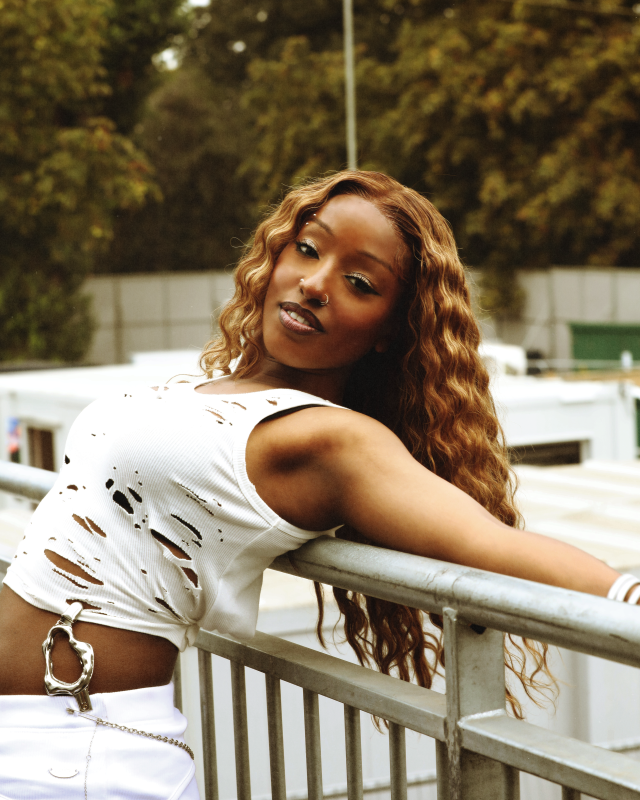
HP: As a kid, you weren’t allowed to listen to a lot of music. What is one artist you wish you could have listened to back then?
A: Probably the strokes. People have such nostalgia, and I don’t. The unfortunate thing about not being able to listen to music when you’re young and then rediscovering it is that it’s so cool, you get to rediscover everybody older and really appreciate it as an adult. It’s your own opinions about things, not like what your parents put you onto, but I love nostalgia, and I get FOMO when everybody’s feeling nostalgia about certain projects and artists. And I think for them, like, for sure, it’s one of them. Like, I’m like, “Damn. I wish this were something I listened to as a kid.” I can now feel that nostalgia, but it’s more just to appreciate the music for what it is in the current moment.
HP:Getting into some of the songs on the album, “I’m over it” is about a friendship that ended due to addiction. You also talk about the lingering care for the person. Why did this feel like an essential story for your EP?
A: In terms of friendships, it was one of the most traumatic things I’ve gone through as a friend. I feel like, because all my family’s in Ethiopia, I didn’t really grow up with a lot of family in America. So, I only have my direct siblings, my mom, and my three siblings. So I think when it came to friendships, I viewed them more as family, because I was like, “Okay, I don’t have cousins, and I don’t have all these things.” I really held them to a standard that they probably shouldn’t even have been in. But I think I cared about my friends so much. It wasn’t an acquaintance that had nothing to do with my life. My friends were so integrated into my life, and this specific friend had that happen to them. It felt like my own sister was going through it. So it’s kind of just like, “Damn.” It happened years ago, but I couldn’t even write about it. Even when we were writing about it in the studio, I was crying. I had to keep turning around and drying my eyes or doing just something. It was such a traumatic thing for me. I tried to storytell a lot in my other project, but when I listened to it now, I didn’t think they were really storytelling songs. It was more just, “this is what I feel, and this is kind of what happened, but this is what I feel,” and I wanted these songs to have more of a real, raw idea of what I’m actually going through. I felt like I needed that just so that when I did get to writing an album in the future, I’m comfortable with the idea of shit I actually went through being out in the world. I think it was just something I felt like I had to do to really be real and show real parts of what I go through in life.
HP: On this new project, your voice sounds very unreserved. How did you go for a vocal evolution, and what were you looking for when it came to that?
A: I feel like I’ve always known my vocal capabilities, but it never came across in the studio because I wasn’t comfortable enough to do it. Also, through collaboration, I was able to get, like, for “Beat A B!tch Up,” the song with Doechii, I did this crazy Haley Williams-ass vocal run, and that was a note directly from Doechii. She was like, “You have to do this, yell at the end. You have to do this crazy vocal yell.” I would not have thought to do that. When I did the song originally, I didn’t have anything like that, so I was like, “damn.” Collaborating, which I hadn’t done a lot in the past, has helped me open up on the project. Just in general feeling like I don’t want the previous project to sound like a continuation of this one. So I was pushing myself. Also I feel like I found my team of people that I’m really comfortable with and love to work with. Producers such as Tyler Cole and this producer named Stint. I feel like, because I was so comfortable in the rooms with them, I was able to open up more. I’m very introverted, so that definitely helped.
HP: How did that friendship with Doechii come about?
A: We’re signed to the same label, and we got signed around the same time of the year. We’re also a year apart in age. So I think it was just kind of like we’re all here in this little bubble of trying to push our careers, and we have the same manager/label. I think she just inspired me so much, because ever since she started, I feel like she’s been so sure of herself and so confident in her art and everything she does.
HP: How has that friendship affected both your art and you as a person?
A: I always say her coming around definitely helped me find myself as an artist. The confidence she has is natural. If you’re not an insecure person, it will inspire you, in my opinion. I was just like, “Damn, okay. I need to be sure of myself like that, too.” I feel like I’ve had imposter syndrome and second-guessed myself since the moment I started. Her coming around helped me be like, “No, I’m here, and I’m here for a reason.” As I said, when we did the song together, she pushed me to do a certain note. So I think she just — she’s just an inspiring person.
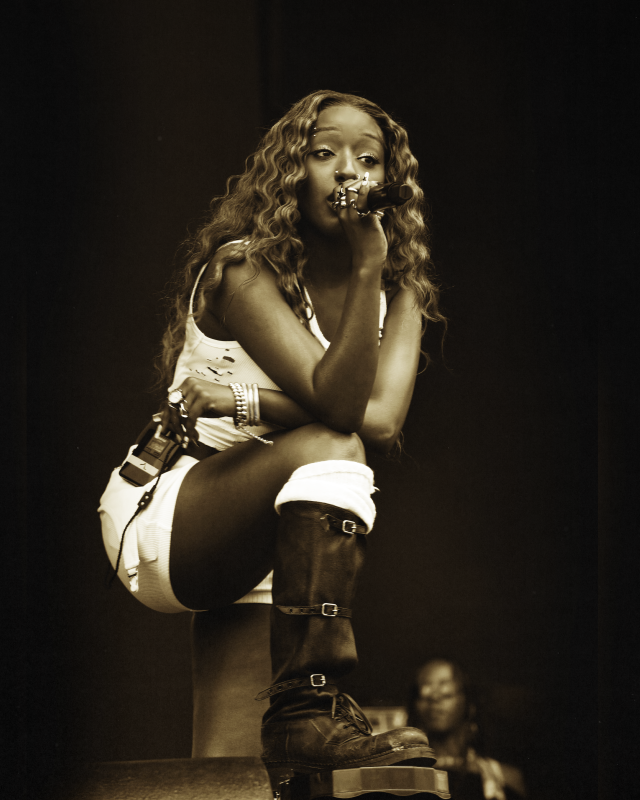
HP: A lot of times when people bring you up, they put you into a category or genre that can either be just incorrect or borderline insensitive. What lens do you want the media and your fans to view you through?
A: At the end of the day, I’m always going to be a black woman doing something. That’s how it’s going to be viewed. Like, it’s never just going to be like, “Oh, you’re a rock artist. You’re an alternative artist. You’re a pop punk artist.” It’s going to be a black girl who’s doing something. So I think I don’t mind that perspective. I think it only gets slightly offensive when people are like, “Oh yeah, this is R&B,” and I’m like, “No, it’s not.” I feel like that bothered me way more than people said that in the beginning. I’ve had people straight up be like, “Yeah, this is hip-hop.” And I’ve actually said to someone straight up, “You wouldn’t say that if I were white. You would not put me in that category if I were white.” At the end of the day, I don’t really feel like I need to fight it anymore. I feel like just existing is going to combat it. And I feel like all the people who listen to my music know exactly how I feel about that. Somebody will call me an R&B artist, and the fan account on Twitter will literally be like, “No, she’s not.” So I don’t even have to say anything anymore. I think I’ve made it so clear what I want to be represented as, and it’s just an alternative rock/pop punk artist. It’s definitely something a lot of black alternative artists have to deal with.
HP: The reason I asked was that some places had you listed as an R&B artist, but when you press play on the music, you do not hear that at all.
A: Yeah, back in my crash-out days, I used to reach out to people who write blogs, and I’d be like, “Hey, this is incorrect.” They would actually go and change it. So, back when I was bold enough to do that, I would do it. But now I don’t even feel the need.
HP: In an interview you did with “D!nk After Hours” back in Ethiopia. The interview was done at one of the first clubs in Ethiopia, and in a different interview, you said the palace was torn down four days later. How do you look back on that experience now?
A: It’s just so wild, because when we went out there to shoot a documentary that’s coming out with this EP. Everyone went, and it was, low-key, a dangerous time — a civil war zone happening, and we were just kind of like risking it. I mean, there was a lot of safety to it, because I have all my family out there, but running around with big cameras and a group full of white people was not blending in at all. So I think it was just really crazy. And I’m not surprised that they did it, but it just made me feel kind of sad. The government kind of just straight up said, “Okay, y’all got three days to get out of here, because we’re gonna crash everything down,” with no compensation for anybody. They’re kind of wilding right now. But I think you could read something in the headlines and hear about it, but you go about your day. But knowing that I was in there, we were there, this guy owns this club, and everything’s gone now, it just made me kind of sad. I was like, damn, I could talk about governments all day long and how much they suck.
HP: That is exactly why I wanted to ask about the experience. I can read headlines or hear about it and feel bad, but I was not there. I did not meet the people.
A: Yeah, it’s heavy because it’s just like, damn. There are a lot of messed-up things happening in the world right now, and I think this is probably less than what’s happening in other places. But it’s like, still sad that people are like this. The country already has a lot of poverty; in the same way, our economy is inflating, but theirs is worse. Because the money out there is called Birr, and that holds no weight anywhere. It’s just sad to know that the government is actively making their lives harder when most people can barely eat or find food to eat. So it just, yeah. The only thing I could describe is, like, really sad.
HP: Horrible transition, but I know you’ve talked about your love for Disney movies before. If you could retroactively star in one, which one would you choose?
A: Hannah Montana, I feel like I’m Hannah right now.
HP: You have the double life going on?
A: I feel like it’s because my family does not really know anything about my career. I go back, and I’m just myself. No one talks to me about anything because no one really knows. It’s a perfect balance for me.
HP: I was going to ask about that because some interviews have asked about how that may be sad. To me, I would love it because then you do not have to worry about what they think.
A: Yeah, it’s amazing for me. I will say I’m very independent, and I don’t need my family’s support. I can support myself with this. To me, this is a dream.