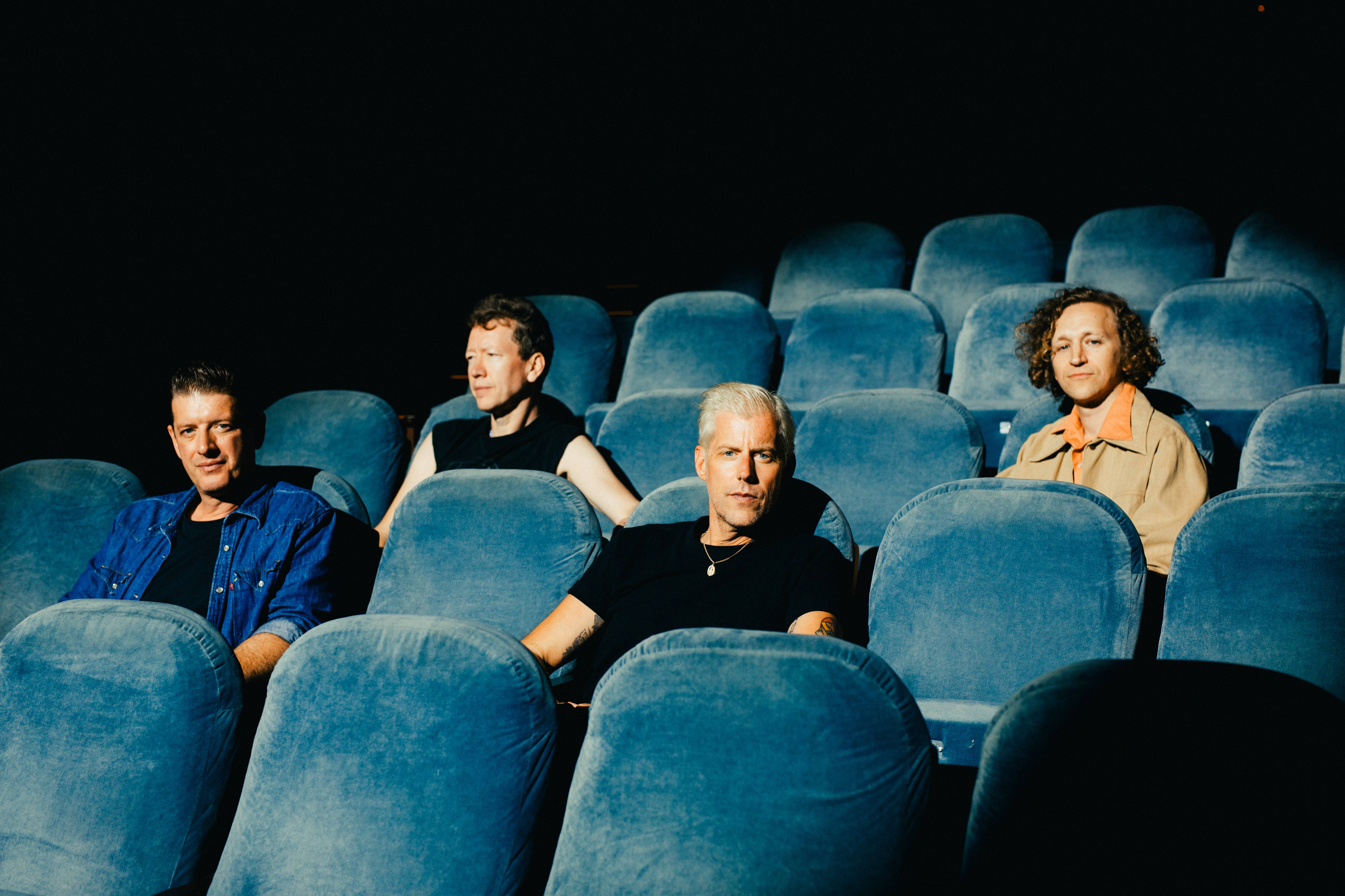
Jack’s Mannequin, one of three projects that make up the ultimate emo & alt rock trifecta anchored by Andrew McMahon, recently took a leap of faith, putting two albums out in one year; the Everything in Transit anniversary re-issue and the Everything in Transit: Strings Attached EP. McMahon is no stranger to juggling many things at once, and tells all about what life is like with three ultra-successful bands, a charitable organization, an entire cruise dedicated to his bands, and health-related ups and downs.
Hit Parader: Jack’s Mannequin is celebrating 20 years with the MFEO tour. I was told that out of 30 of those dates, most of them sold out insanely fast. What’s it like to still see that kind of response after two decades?
Andrew McMahon: It’s been very nice. You know, I think anytime you put up a tour, I’m always crossing my fingers that the dates go quick. And so, I think this was like, a little bit untested. We put up Something Corporate last year. But really, it had been, you know, with Something Corporate like 20 years since we got the whole lineup back together. A lot of these guys that play with me in Jack’s also play with me in the Wilderness, and we’ve done some Jack’s stuff. So I was curious how the response would be, but it’s been very nice to see people excited to come out to these shows.
HP: In August, you surprised us with the strings attached version of Everything In Transit, which reimagines everything with new acoustic and orchestral arrangements with Suzy Shinn and Allie Stamler. It looks like that was at Treehouse studios in LA. How did you end up with those creative partners, and what led you to reimagine the album in that style specifically?
AM: Originally the idea was, hey, you know, this anniversary is coming up. Obviously this record was super important for me and for a lot of fans as well, and so originally, my thought was well, maybe I could just go in and cut piano, vocal versions of the songs and have like, the acoustic version of the album. Suzy was a natural phone call for me. She’s been a collaborator of mine over the years. We’ve been friends for a long time, and have a lot of mutual friends that we work with, and I love her records, so I reached out to her to see if she was free and when we got in there, and sort of started that process of like, okay, we picked a song, and I played the piano and sang, and even if I’m like, re-recording something, I want it to stand on its own two feet, and something about that didn’t quite feel right.
So we started just experimenting by doing what you call prepared pianos, where we would put sticky tack across the strings of the piano and record the left hand and the right hand separately. And it started to kind of evolve into these sort of weirder, fun experiments around the songs. Probably the first or second day, we invited Allie over just to see what would happen if we threw some strings on it, and that kind of was the key to unlocking everything. It became this sort of really fun, stream of consciousness process where we’d sit in a room together with Allie on the violin, and we would stack string parts and just kind of throw the kitchen sink at it, and then in the editing process, kind of figure out what was working.
But, yeah, it was like a two week kind of hang, where we just pulled songs up and played around with them and landed on these five mostly because we just ran out of time. The goal was to do all ten, but I was like, I’d rather do five and have them be really special and feel like a sort of B side to the original A side of each song, and, yeah, that’s how it all came together.
HP: Was there any experiments that you tried that were super off the wall, and you were just like, “This is absolutely not gonna work?”
AM: There were a couple times where I was playing drums, and you know, it started like, cool, this needs rhythm. And we would go down that road for an hour or two, and then the next day come back and listen, and just be like, okay, let’s not do that. So there was a moment where we invited a drummer over to do a little bit of work on the mix tape, but those were most of the failed experiments. I mean, again, the beauty of the studio is there are always tons of failed experiments, but usually it’s kind of in playfulness, and you go, okay, that didn’t work, let’s move on.
HP: So we’re looking at 20 years cancer free for you. Congratulations! That’s so awesome. I know that your timelines kind of lined up in an unexpected way back then, where your diagnosis and the wrapping kind of happened at the same time, and then your stem cell transplant happened on release day. These were all very unexpected things. So how does that kind of change how you looked at that particular album?
AM: Well, I mean, almost immediately the assumption would be, you find out that you’re, you know, sick with cancer at 22 and that, it’s a slap in the face, for sure, but I think there were these sort of premonitions written into the lyrics of the record. I think a lot of it had to do with just I was moving so fast through the world at that point, it was like, working with Something Corporate, and then rushing home to get in the studio and work on this Jack’s Mannequin record. And then the record is picked up, and all of a sudden there’s all this energy, and it was this really frenetic time. And so there are lots of lyrics in the album that talk about hospitals and like the first line, I think on the whole album, is “She thinks I’m much too thin, she asked me if I’m sick.”
You know, there were so many of these little moments sort of written into the album that when I ended up actually being sick, you know, I felt like there was something in the DNA of the album, like the fact that the project was named after a pediatric cancer survivor. There were all these little signals you know, coming from the universe that, for me, I took as a sign that whatever path I was on was the one I was meant to be walking and then certainly, you know, when one, miraculously, my sister was named a match for my stem cells, and then the target on that date kept moving, and then, in the last minute, ended up landing right on the release date of the album. You know, I think, if nothing else, when you’re sick like that, you’re looking for hope, and you’re looking for any sign that you might be in the right place at the right time, even if it doesn’t feel good. And I was sort of in the moment, buoyed by that sense of purpose, and that there was some intention behind all of this. And, it was integral, and kind of getting me through the other side and feeling like I was where I needed to be, regardless of how uncomfortable that was.
HP: That’s a really beautiful point of view. So that led to the Dear Jack Foundation. Which happened shortly after, in 2006?
AM: Yeah, originally, I was raising money for other organizations, and we were finding there was so much adoption by my fans to this cause, and as somebody, I think, who, early in my career, didn’t really have, like a philanthropic sort of angle on what I was doing. There was no charity that I was really attached to, and this obviously became a mission for me. Fans were raising so much money for the organizations that we were partnering with that around 2006 we decided, okay, well, let’s start taking this money in and sending it to the organizations that we feel are really closely aligned with our mission, which for me was adolescent and young adult cancer, which is wildly underfunded and something that is really much more well understood now than it was 20 years ago.
But there were a lot of young people slipping through the cracks in the cancer world. And as we grew, you know, I was able to bring on staff, and now we have an incredible staff of six people who run programs that are native just to our organization and we’ve seen a lot of growth over the last few years post pandemic.
We really got on our feet and have been delivering a lot of really meaningful programs to young people who are both facing a cancer diagnosis and those who have survived one.
HP: I know it’s benefited and helped a lot of young people, but are there any participant stories that you’ve seen or heard that stand out to you?
AM: Yeah, I mean, there’s so many, sadly, people that we’ve lost along the way, but who were engaged with our programs that as an organization, because we’re small, we’re able to get close with a lot of the people that we work with, and certain members of the community become really ingrained in the process.
There’s a young man named Chris who passed several years ago, who we had a really close bond with, who was a drummer and came up and played drums with the band on a couple of occasions. And we got to take him out to a festival show, and I spent a lot of time with him, and he was very dear to us there. There are a lot of instances of the couples who attend our breathe now retreat. We host a survivorship retreat for young couples that are, you know, realigning the balance of their relationships post cancer. It’s a tricky thing that my wife and I went through, and we really wanted to pay it forward by helping other survivor and caretaker partners that have gone through this. And just in the last year, when we did our cruise, we had one of those couples on stage speaking about their experience and how important it was to bringing their relationship back in focus post cancer.
Those stories are largely why we continue the work. Because we see people who are moved by what we do, and also who are able to see some hope and a way through to the other side of their experience through what we’re doing with them.
HP: That’s such important work, because caregivers are not given a handbook. You just do the best you can. So it’s really nice to have that resource available to them. You just touched on the cruise a little bit there. We’ve been on a music cruise (with a baby). It’s such a different world, but everyone was super cool and accommodating.
AM: Even with ours, we had a lot of families come out on our cruise, and which is like, such a loving environment. And I know that there are certain cruises that are, it’s just
a crazy party, and there’s certainly a lot of partying on the boat. But I feel like our fans are such a nurturing community and I see, like, a little one cruising around or at the show, and I think it actually helps to round out the community experience, you know, to have little ones there and be able to sort of celebrate as a fully formed community.
HP: What’s that like for you to be on the cruises and be essentially like neighbors with these other bands and all these fans?
AM: It’s amazing. Honestly, like look, I don’t recommend it for every band, because I know there are people that are a little more introverted and I totally understand. And I think for me, because so many of my fans around the country, but especially when
we talk about these flyaway things and the cruises and stuff, I know so many of them, if not all by name, by face, and city and there’s a general sense on the ship that, because we’re all there together, and we have all of this time together, that the temperature comes down a little bit on the fandom, and it becomes a little more of a, “Oh, we’re all here at this, like, amazing gathering,” and fans are meeting fans, and the band and I are out shaking hands and hosting belly flop competitions or flip cup or whatever it is. And it’s intense, not so much from the community aspect, but just for me, just because I’m bouncing from event to event and doing lots of shows.
But, I liken it to kind of stepping onto another planet for four days and sort of surrendering to the experience and just really, like, there’s just a smile painted across my face for four days straight. And it’s a lot of love and super nourishing in a way that I hadn’t really anticipated, truthfully.
HP: Is there some possible etiquette you may have learned over time that you would like fans to know and respect when it comes to those boundaries being blurred?
AM: You know, honestly, I have not really had anything happen to me. I’ve done two other Sixth Man cruises. I’ve done the Rock Boat twice, and then this will be the second year we do our cruise. I have to admit, there is very little, if anything, that I found jarring or strange, like, I’m a music fan first, right? I was the kid waiting outside the tour bus for my favorite bands to come out and say hi. So I think I have, like, a fan mentality within me that there’s very little that throws me off. I think the bigger thing is how to sort of bring those conversations into a human one to one interaction, and feel more like peers and people who, you know, I have respect for my fans, they take care of me. I have a job because they like my music! There’s a part of me that I’ve like shared with them that’s so deep and so personal. So I really just try and kind of focus on what makes us alike, rather than what makes us separate. And I think that is helpful. I’d say the biggest thing on the boat, and like my one note will be like, because I like to creep into the silent disco at the end of the night, and this year I feel like every DJ switched their channel to my music when I came in, and so, that’s the one thing that I would request a change on the boat, because when I go down to silent disco, I want to dance to whatever they’re programming, not to my songs. But that’s less of a fan thing and a little more of an internal conversation with our DJs.
HP: How did you pick who’s on the lineup, and who is on the lineup, this year?
AM: Usually the way that we pick the lineup is we start with bands we love, right? We start with bands like, that we’re fans of, and a lot of times bands that we’ve toured with before. But a lot of times, what I try and do is pick bands that I know not only are amazing live bands, but also are great hangs. Frankly, this is a way for me to be in a space with bands that I’ve toured with, that I love, that I don’t get to see all the time, because we’re all on the road doing other things, and it’s a chance to dig in deeper with some of those old friends. So we usually start there.
And then, of course, we lean on Sixth Man, and my agency, and my managers, to hint me to acts that I might not know about, that they think would do well on the cruise, and bands that would be fun to introduce our fans to. So like this year, obviously all my bands will be playing, and we have the Maine and the Starting Line, which are you know, our dear friends. I’ve been a huge fan of Petey forever, so Petey is on this round with us. Michigander, who I love, Flor, Annika Bennett, Ivory Layne. Then there’s a band called Trousdale, who I’ve never toured with, but have been on some of the other Sixth Man cruises. And they were like, “You have to get this band. They’re gonna blow up, they’re an amazing female fronted act.” So I mean, it’s a lot of that. And then we’ll have sets from guys in my band. So Will and Brian from Something Corporate will do their own set. Zach will do his own set. Bobby, who plays in Jack’s, will do a set with his band. So, yeah, it’s a ton of music like, there’s not a band on this bill I wouldn’t be psyched to see. So the fact that we’re all in one place playing multiple sets, I think fans are gonna really dig it.
HP: It’s a really good lineup! So with the tour, I know $1 from each ticket is benefiting the foundation. Is there a charitable element to the cruise?
AM: Yeah, we donate a portion of all the sales from the cruise to the foundation as well. Last year, I guess a little over a year ago now, the Eleven Eleven benefit was on the ship. So we were counting down and raising money in that space. I’m sure we’ll do some things on there as well to support the foundation separately. But we also have a portion of each cabin going to the foundation, too.
HP: That’s a really great way to raise money. So completely changing gears, the vinyls.
I saw Brooklyn Vegan and Tower Records have a couple different colorways. On your personal merch site, we got that red, pink, kind of splatter, and on the B side, there’s an etched image. Can you tell us more?
AM: The ones we’re selling on our site, it’s actually been kind of a crazy thing, because I’m traveling a bunch. I just signed 4,000 of these postcards that are getting enclosed
in our variant, and then the same thing will happen with the liner notes on the reissue of the 20 year. So I’m going to have to find time in the next two weeks to sign 5,000 of those.
So it’s an adventure, right? We were sort of like shocked by how well both performed. I was kind of nervous about putting out two vinyls at the same time. You know, I pinch myself, honestly, that people care about this music as much as they do. It’s, like, you know, it feels good all these years later, for sure.
HP: I love that you’re not turning to auto pen and stuff like that. It really shows how much you care about the fans, because so many people are doing that now.
AM: My God, my fans would kill me if they thought that I was doing that, I would feel like, I mean, it’d be one thing to do it and not sell it as an autograph, but just, you know, say it’s a part of the artwork. But yeah, again, I think coming up in sort of like the punk scene, not being a punk, but sort of being surrounded by that ethic of being really earnest and really true to your fans and just not trying to pull some bullshit to make $1 I think is so deeply ingrained in my ethos, in the way that we try and run our business that, yeah, I just wouldn’t. I would say they were unsigned.
HP: Switching gears, can we talk about Red Rocks? I’m trying to wrap my head around how you juggle the requirements of being support, opener and headliner, when I’m seeing other people do a 20 minute set and they’re on the verge of passing out because they’re doing all this movement and the heat and there’s so much happening, and you just went, bam, bam, bam. Did all of it. How do you juggle all of that?
AM: I mean, a lot of it is adrenaline, right? And just, you know, especially with the Red Rock show, I don’t think there’s a single event that I put more of myself and my time and the time of my team and bandmates. It was just such a high priority that we did it and did it well. It was probably more than a year in advance of that show that I said, I can do this, and we’re going to do it, and we’re going to find a way to do an evening with all three bands.
But, I mean, there’s an element of, like, training, right? Luckily, I’d been on the road with Jack’s, and we were doing two hours a night on the Jack’s tour. So it was really about, okay, how do we add an hour plus to that. I built in these little vignettes and little breaks in between the sets, and took a 15 minute intermission before, sort of the big super jam of all the bands on stage, kind of sharing each other’s catalogs.
But yeah, I’ve got a lot of stamina. I mean, it’s kind of like a thing that I’ve been known for over the years; I could get no sleep and run around for two hours on a stage and take a day’s worth of phone calls and be ready to party after it’s all done. My energy level since I was young has just been really high.
But one of the lessons, like, I’ll put it like this, I wouldn’t have been able to do another one of those the next day. It took a bit of recovery, but knowing it was this island unto itself, and that I was going to throw everything I had at it and just sing my heart out until the last note was played. It miraculously came together about as flawlessly across the board from a production and execution standpoint as it could, which was mind blowing to me, considering, we rehearsed it, but we only did one run through of the actual whole show. We had massive technical stuff happening during that run through that I was like, you know, just walking on a stage like this.
But I think when you just get into the swirl of it, and there’s just this massive energy, you know, it doesn’t go one way, from the stage; it comes from the stage to the fans and back. And it kind of becomes this sort of energetic thing that carries you through it.
HP: That was making history. Anything else you want to share with fans before we go?AM: I’m sad that this tour is over. It was a really beautiful moment to get to be back with these three guys and just live inside of this catalog and all these memories for a while.