“The greatest stars, the ones that endure, are the ones, beautiful or not, who are generous with their spirits and faces in the images they present to us…” – Courtney Love “Beauty Manifesto DuJour” from 11/09/1998, reprinted in Melissa Auf
Der Maur’s Even the Good Girls Will Cry
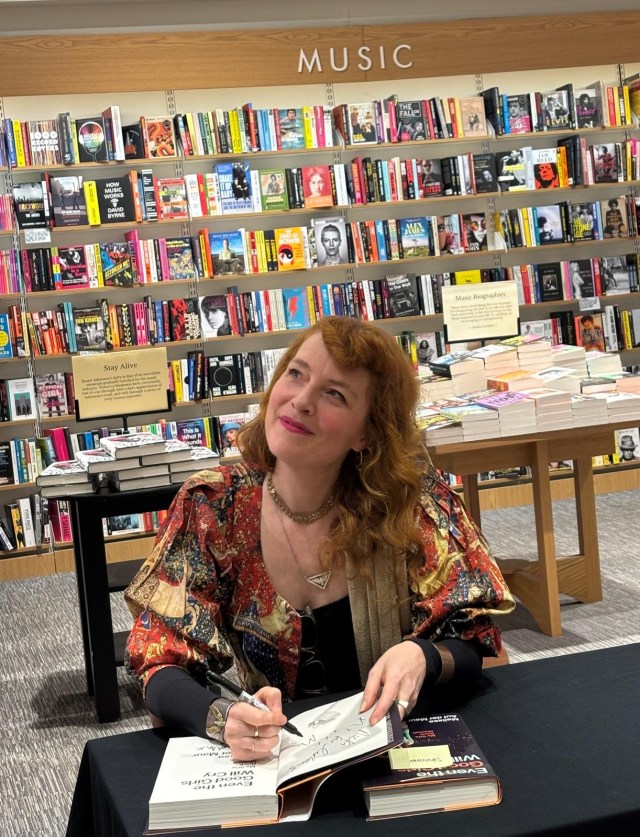
After Courtney Love appeared on Billy Corgan’s music podcast The Magnificent Others last month, people had a lot to say— about her, about him, about Kurt Cobain and Sonic Youth’s Kim Gordon, and about the 1990s in general. Whose band was better? What’s Dave Grohl’s deal? Are these rockstars mad narcissists, genius icons or both?
There’s literally nobody who could answer these questions better than Melissa Auf der Maur, who played with both Hole and Smashing Pumpkins during one of the most pivotal — and currently most reconsidered — periods in music.
If Auf der Maur’s new book Even the Good Girl’s Will Cry seems incredibly well-timed, prophetic even, amid the culture’s current obsession with the 90’s, there’s a good reason for that. Approaching her 50th birthday and finding herself with free time during the COVID 19 pandemic, the Montreal, Canada native and current Hudson, New York resident, began reflecting as a lot of us did, about her life.
As touring bass player alongside two of the most enigmatic characters in rock, she explores each band’s impact in the book, recalling interactions with them as an innocent 22-year-old young woman finding herself as she perfected her instrument. More significantly, she delves into a unique period of time that only Generation X can fully understand, as humanity transitioned from analog creation and communication to a digital dominance of basically everything. There was a lot to unpack.
Sifting through her extensive archive of photographs, journals and other ephemera, the project took shape, though it was something she’d intended to revisit for years as she was just as much a “documentarian as a musician” back then. It was — like seemingly everything that happened to her in 1991-2001 — cosmically destined. Given the 30-year nostalgia pendulum, it was also the right time to dive in.
“I always knew that I was documenting a time in history; in my personal history, in our cultural history, and in the history of rock music,” Auf der Maur tells me in the parking lot of a Koreatown cafe before her first LA book event at the nearby Dynasty Typewriter. “This is the history of women in culture and women in arts.”
Her story as it pertains to the scheme of feminism and music’s evolution is insightful, a bit juicy at times, but mostly unflinchingly real, especially for those of us who happen to be around her age and remember what it was like to be turned on by the visceral riffs of alternative music, and the imposing grandeur of her “grunge parents” Love and Corgan in their heyday.
Beyond the pair’s own love triangle (Courtney left Billy for Kurt in 1991), both were polarizing all on their own, even back then. In Love’s case, there was a shadow of drugs and death to contend with as well as overall public disdain for her raw and outspoken ways, mostly rooted in misogyny. Defiant and dangerous, Hole challenged it all on stage and Auf der Maur not only contributed, she took notes and lived through it all.
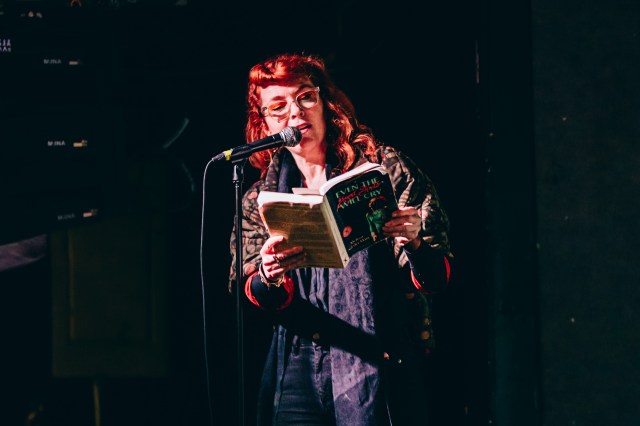
She initially said no when Corgan, who she met at an early SP gig in Montreal, suggested she join Hole. Kurt Cobain’s suicide was followed by Hole’s original bassist Kristen Pfaff dying of an overdose just as they were about to tour 1994’s Live Through This. She was stepping into a dark situation, but she was bringing light and she seemed to know it even back then. Things weren’t much easier when Love got sober, became a movie star and they began to record Celebrity Skin four years later, but the band had something to prove and despite the struggles, they made a great high-production value rock record.
Auf der Maur’s time with Smashing Pumpkins came immediately afterward and lasted about a year, during which she honed her bass skills and saw more of the world. Her wild rockstar journey ended as the aughts began, but she continued with some stellar solo music, a Black Sabbath tribute band, more photography and years later, the creation of a thriving NY arts community (built with her husband Tony Stone) called Basilica Hudson. Then she became a mother, which changed her focus for years to come, but also inspired her to look at her past experiences through a modern female lens for the memoir.
“We came through the birth canal of this new world and we weren’t submissive. We weren’t blind. We saw what was happening and we were angry, but we couldn’t stop it,” the author shares. “A big part of my book is trying to say to my daughter and her generation — she’s 14 — we saw this happen and I am so fucking sorry. I just want my story to be of help to understand… so that the future, the people who are living in this new future, can somehow put the pieces together. So, I wrote it for personal healing, but also as my offering to the cultural reflection of history books. It’s so disturbing where we’ve landed and we all are grieving what we’ve lost, you know?”
True, but with the exception of her father’s death and losing drummer Patty Schemel from the band in 1998, her story is not somber. Auf der Maur’s tales of tempestuous stage moments alongside Love, rocking the globe playing for tens of thousands nightly, doing fabulous fashion-focused photo shoots and big budget videos, working with the biggest producers in the music business and hob-nobbing with famous actors and fellow musicians (even making out with some of them, though she only references her ex-boyfriend Grohl by name) is a really fun, aspirational read.
“I didn’t do this to just publish a book about the 90’s and go on podcasts,” the writer, who did her mentor’s pod before Love, explains of her motivations. “I did it because I needed to unpack the past that I went running from, to heal the wounds I hadn’t yet dealt with and to purge — to get the 90’s out of me, because it was such an intense time for all of us, especially those in rock bands, especially the ones in the nexus with all the levels of death, fame, talent, greatness, horrificness.”
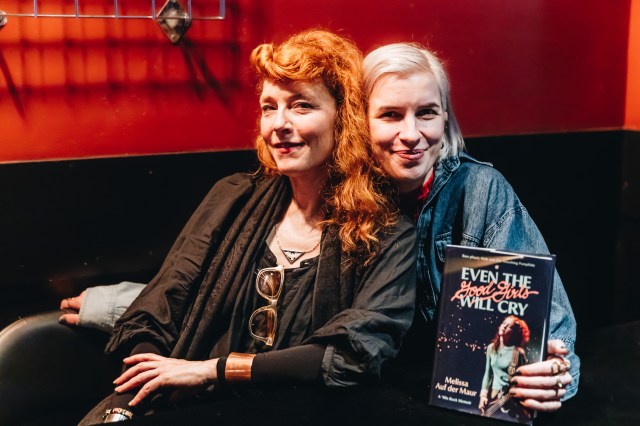
It’s no tell-all, but it is honest, mostly on an introspective level. There’s also a contextual and mystical flair to her prose that makes it stand out amid other memoirs out there, not surprising considering her parents were celebrated journalists. Auf der Maur is an evocative storyteller. But did she have any trepidation writing about others in the book? Did she check with everyone first?
“I emotionally, spiritually and personally checked in with every major character, Dave, Billy and Courtney. I reached out and I went to see each of them to discuss and say, ‘I’m doing this,’ to let them know, not ask for their approval but just simply to let them know I’m writing my story,” she shares. “I got a full thumbs up and ‘we love you and trust you’ from all three. They know I’m not in it for money, glory or fame. I just want to be true to who I am. I love them. There was no threat, and I did show all parts of them.”
In particular, her examination of Love’s place in rock music and the influence it had — and can continue to have — on women, girls and culture itself, has a redemptive quality that’s been sorely missing on the media landscape. As Love prepares to release new music (Auf der Maur sings on a few songs and says “it’s incredible”) and a documentary about her unapologetic past and present that just premiered at Sundance, her bassist’s book couldn’t have been more prescient.
The alignment was coincidental, but it all feels like it was meant to be. After a recent viral Instagram post that had the web buzzing about a Hole reunion, which quickly got quashed, the bassist still doesn’t rule out ever playing live with Love again in some capacity.
“I’m not against it. I always say that Courtney is the most unpredictable, wild, wonderful force,” she says. “The fact that in 2026, we both are coming out of 15 years of a kind of hibernation — we could not have planned that. So you just have to trust in the magic of it.”
She clearly did just that with Even the Good Girls Will Cry. Its cathartic energy may have started with her, but it is for everyone. “The writing process was amazing, but to look back at that person and the painful parts; I could have lost a big part of myself permanently,” she says as we wrap up an inspiring conversation. “I finally grieved for my loss and the things our generation lost. A big part of writing the book was trying to celebrate and grieve what we lost, while hoping that we can bring some of it back.”
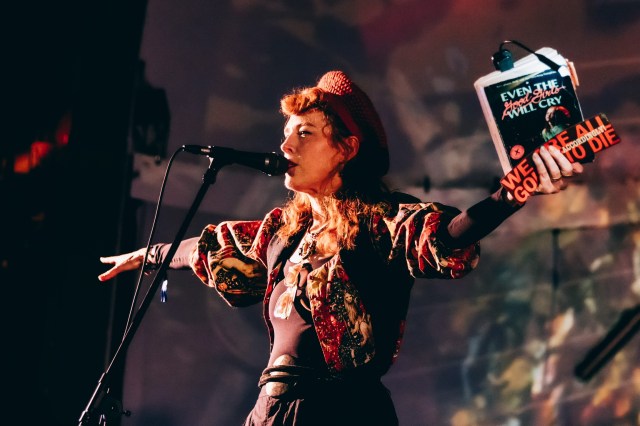
Info on Melissa Auf der Maur upcoming book events can be found here.