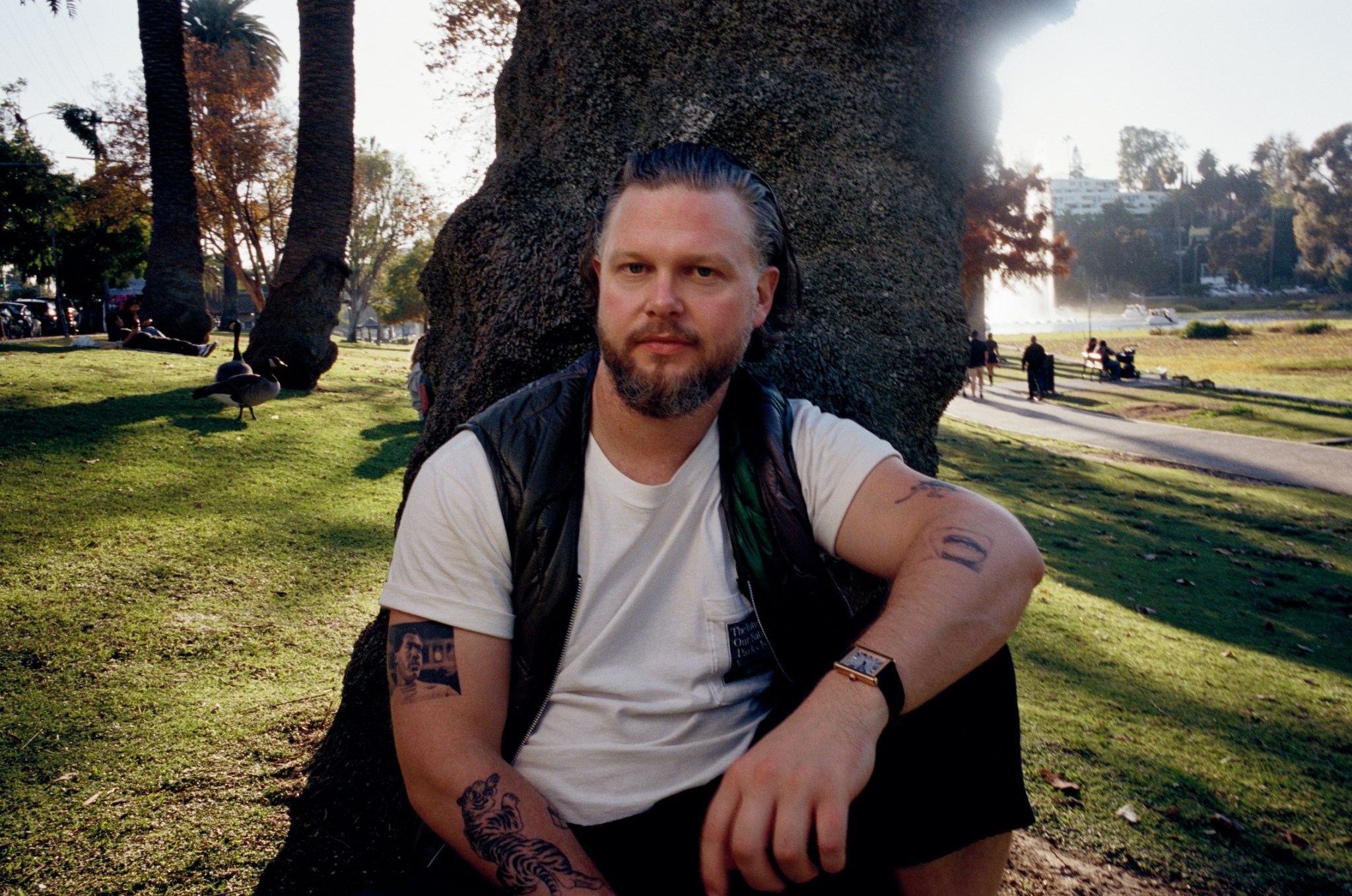
With Alt-J, frontman Joe Newman enjoyed commercial and critical success, including hit singles such as “Breezeblocks,” “Something Good” and “Left Hand Free,” as well as major festival appearances such as Glastonbury, Lollapalooza and Coachella three times. Yet, for his just-released solo debut, The Canyon, you will not see the name Joe Newman prominently displayed anywhere. Instead, it is credited to JJerome87.
As Newman explained when we connected recently, the pseudonym allows the music to remain at the forefront.
“Ultimately, I think my dream has always been I want people to be familiar with the songs, not necessarily familiar with me. I like that I have my anonymity to a degree. That’s a little hard to do when you go solo, but I certainly have hidden slightly by using this moniker,” he says.
Like so many artists before him, Newman likens going from the safe confines of a band, where you are with like-minded friends striving for similar goals, to being on your own as a solo act, to being akin to starting over. And in his case, it is especially true because the immediate success of Alt-J never gave him proper time to adjust to popularity.
“We went straight from university and then all of a sudden, we got management, we got a booking agent, we got played on the radio and then within eight months we were touring. Then, very quickly, we won a Mercury Award and an Ivor Novello; things then just blew up,” he says. “That was my experience of giving it a go in a band. You don’t realize how lucky you are because your success is all you know. So, I think now, doing this as a solo career and experiencing the consecutive release of albums, you find a place in the world of music. And if you’re lucky, you can write a record that guarantees the next record. That’s where we were. We found a place. Then, when I’m working on this solo album, in a way, I feel like a new artist again. So, it’s very easy for me to look back on the band and think, ‘Wow, that was really cool and lucky. We worked really hard, but that’s crazy rare for something like that to happen.’”
Though the instant fame was a difficult adjustment, Newman is grateful for it because that connection has given him the confidence to grow with his listeners on each subsequent album.
“I definitely feel validated to be more like myself with every album I write because people respect it or the fans respect it. They enjoy it, it means a lot to them. They process it through their own filters, and it means something different to them. And it’s a really important part of their life. And that connection is really important. In a sense, I have an audience where I can talk more like myself through prose and songs,” he says.
By that principle, The Canyon would be the most Joe Newman record made to this point. Or at least it is a natural extension, to him, of the bond he has built with fans of Alt-J.
“There are so many things that connect to examples of my personality that I’ll see again through writing new music. And I think if people like what they hear, you lean into pleasing that audience, and you do so with the understanding that you like it too. It’s like a rapport with you and your audience, essentially, writing,” he says. “So, what you write in the future is a more detailed understanding of what they’ve liked leading up to that point because you’ve had more source material to draw from. You have more of an acute set of understandings towards how you write, who you’re writing for, what you like to write and what they like to hear.”
The concept he floats of new songs being a continuation of the already established dynamic between the artist and audience is similar to one that exists in literature, which suggests all writers are constantly rewriting the same theme, just trying to perfect it. While it is not quite that simple, Newman does see elements of that in his work.
“There is an element of all the songs are just siblings. Some look like each other, and some don’t; some are better looking, and some aren’t. Others are just different levels of different characteristics within, but they all share the same DNA. I don’t know which one’s an advancement of the canon but perhaps ‘Mr. Alligator’ is,” he says. “It’s got an interesting guitar riff; it’s cinematic; it’s where my voice likes to be; it’s where the rhythm of my voice is most safe in terms of feeling good. I’m utilizing field recordings. We’ve got the jump ropers in that song. We’ve got them enjoying the recording day while we get them to do the jump roping, we’ve got them enjoying that day on film and on mic, and we’ve peppered that around the album. We’ve given it so much life, and we’ve injected it with so much atmosphere and energy, I think it encapsulates everything that I wanted to achieve for this album, and I think it’s a build-up of things that have slowly been happening from the first Alt-J album to the most recent.”
At one point, the conversation turns to film when Newman mentions being a big fan of Martin Scorsese and the era of film he represents (his favorite Scorsese films: The King of Comedy and Goodfellas). Once the subject of movies emerges in the interview, it is easy to see his cinematic influences, especially in the album’s brilliant closer, “Pennine.”
Newman does see film and visuals, in general, as a big influence on his work. “I think, in the UK, you’re prescribed the American cinematic vision at an early age. And it means that you end up watching a lot of American cinema, and you fall for it, and it becomes a large part of your diet. It had a huge impact on someone like me who grew up being interested in fine art. Then I went to universities, art college to study art,” he says. “I always thought in pictures, so I’d have these fantastical visions of things that I like to put into the music. And I think that built this cinematic. atmosphere because when I wanted to reinforce the message, I would use field recordings as well, which would blur the lines between this play on the radio experience and a song. I like to marry those worlds, and then I think you incorporate other, less traditional accompaniments into the music using brass and strings. So, you’re building this mood, and you’re thinking it like you’re scoring a film.”
If The Canyon were a film, to him, it would be a documentary of a key time in his life.
“I think the through line is probably behind the scenes. It’ll be, for me, the feelings that I had at the time; my daughter being born and raising my child, spending time away from the band to do this. It will feel like a time capsule of a period as a young father.”