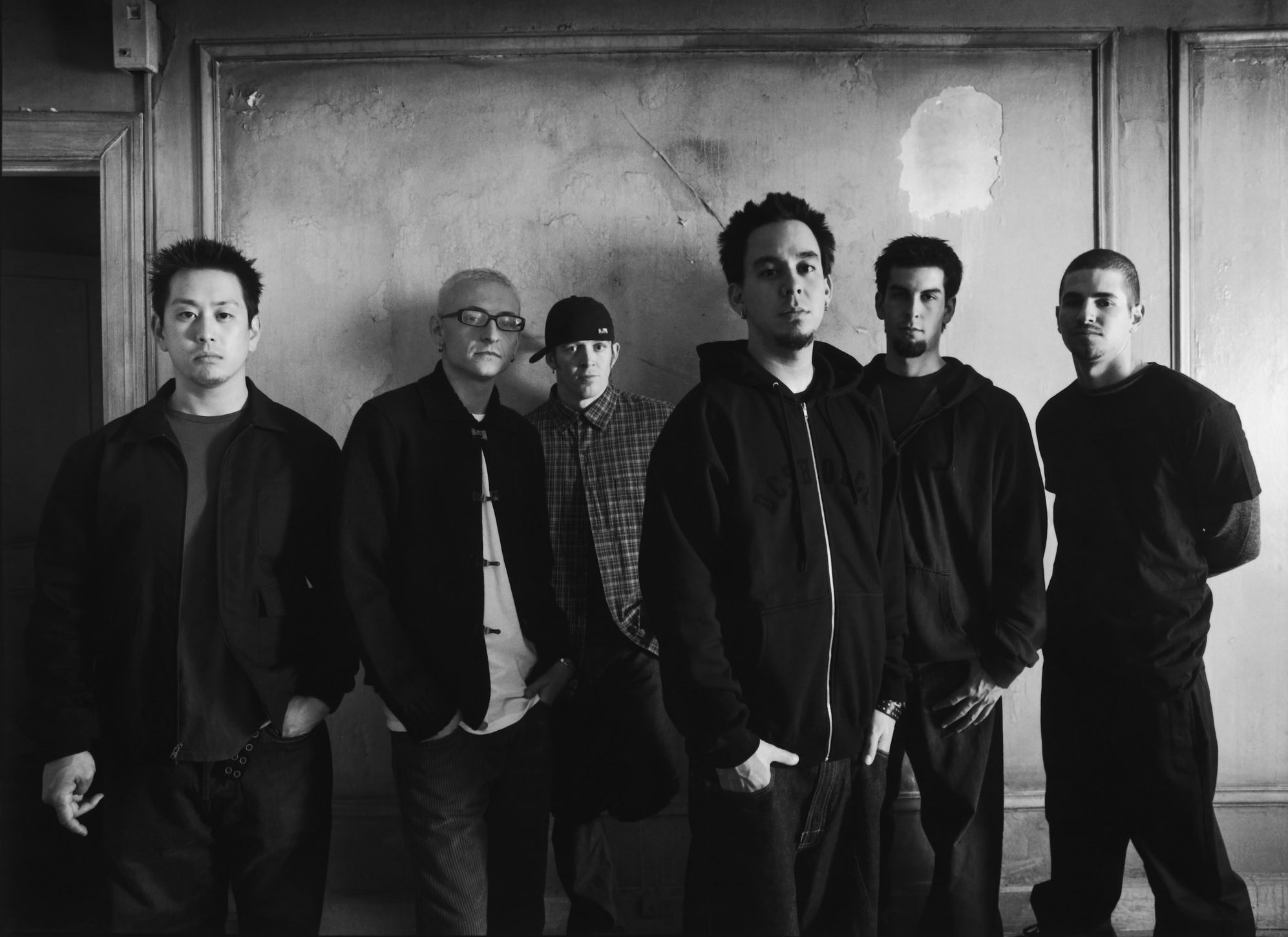
From the pages of Hit Parader: May 2002
Perhaps the oldest saying in the book is that when opportunity knocks, you’d better be ready to answer the damned door! And none of us can deny that over the last two years opportunity has certainly knocked time and time again on the door of Linkin Park. And you know what? This California-based rap/metal unit has not only answered that call, but they’ve responded to it like few “rookie” bands have ever done before. With sales for their debut album. Hybrid Theory, now well past the quadruple platinum level, their recent DVD, Frat Party at the Pankake Festival, a bonafide best-seller and response to their recent headlining Projekt Revolution tour rating as an overwhelming success, there’s no denying the impact that Chester Bennington (vocals), Mike Shinoda (vocals), Brad Delson (guitar), Joseph Hahn (turntables), Rob Bourden (drums), and Phoenix (bass) have now had on the contemporary music scene.
But all that they’ve accomplished so far seems to have only further whetted the collective appetite of this ever-ambitious un it. Not only have their tours, their DVDs and such MTV-friendly songs as “Crawling” and “One Step Closer” further solidified the often tenuous relationship between metal, hip-hop and electronic forces, but their future plans which include the imminent release of a remix disc featuring contributions from everyone from Marilyn Manson to Crystal Method seem determined to push the boundaries of contemporary music to even greater extreme. But according to the ever-informative Mr. Delson, all of this just seems to be part of Linkin Park’s still-evolving creative process.
“It’s always been the primary goal of this band to not recognize any particular musical boundaries,” the guitarist said. “I can remember a bunch of us hangin’ out in Mike’s bedroom just playing around with the idea of mixing together every kind of music we could think of. We didn’t care if it was metal, hardcore, techno or hip-hop, we wanted to find a way to use it and make it work. That’s still our mission to take diverse sounds and make them our own.”
“We’ve never wanted to be limited by any musical boundaries.” — Brad Delson
Linkin Park’s unique ability to turn conventional contemporary music sounds on their ear has been one of the key qualities in this band’s rapid ascension up the rock and roll
ladder of success. But perhaps even more important than their ability to take so many seemingly divergent musical reactants and create their own music “hybrid” is their ability to make it all sound so natural and so “real.” In sharp contrast to too many other rap/metal bands who cloak their ham-fisted attempts at sounding “cool” under a “we’re-so-real” halo, for Linkin Park the successful amalgam of these potentially combustible rock and roll elements stands as one of their greatest achievements. Perhaps, as Bennington explains, it is the LP brigade’s unique chemistry and special “team spirit” that has allowed the group to accomplish so much, so fast.
“The one quality that always shines through with this band is our willingness to do everything we possibly can to make an idea work,” the vocalist said. “We don’t like to hear why something can’t work or shouldn’t work. To our way of thinking, it’s our job to do our best to make it work. It’s really amazing that after practically living together non-stop for the last two years, we still get along great and never really have any problems. That’s why we can always work together to make an idea come together; it’s that ‘team’ mentality that has really made so much of this special for all of us.”
It’s hard to believe that prior to the release of Hybrid Theory in the fall of 2000, there were many who doubted whether the rap/metal form could ever truly make an artistic impact on the contemporary music world. While clownish acts like Limp Bizkit had long since proven the commercial appeal of this mismatched musical marriage — at least in its most blatant form — there had yet to be a band that had utilized the varied formats of hip-hop and hard rock with true elan and style. Then along came Linkin Park with an eclectic, powerful and eminently compelling approach that immediately signaled that the rap/metal union had finally come of age. But somewhat surprisingly, instead of opening the floodgates for the expected avalanche of Linkin Park imitators seemingly destined to emerge in the wake of this band’s groundbreaking success, it now appears as if the LP boys have virtually scared off much of their competition.
“We don’t like to hear why something can’t work or shouldn’t work. To our way of thinking, it’s our job to do our best to make it work.” — Chester Bennington
“I think that a lot of young bands hear a band like Limp Bizkit, and their first reaction is ‘Hey, I can do that,'” said an influential music industry insider. “But when they hear the music created by Linkin Park, their reaction is one of awe and respect. There’s so much going on in the music, and so much complexity and power contained within their format, that they may well have intimidated some young bands. They’ve certainly raised the bar as far as how a band can utilize both hip-hop and metal influences. In that regard, they’ve done both themselves and the entire rock industry a great service.”
While it’s highly unlikely that the members of Linkin Park ever set out with the express intent of intimidating any new pretenders to their rap/metal throne, that is unquestionably the net result of their efforts. It is amazing to consider all that this So Cal-based unit has accomplished in so short a time, but it seems quite apparent that their on-going successes has only served to further inspire this group’s creative juices. In fact, Delson can barely contain his enthusiasm as he begins to think ahead to what this ever-unpredictable unit may have in store for us in the weeks, months and years to come.
“I know we’ve already got some ideas floating around for the next album,” he said. “To be honest with you, I think they’re surprising us as much as anyone. That’s the way we like it. We’re not going to try and duplicate anything that we did on Hybrid Theory. There may be a number of things that the fans can relate to, because that’s just the way we write and play. But we’re not letting anything limit us or hold us back. If we hear something new that motivates us, you can bet that we’re going to try and find a way of incorporating an element of it into what we do.”
“We’re not letting anything limit us or hold us back. If we hear something new that motivates us, you can bet that we’re going to try and find a way of incorporating an element of it into what we do.” — Brad Delson
If Linkin Park were working the tables in Vegas, you could bet your bottom dollar that they’d be holding a winning hand. That’s the way it’s been for the better part of the last two years for vocalist Chester Bennington, guitarist Brad Delson, vocalist Mike Shinoda, drummer Rob Bourdon, keyboardist Joseph Hahn and bassist Phoenix. Their debut album, Hybrid Theory, emerged as the biggest-selling album of 2001, moving over four million copies. Their videos for songs like “One Step Closer” and “Crawling” won a variety of industry kudos while remaining MTV playlist staples. Along the way, this multi-talented California-based unit almost single-handedly proved the on-going viability of the oft-criticized rap/metal form. Indeed, it has been a series of “royal flush” hands for this ever-inventive unit, a fact we recently discussed with the highly enlightening Mr. Shinoda.
THE YEAR OF LINKIN PARK
Interview by: Henry B. Shaw
Hit Parader: Four million albums… not too shabby!
Mike Shinoda: [Laughing] No kidding! I think we were all pretty surprised when the final tally came in at the end of last year, and it was announced that Hybrid Theory was the year’s best-selling album. We knew how many albums it had sold, but we really hadn’t followed how well everyone else had done. I mean there were some MAJOR releases last year. And we ended up topping them all. Amazing!
HP: In many ways Linkin Park single-handedly “saved” the whole rap/metal world. It had fallen into a real party-hearty category before you came along.
MS: We never viewed ourselves as one of those bands that just took rap and hip-hop elements and mixed them with metal. There’s always been more to what we do than that. I know back when the album first came out, people heard that we were a rap/metal band and figured we’d be like Limp Bizkit. Nothing against them, in fact we love them, but we aren’t anything like them. Our music is a very natural and very powerful hybrid. That’s why it works.
HP: You’ve become known as the “rap guy” in the band. How do you react to that?
MS: Well, it’s true, so I guess I should react to it with a lot of pleasure. But I’ve always looked at what I do and what Chester does as two pieces of the puzzle. We definitely compliment each other, and together we give the band some of its distinctive quality. I mean, let’s face it, I’m never going to have a voice like Chester — in fact I can think of very few people who have ever had a voice like that. But I’m very happy doin’ my thing and helping the band do theirs.
HP: One of the elements that has emerged as a key to the Linkin Park “sound” is the power of your lyrics. Has that always been a vital element of your approach?
MS: That’s something that has always been there, right from the beginning. We’ve always wanted people to not only get into the energy of the music and get into the beat, but we also wanted them to be able to hear our lyrics and relate to them. I’ve noticed that a lot of current bands don’t even bother to include a lyric sheet inside their albums anymore, and we wanted to make sure we did that. Our lyrics are very personal, but they’re not about really crazy things. For the most part they’re about every day things that everyone has experienced or can experience. The fans hear our songs and then hopefully their own stories fit right in. That’s the way it should be with music. You have to be able to relate to it on a personal level, or it looses a lot of its appeal. One of the greatest compliments that we can ever have is when a fan comes up to us after a show and thanks us for a song and says that we put into words what they were feeling. Wow, that’s the best.
HP: Where does the band stand as far as the next record goes?
MS: We’ve been so busy that it’s been a little tough to focus in on it the way we’d like. But I guarantee you that we will. We’re one of those bands that’s determined to stick around for a long time… whether people want us to or not. [laughs] The only way to do that is to keep making good albums. We know that a lot of people will be looking at us next time to see if we can repeat what we did on Hybrid Theory, and the answer is that we won’t. By that I mean that while we’d love to repeat the success, but I think you’re gonna hear some really different and exciting things on the next record.
“You’re gonna hear some really different music on our next album.” — Mike Shinoda
HP: Take us through the band’s creative process for writing a song.
MS: We’re very much a team in this band, we like working together and writing together. No matter who may have come up with the basic song structure, when it comes to something like the chorus, you can bet that everyone wants to put their own two cents in. It works for us. I imagine for some bands that can lead to chaos, but for us it’s been great. We challenge and push one another, but since we’ve been together for so long, we just seem to sense what will work, and what won’t work for a given song. We never even argue about those things. We just trust one another totally.
HP: Tell us something that would really surprise us about Linkin Park.
MS: Maybe the most surprising things is how well we all still get along. Sometimes you hear the horror stories about bands that have been together on the road for a year or more, and that’s just not true with us. We started this whole thing as really good friends, and we’re still really good friends now. I don’t think we’re the kind of band that’s got a lot of hidden secrets or surprises. With us, it’s pretty much “what you see is what you get.” We all have our tastes in music, but even those are pretty normal. I like all sorts of things — from rock to rap. Chester has really diverse tastes. Brad’s taste may be a little surprising because occasionally we catch him listening to pop music. But all those influences and tastes are cool. They all go into the mix and comes out as Linkin Park.